
7 Ways to Automate Team Planning for Project Managers



TL;DR:
- Automating team planning with AI-driven tools can significantly reduce manual effort, enhance accuracy, and improve workflow efficiency. Effective implementation requires clean data, integrated systems, and human oversight to ensure reliable schedules and stakeholder trust. Starting small with high-friction tasks helps organizations prove value before expanding automation across broader processes.
Automating team planning is the process of using AI-powered and integrated software to handle scheduling, task allocation, and workflow tracking with minimal manual input. Tools like Humanforce Smart Scheduling, Flor.work, and Supatimer now make it possible to cut planning overhead by 60 to 75 percent, generate compliant schedules in minutes, and detect blockers before they derail delivery. For project managers and team leaders, the practical ways to automate team planning fall into clear, repeatable methods. Each one builds on the last.
1. Use AI-powered scheduling tools to generate compliant shifts

Automated team scheduling starts with replacing manual roster building with AI that understands constraints. Humanforce Smart Scheduling reduces roster management time by up to 70% and cuts labor costs by 15%, generating shifts that account for availability, skills, fatigue rules, and labor compliance. That means a manager who once spent half a day building a weekly schedule can review and approve one in under an hour.
The key distinction here is that Humanforce does not remove the manager from the process. It accelerates the paperwork and constraint validation, then surfaces a draft for human review. This approach keeps decision authority where it belongs while removing the grunt work that consumes planning time.
Pro Tip: When evaluating scheduling tools, check whether they validate labor compliance rules automatically. A tool that generates fast but non-compliant schedules creates more work, not less.
2. Automate sprint planning with AI tools that connect to your backlog
Sprint planning is one of the highest-friction recurring tasks for any agile team. Flor.work automates sprint plans from Jira, Linear, and Notion, cutting grooming and planning session durations by 60 to 75 minutes per sprint. It assigns tasks by skill and capacity, which removes the guesswork that typically slows down sprint kickoffs.
The tool integrates directly into Slack, so teams receive plan updates and blocker alerts inside the communication channel they already use. This matters because adoption of any planning tool depends on how much behavior change it demands. Flor.work demands almost none.
3. Embed scheduling bots in your team’s communication channels
Availability collection is one of the most time-consuming micro-tasks in team planning. Supatimer automates weekly availability collection and generates auto-lineups for roles directly inside Discord, supporting up to four daily time blocks and scaling from small squads to larger rosters without spreadsheets. Teams that coordinate across time zones or shift patterns benefit most from this approach.
The broader principle applies beyond Discord. Embedding scheduling logic inside Slack, Microsoft Teams, or Discord means your team responds to availability polls in the same place they read project updates. Response rates go up, and the data feeds directly into your planning system without manual transfer.
4. Integrate your planning tools into a unified workflow
Isolated automation tools rarely deliver full value. 95% of GenAI pilots fail to produce organizational ROI because they are not integrated into real workflows and operational systems. Lucid Software describes this as an orchestration problem: automation needs to receive input signals from your existing tools and push outputs into your systems of record.
In practice, this means your sprint planning tool should read from Jira, your scheduling tool should sync with your HR system, and your alerts should surface in Slack. When these connections exist, integrated planning tools compound each other’s value. When they do not, you end up with accurate data in one system and stale data everywhere else.
Here is a practical integration sequence to follow:
- Audit which tools your team already uses daily (Jira, Slack, Notion, Google Calendar).
- Select automation tools with native integrations to those platforms first.
- Map data flows: where does availability data come from, and where does the final schedule need to land?
- Test integrations with a single team before rolling out organization-wide.
- Assign one owner to monitor integration health and flag sync failures.
5. Keep humans in the approval loop
Full automation without human oversight creates a different kind of planning problem. Humanforce’s model demonstrates this well: managers review and approve AI-generated schedules before they are published, which reduces errors and maintains team trust. Automation accelerates the process but does not replace the judgment call.
This is especially relevant for cross-team planning where resource conflicts are common. An AI tool can optimize for capacity, but a manager knows that a specific developer is mentoring a junior colleague this sprint and should not be double-booked. That context rarely lives in a database.
“The goal of automation in team planning is not to remove human judgment. It is to free up human judgment for the decisions that actually require it.”
Workday embedded inside Microsoft Teams reduces HR administrative time by up to 80%, which illustrates what happens when AI handles the transactional layer. Managers gain time to focus on the strategic layer.
6. Use continuous monitoring to prevent plan degradation
A sprint plan that is accurate on Monday can be wrong by Wednesday. Flor.work addresses this by continuously monitoring for blockers and sending early alerts in Slack before deadlines are missed. This prevents the cascading disruptions that happen when a single blocked task quietly delays three others downstream.
Continuous monitoring is a distinct capability from plan generation. Many team planning software tools generate a plan well but provide no signal when reality diverges from it. The tools that do both are significantly more valuable for project managers managing multiple workstreams.
Pro Tip: Set up automated alerts for tasks that have been in-progress for more than 48 hours without a status update. This single rule catches the majority of silent blockers before they become delivery risks.
For a deeper look at how workflow automation examples apply in real project management contexts, the patterns are consistent: early detection outperforms late correction every time.
7. Start with data hygiene before adding automation
Automation amplifies whatever data quality already exists in your systems. If your Jira backlog has stale tickets, incorrect story points, or unassigned tasks, an AI sprint planner will generate a plan based on that noise. The output will be fast and wrong.
Before deploying any team planning software, audit your data sources. Clean up your backlog, standardize skill tags in your HR system, and confirm that availability data is current. This step is unglamorous but it determines whether automation saves time or creates a new category of error to debug.
The comparison below shows how planning approaches differ across three maturity levels:
| Approach | Time spent on planning | Error rate | Human oversight |
|---|---|---|---|
| Manual planning | High (4 to 8 hours per sprint) | High (dependent on individual accuracy) | Full, but reactive |
| Semi-automated (templates and partial tools) | Medium (2 to 3 hours per sprint) | Medium (some constraint checking) | Moderate |
| Fully automated with integration | Low (under 1 hour per sprint) | Low (AI validates constraints) | Targeted and proactive |
The jump from semi-automated to fully automated only pays off when the underlying data is clean and the tools are connected. Organizations that skip the data hygiene step consistently report that automation delivered less than expected.
For a practical walkthrough of step-by-step team scheduling that accounts for data readiness, the process is more structured than most teams expect.
Key takeaways
Effective team planning automation requires integrated tools, clean data, and human oversight at approval points. Automation without these three elements consistently underdelivers.
| Point | Details |
|---|---|
| Start with data quality | Clean your backlog and availability data before deploying any automation tool. |
| Choose integrated tools | Select tools that connect natively to Jira, Slack, or your existing stack to avoid data silos. |
| Keep humans in the loop | Use automation to generate drafts and flag blockers, not to make final scheduling decisions. |
| Monitor continuously | Tools like Flor.work that detect blockers in real time prevent cascading delivery failures. |
| Measure ROI early | Track time saved per sprint and error rate reduction within the first 30 days of adoption. |
Why most teams automate the wrong thing first
I have watched teams invest in scheduling automation before they had consistent data in their project management tools. The result is always the same: the automation runs, produces a plan, and the plan is wrong in ways that take longer to debug than the original manual process. It is a frustrating and avoidable outcome.
The teams that get the most out of automation do two things differently. First, they treat data hygiene as a prerequisite, not an afterthought. Second, they automate the highest-friction recurring task first, whether that is sprint planning, availability collection, or shift scheduling, and they measure the time saved before adding more tools.
The instinct to automate everything at once is understandable. But the organizations I have seen succeed with this consistently start narrow, prove value in one workflow, and expand from there. Flor.work cutting 60 to 75 minutes from a single sprint planning session is a concrete, measurable win. That kind of proof builds internal support for the next phase of automation.
One thing I would push back on is the idea that automation is primarily a technology problem. It is mostly an organizational alignment problem. The tools are mature enough. The harder question is whether your team has agreed on what good planning looks like, who owns approvals, and how conflicts get resolved. Automation makes your existing process faster. It does not fix a broken one.
— Dima
See how Teambuilt handles automated team planning
Teambuilt is built for exactly the scenario this article describes: multiple teams, complex workflows, and the need for real-time visibility into capacity and delivery timelines. The platform combines automated team scheduling, workload visualization, and cross-team coordination in one place, replacing the spreadsheets and disconnected tools that slow planning down.
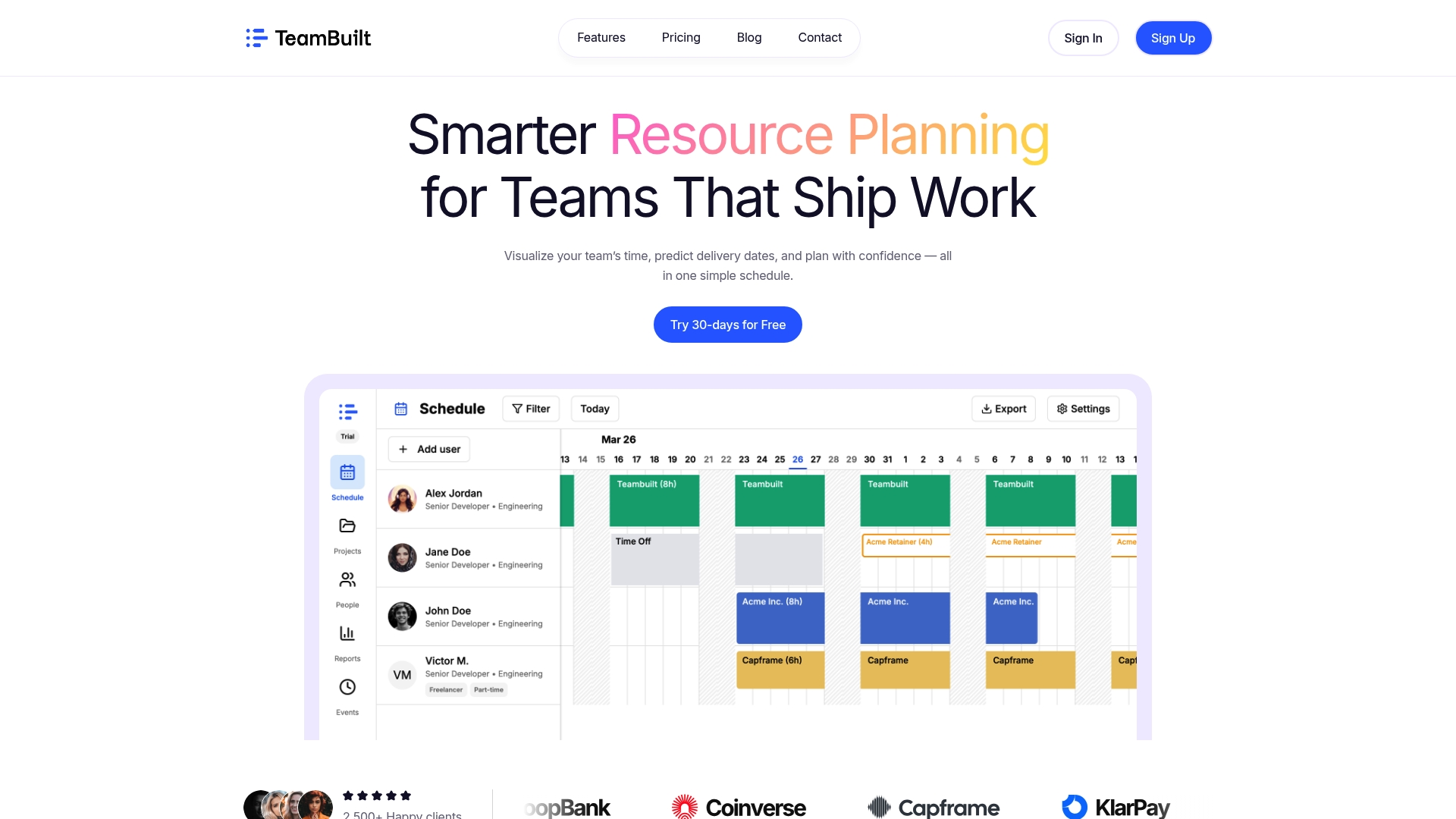
If you are evaluating team planning software that integrates with your existing stack and gives managers the oversight they need without the manual overhead, Teambuilt’s planning platform is worth a close look. The platform is designed for growing startups, SMBs, and agencies that need delivery predictability without adding operational complexity.
FAQ
What are the best tools for automating team scheduling?
Humanforce Smart Scheduling, Flor.work, and Supatimer each address different scheduling needs. Humanforce focuses on shift-based workforce scheduling, Flor.work handles agile sprint planning, and Supatimer automates availability collection inside Discord.
How much time can automation save in team planning?
Humanforce reduces roster management time by up to 70%, while Flor.work cuts sprint planning sessions by 60 to 75 minutes. Actual savings depend on team size, planning frequency, and how well the tools integrate with existing systems.
Why do most AI planning tools fail to deliver ROI?
Lucid Software’s research shows that 95% of GenAI pilots fail to produce organizational ROI because they are not integrated into real workflows. Automation that cannot read from and write to your systems of record produces accurate outputs that no one acts on.
Do automated planning tools replace project managers?
No. Tools like Humanforce are explicitly designed so managers review and approve AI-generated schedules before publishing. Automation handles constraint validation and draft generation; managers handle judgment calls and conflict resolution.
How do I start automating team planning without disrupting current workflows?
Begin with one high-friction recurring task, clean the underlying data first, and select a tool with native integrations to your existing stack. Measure time saved in the first 30 days before expanding automation to other workflows.
Recommended
- Workflow Automation Examples for Project Managers 2026 | Teambuilt Blog
- Collaborative Project Planning Tips for Team Leaders | Teambuilt Blog
- Top collaborative planning templates for better teamwork | Teambuilt Blog
- Top 6 tasklly.webflow.io Alternatives for Team Resource Planning 2026 | Teambuilt Blog