
Benefits of Real-Time Analytics for Business Leaders



TL;DR:
- Organizations face critical challenges in leveraging real-time analytics to make faster, smarter decisions that improve revenue, customer experience, and operational efficiency. Implementing predictable latency architectures and focusing on high-value use cases enable organizations to gain a competitive edge through timely insights and automated responses. Success depends on cultivating a trusting organizational culture that prioritizes immediate, reliable data access and focusing on key applications first.
Organizations drowning in data but starved for timely insight face a problem that batch processing simply cannot solve. The benefits of real-time analytics go far beyond speed. They reshape how businesses detect threats, allocate resources, serve customers, and outpace competitors. When decisions hinge on what happened three hours ago rather than what is happening right now, the cost of latency becomes visible in lost revenue, missed fraud, and poor customer experiences. This article breaks down the specific, measurable advantages that real-time analytics delivers across decision-making, operations, customer engagement, and technical architecture.
Table of Contents
- Key Takeaways
- 1. Improved decision making with real-time analytics
- 2. Enhanced operational efficiency through real-time monitoring
- 3. Increased customer engagement through personalization
- 4. Competitive advantages and business agility from real-time insights
- 5. Technical and architectural benefits of real-time platforms
- My take: the organizational side that technology cannot fix
- How Teambuilt puts real-time analytics into practice
- FAQ
Key Takeaways
| Point | Details |
|---|---|
| Faster, smarter decisions | Real-time data cuts reliance on stale reports and enables proactive responses to threats and opportunities. |
| Operational efficiency gains | Continuous monitoring and automated triggers reduce downtime and free teams from reactive firefighting. |
| Customer experience lift | Live behavioral data powers personalized interactions that directly improve satisfaction and retention. |
| Strategic competitive edge | Real-time businesses show over 50% higher revenue growth than slower competitors. |
| Architecture matters | Predictable latency, not just raw speed, determines whether real-time systems deliver consistent value. |
1. Improved decision making with real-time analytics
The most direct benefit is obvious but frequently underestimated: knowing what is happening right now rather than what happened yesterday. Traditional batch reporting creates a lag that forces leaders to act on outdated snapshots. Real-time analytics closes that gap, giving analysts and executives a live view of the metrics that drive outcomes.
Consider fraud detection. Advanced fraud detection systems process over 2.4 billion transactions monthly with decisions made in under 80 milliseconds, achieving 99.97% accuracy under peak loads. That level of precision is impossible with batch processing. By the time a nightly job flags a suspicious pattern, the damage is done.
Dynamic pricing is another case where real-time decision making pays off immediately. Airlines, ride-share platforms, and e-commerce retailers adjust prices based on live demand signals, inventory levels, and competitor activity. Waiting an hour for a report to refresh means leaving money on the table or pricing yourself out of a sale.
Key areas where real-time decision making outperforms delayed approaches:
- Fraud and risk management: Catch anomalies before transactions clear
- Dynamic pricing: Adjust offers based on live supply and demand
- Inventory management: Reorder before stockouts happen, not after
- Operational alerts: Respond to system failures before customers notice
Pro Tip: Set decision thresholds in your real-time system so automated actions trigger for routine responses, reserving human judgment for exceptions. This preserves analyst bandwidth for genuinely complex calls.
2. Enhanced operational efficiency through real-time monitoring
Operational efficiency is where real-time analytics delivers some of its most concrete and measurable returns. The core idea is simple: if you can see a problem forming, you can stop it before it escalates into downtime, a service failure, or a compliance breach.

Manufacturing facilities use sensor data streams to monitor equipment health continuously. When a temperature reading or vibration pattern deviates from normal ranges, automated alerts fire before a machine fails. The alternative, waiting for scheduled maintenance or a breakdown, is far more expensive. The same principle applies to IT infrastructure, where real-time operational monitoring through continuous data streams has demonstrably reduced downtime in financial services and manufacturing environments.
Automation is the multiplier here. Real-time data inputs trigger workflows without waiting for human review. An IT operations team can configure auto-scaling rules that spin up additional compute capacity the moment traffic spikes, rather than scrambling to respond after users report slowdowns.
Core operational efficiency gains from real-time monitoring:
- Predictive maintenance: Replace components before failure, not after
- Auto-scaling infrastructure: Match compute resources to live demand
- Supply chain visibility: Detect delays and reroute before they cascade
- Service-level compliance: Alert teams before SLA thresholds breach
For resource planning and scheduling, the same logic applies to people and project capacity. Knowing in real time which team members are over-allocated prevents burnout and missed deadlines before they become a crisis.
Pro Tip: Start monitoring the three or four metrics that most directly predict failures in your environment rather than instrumenting everything at once. Broad telemetry with no clear action attached creates noise, not efficiency.
3. Increased customer engagement through personalization
Customers tolerate generic experiences far less than they did five years ago. Real-time analytics is what separates a “we thought you might like” recommendation that converts from one that gets ignored.
The mechanism is straightforward. As a user browses, adds items to a cart, abandons a page, or interacts with support, live behavioral signals feed into recommendation engines and customer experience platforms. The response, a tailored offer, a proactive chat prompt, a personalized email, fires within seconds rather than being queued for the next batch campaign.
Empowering teams with real-time responsiveness produces measurable results. United Airlines, for instance, doubled customer satisfaction scores by giving frontline staff live data access to proactively address passenger needs rather than reacting after complaints surfaced.
High-impact personalization use cases powered by live data:
- E-commerce recommendations: Adapt product suggestions to current session behavior
- Customer support routing: Match inquiries to agents based on live queue and skill data
- Real-time sentiment analysis: Detect brand reputation shifts on social channels and respond before issues amplify
- Marketing offer timing: Trigger promotions at the exact moment a customer shows purchase intent
The retention impact compounds over time. Customers who receive relevant, timely interactions return more often and spend more per visit. The analytics investment that enables this pays dividends across the customer lifecycle.
4. Competitive advantages and business agility from real-time insights
Speed is not just a technical property. It is a strategic one. Organizations that act on live data consistently outmaneuver slower rivals because they see shifts in market conditions, customer behavior, and operational risk before those shifts become obvious to everyone.
The numbers are striking. Real-time businesses demonstrate over 50% higher revenue growth and net margins compared to competitors who rely on batch or delayed data. That gap compounds year over year as faster organizations build institutional muscle for rapid adaptation.
The table below illustrates how real-time and batch analytics approaches compare across key business dimensions:
| Business dimension | Batch analytics | Real-time analytics |
|---|---|---|
| Fraud detection speed | Hours to days | Under 80 milliseconds |
| Pricing adjustments | Daily or weekly | Continuous |
| Customer personalization | Segment-based campaigns | Individual, session-level |
| Operational incident response | Post-failure review | Pre-failure alerting |
| Market opportunity capture | Next planning cycle | Immediate |
Risk management also improves materially. When external disruptions, such as a supply chain bottleneck or a sudden regulatory change, appear in live data, organizations using real-time analytics can recalibrate weeks ahead of competitors still waiting for their monthly reports.
Mature analytics programs that tie real-time initiatives to strategic KPIs achieve 2 to 5 times ROI through a combination of revenue growth, cost savings, and risk reduction. Some organizations measure analytics returns between 300% and 1000%, though fewer than 30% can quantify that value accurately. The gap between knowing real-time analytics is valuable and measuring how valuable is itself a competitive problem worth solving.
5. Technical and architectural benefits of real-time platforms
The business benefits of real-time analytics rest on a specific set of architectural decisions. Understanding them helps IT professionals make smarter platform choices and helps business leaders ask better questions of their engineering teams.
Three principles stand out:
-
Predictable latency beats raw speed. A system that responds in 2 milliseconds 95% of the time but spikes to 500 milliseconds for the remaining 5% causes more user experience damage than a system that consistently delivers 10 millisecond responses. Specialized data stores reduce P99 latency by over 90%, with one documented case improving tail latency from 13.3 milliseconds to 1.3 milliseconds. Consistency is the target.
-
Hybrid streaming and batch architectures balance cost and capability. Not every computation needs to happen in real time. Effective real-time systems combine streaming SQL for instant rule checks with batch machine learning models for deeper behavioral analysis. This hybrid approach controls infrastructure costs while preserving the speed advantages where they matter most.
-
SQL-based stream processing lowers the skill barrier. Teams familiar with standard SQL can write and maintain streaming queries without learning new programming paradigms. Streaming SQL enables rule updates without full deployment cycles, meaning fraud detection rules or alerting thresholds can be adjusted in hours rather than weeks.
The following table shows how architectural choices affect real-time system performance:
| Architecture choice | Impact on latency | Impact on cost | Best suited for |
|---|---|---|---|
| Specialized real-time data stores | Very low P99 latency | Higher infrastructure cost | Fraud, pricing, UX |
| Hybrid streaming plus batch | Moderate latency | Balanced | Most enterprise use cases |
| Batch-only processing | High latency | Lower | Historical reporting |
| SQL-based stream processing | Low, predictable | Moderate | Operational monitoring |
Pro Tip: Before committing to a fully real-time architecture, audit each use case for whether instantaneous data actually changes the outcome. Not every scenario warrants real-time processing. Over-engineering adds cost and complexity without proportional benefit.
My take: the organizational side that technology cannot fix
I’ve worked with enough data teams to know that the biggest failures in real-time analytics have almost nothing to do with technology. The pipeline is solid. The dashboards are live. And the organization still makes decisions based on gut feel and last quarter’s spreadsheet.
What distinguishes successful implementations is not the sophistication of the stack. It is whether frontline teams actually trust and use the data they are given. The defining feature of a truly real-time business is employee empowerment through immediate, trusted data access inside clear governance guardrails. That is a culture problem as much as a technical one.
In my experience, the organizations that get the most from real-time analytics start narrow and go deep. They pick one high-value use case, instrument it well, prove the return, and build from there. The teams that try to make everything real-time simultaneously usually end up with expensive infrastructure that nobody fully trusts.
I also think the industry undersells the importance of aligning real-time analytics with project delivery and forecasting. Knowing your team’s live capacity and current utilization changes how you commit to deadlines and allocate work. That kind of operational intelligence compounds quickly when it is embedded in how teams actually plan.
— Dima
How Teambuilt puts real-time analytics into practice
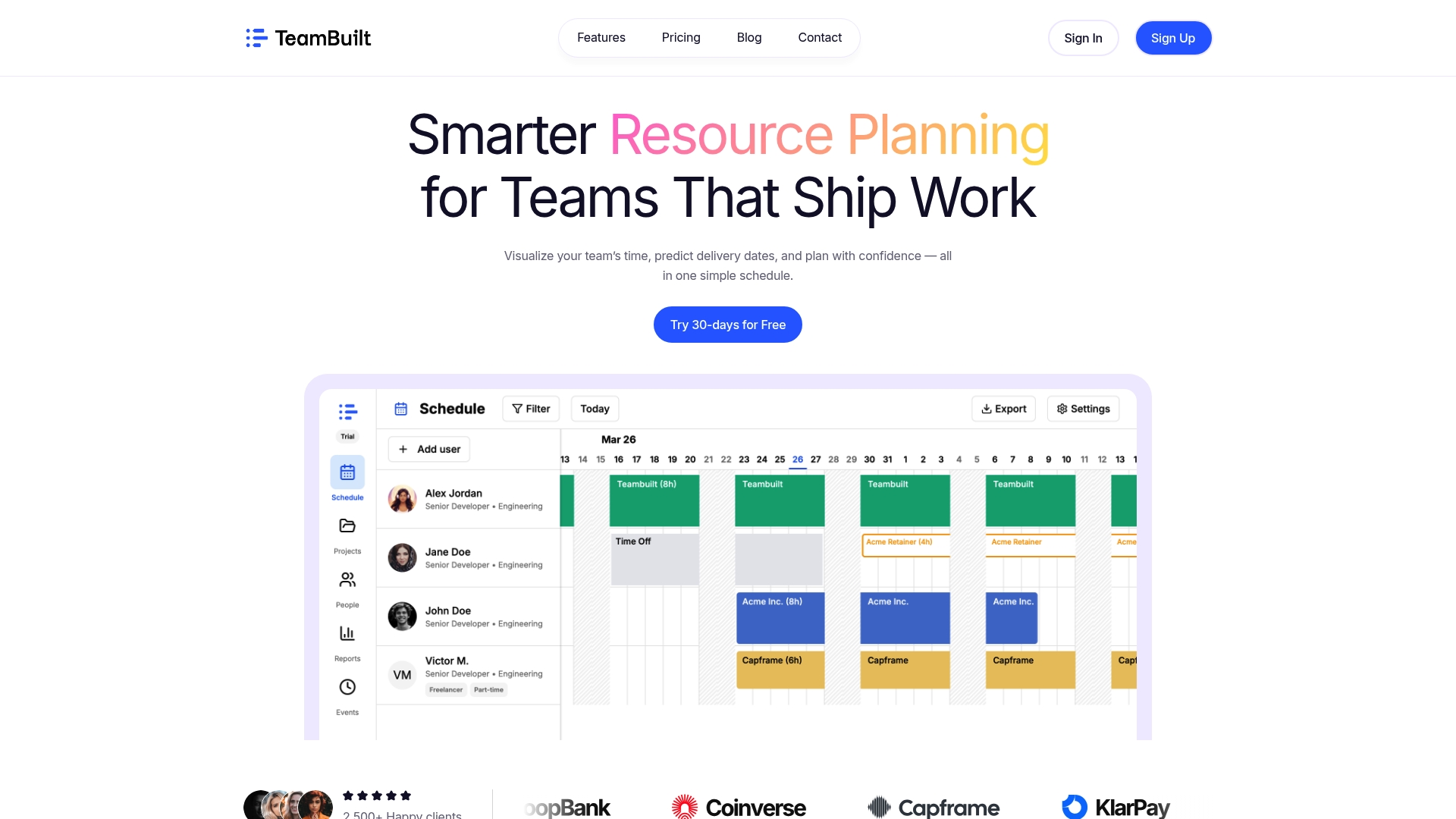
Understanding the benefits of real-time analytics is one thing. Embedding them into daily team workflows is another challenge entirely. Teambuilt was built specifically for organizations that need live visibility into capacity, workload, and project timelines without building a custom data infrastructure from scratch.
The platform gives project managers, operations leads, and CTOs a single place to see who is available, what is overloaded, and when projects are likely to deliver. Workload visualization updates continuously so allocation decisions are based on current reality, not a snapshot from Monday morning. You can explore the full set of platform capabilities here or read how real-time team coordination drives measurable growth for SMBs. If your team still relies on spreadsheets for resource planning, that is the first real-time gap worth closing.
FAQ
What are the main benefits of real-time analytics?
Real-time analytics improves decision-making speed, reduces operational downtime, enables customer personalization, and strengthens competitive positioning. Organizations with real-time capabilities show over 50% higher revenue growth compared to slower competitors.
How does real-time analytics improve decision making?
It replaces outdated batch reports with live data feeds, allowing teams to act on what is happening now rather than what happened hours ago. Fraud detection systems using real-time data make decisions in under 80 milliseconds with near-perfect accuracy.
Is real-time analytics always better than batch processing?
No. Real-time processing adds cost and complexity that only pays off when instantaneous data actually changes the outcome. Use cases like fraud prevention, dynamic pricing, and operational monitoring justify real-time investment. Historical reporting and trend analysis often do not.
What technical factors determine real-time analytics success?
Predictable latency matters more than raw speed. Hybrid architectures combining streaming SQL with batch machine learning models balance performance and cost. Specialized data stores have demonstrated P99 latency reductions of over 90% in production environments.
How can smaller organizations start using real-time analytics?
Start with one high-impact use case where delayed data has a visible cost, such as resource over-allocation or customer churn signals. Platforms like Teambuilt provide real-time operational visibility without requiring custom infrastructure, making the entry point practical for SMBs and growing agencies.
Recommended