
Dev Team Headcount Optimization: a 2026 Guide



TL;DR:
- Optimizing dev team size balances coordination costs, onboarding impact, and AI leverage to improve productivity.
- Effective planning involves proactive hiring, team splitting before costs spike, and regular headcount reviews to prevent dysfunction.
Dev team headcount optimization is the practice of aligning your development team’s size and skill composition precisely to project demands, while keeping coordination costs and onboarding disruptions to a minimum. Most engineering leaders treat headcount as a budget line. The teams that consistently ship on time treat it as a living operational variable. With AI tools like GitHub Copilot reshaping how much a single developer can produce, the old formula of “more engineers equals more output” no longer holds. Understanding what drives optimal team size is now a core competency for every CTO, team lead, and project manager.
What is dev team headcount optimization, and why does it matter?
Dev team headcount optimization is the discipline of finding the team size where added capacity produces more value than the coordination cost it introduces. This is not simply about cutting headcount or hiring aggressively. It is about matching the right number of people, with the right skills, to the work at hand.
The economic logic is straightforward. Optimal team size is the point where marginal production equals marginal coordination cost. Beyond that point, every new hire slows the team down more than they speed it up. That principle has been true since Fred Brooks published The Mythical Man-Month in 1975, and it remains the foundation of every modern headcount model.
What has changed is the scale of AI’s influence on where that optimal point sits. Tools like GitHub Copilot compress the repetitive work that once required additional junior developers. That compression shifts the math, often dramatically, in favor of smaller, more capable teams.
What factors influence the optimal size of a development team?
Three variables drive efficient development team size: coordination overhead, onboarding impact, and AI productivity leverage. Each one deserves a precise understanding before you make any staffing decision.

Coordination overhead grows faster than team size
Communication channels in a team do not grow linearly. They grow quadratically. A team of five has ten communication paths. A team of ten has forty-five. That explosion in coordination cost is why teams larger than 8–10 people should be split into smaller autonomous sub-teams with clear ownership and interface contracts. The coordination tax on a single large team is almost always higher than the cost of running two smaller ones.

Onboarding creates a temporary productivity dip
Adding a developer to a team does not immediately increase output. New hires cause a productivity dip of 2–4 weeks, affecting not just the new person but the entire team that must support their ramp-up. In a five-person team, that disruption is felt by everyone. Staggered hiring, onboarding buddies, and documented processes reduce the drag, but they do not eliminate it.
Pro Tip: Never add more than one new developer per sprint cycle in a team of five or fewer. The onboarding load compounds faster than most managers expect.
AI leverage changes the math on headcount
If over 25% of engineering time is spent on administrative coding tasks like boilerplate and testing scaffolding, the right answer is AI tooling, not more headcount. Senior engineers should spend less than 20% of their time on those tasks. When that threshold is breached, adding developers without first deploying AI tools is a waste of budget. The productivity gain from a well-configured AI coding assistant often exceeds the gain from a new mid-level hire, without the onboarding cost.
How does AI reshape traditional headcount models?
AI-assisted software engineering does not simply reduce the number of developers a team needs. It restructures which roles matter most and creates new governance demands that many organizations fail to anticipate.
Organizations adopting AI-assisted engineering need 20–30% fewer developers by 2027 to maintain the same output levels. That is a significant shift in workforce planning. But the common misreading of that statistic is dangerous: leaders assume they can cut junior headcount and pocket the savings. The reality is more complex.
“Headcount modeling without factoring AI leverage risks over or understaffing due to non-linear output changes and governance overhead.” — SoftwareSeni Engineering Research
AI tools generate more code, faster. But PR review times increased by 91% with AI-generated code, placing a disproportionate burden on senior engineers. That means the headcount savings from AI must be partially reinvested into senior engineering capacity and dedicated AI governance roles.
The practical implications for team structure are clear:
- Reduce junior developer hiring for repetitive implementation tasks
- Increase investment in senior engineers who can review AI-generated code at speed
- Create dedicated AI platform or tooling roles to manage workflow governance
- Treat AI productivity gains as a reason to take on more ambitious project scope, not just to cut costs
The teams that win with AI are not the ones that cut the most people. They are the ones that redeploy capacity toward higher-value work.
What are the best practices for scaling dev teams effectively?
Scaling a development team without a deliberate plan produces one of two outcomes: a bloated team drowning in coordination overhead, or a chronically understaffed team missing deadlines. Both are avoidable.
Apply Brooks’s Law before you hire
Adding developers to a late project makes it later. That is Brooks’s Law, and it applies just as strongly in 2026 as it did in 1975. The coordination and onboarding overhead from a new hire consumes more capacity than the hire contributes in the short term. The fix is proactive hiring, not reactive hiring. Plan headcount increases at least one quarter ahead of the sprint cycle where you need the capacity.
Split large teams before coordination costs spike
| Team size | Communication paths | Recommended action |
|---|---|---|
| 3–5 people | 3–10 paths | Single team, light coordination |
| 6–8 people | 15–28 paths | Add a tech lead, formalize processes |
| 9–12 people | 36–66 paths | Split into two autonomous sub-teams |
| 13+ people | 78+ paths | Mandatory sub-team structure with API contracts |
Small autonomous teams with clear ownership and defined interfaces enable scaling without exponential coordination tax. Each sub-team should own a specific domain, have a dedicated tech lead, and communicate with other teams through documented contracts rather than ad-hoc meetings.
Pro Tip: Treat your team structure diagram the same way you treat your system architecture diagram. Both need to be updated every time the team or the product changes significantly.
Build attrition into your headcount model
Engineering headcount models must factor in an annual attrition buffer of 15–20% to maintain sustainable staffing. Most organizations plan headcount based on project demand alone and then scramble when engineers leave. Attrition is predictable at the portfolio level even when individual departures are not. Build the buffer in, and you avoid the reactive hiring that triggers Brooks’s Law.
How to apply headcount optimization in project-based work
Project managers and operations leads in professional services face a specific version of the headcount challenge: team size must flex with project scope, often across multiple concurrent engagements. The principles of dev team size optimization apply, but the execution requires additional tools.
Workflow automation is the first place to look before adding headcount. Reducing repetitive engineering tasks through automation directly improves team utilization without increasing payroll. Tasks like environment setup, deployment pipelines, and test execution are prime candidates. When those tasks are automated, the same team can handle a larger project load.
Capacity planning is the second discipline. Optimizing team capacity means knowing, in real time, which engineers are available, which are at risk of overload, and where the next bottleneck will appear. Spreadsheets fail at this task the moment a team crosses five or six people. Purpose-built capacity planning tools give project managers the visibility they need to make staffing decisions before a deadline is at risk.
Treating team sizing as a living strategic document, with monthly or quarterly reviews, prevents the reactive, costly hiring cycles that damage both budgets and team morale. The review cadence should align with your project pipeline review so that headcount decisions are always tied to real delivery commitments.
Finally, plan for natural attrition explicitly. Professional services firms with sustainable staffing models account for developer turnover in their annual capacity plans. A team that looks fully staffed on paper but carries no attrition buffer is one resignation away from a delivery crisis.
Key takeaways
Dev team headcount optimization requires balancing coordination costs, onboarding impact, AI leverage, and attrition planning as a continuous operational discipline, not a one-time hiring decision.
| Point | Details |
|---|---|
| Optimal size has a ceiling | Adding developers beyond the coordination cost threshold reduces overall team output. |
| AI changes the math | AI tools can replace 20–30% of developer capacity, but require senior engineers to manage review overhead. |
| Onboarding has a real cost | Every new hire causes a 2–4 week productivity dip across the whole team. |
| Split before you scale | Teams larger than 8–10 people should be divided into autonomous sub-teams with clear ownership. |
| Plan for attrition | Build a 15–20% annual attrition buffer into every headcount model to avoid structural understaffing. |
Why most leaders still get team size wrong
I have watched engineering organizations make the same mistake repeatedly: they treat headcount as a lever to pull when a project is already in trouble. A deadline slips, so they hire. A feature is late, so they add a contractor. Every time, the short-term fix creates a longer-term coordination problem that costs more than the original delay.
The uncomfortable truth is that most teams are not understaffed. They are poorly structured. The work that should be automated is being done manually. The senior engineers who should be reviewing architecture are buried in boilerplate. The junior developers who could be productive are waiting on unclear requirements. Adding more people to that system does not fix it. It amplifies the dysfunction.
AI tools have made this clearer than ever. A team that deploys GitHub Copilot and invests in proper code review governance can outperform a team twice its size that has not. The productivity multiplier is real, but it only works if the team structure supports it. That means fewer, more senior engineers, clear ownership boundaries, and a headcount model that gets reviewed on a schedule, not just when something breaks.
The leaders who will build the best engineering organizations over the next three years are the ones who treat team sizing as a strategic discipline today. They will hire proactively, automate before they staff up, and split teams before coordination costs become visible in missed deadlines.
— Dima
How Teambuilt supports smarter team planning
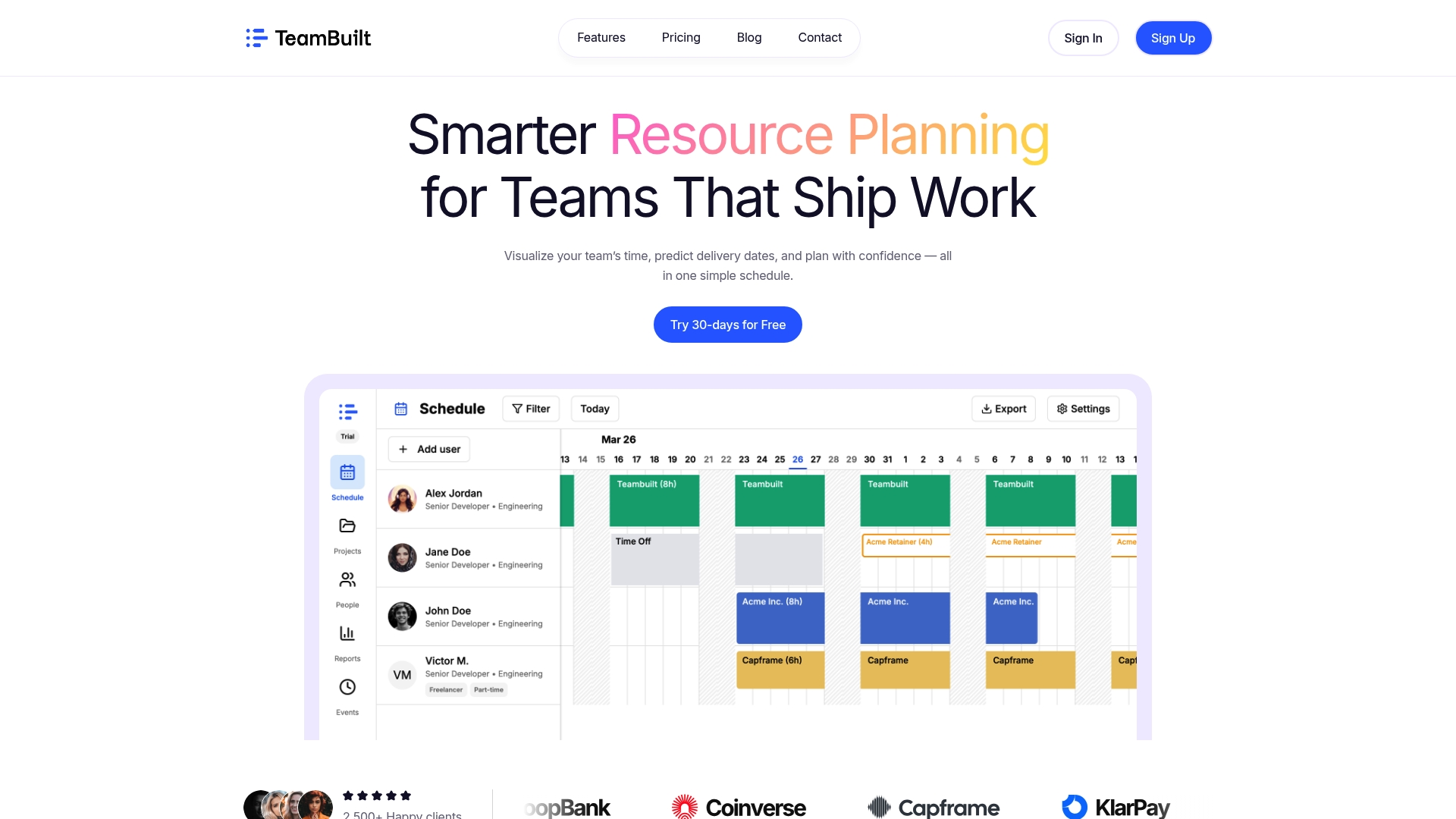
Teambuilt is built for exactly the kind of team management that headcount optimization requires. The platform gives project managers and CTOs real-time visibility into team capacity, workload distribution, and delivery forecasts, all in one place. When you need to decide whether to hire, automate, or restructure a team, Teambuilt surfaces the data that makes that decision clear rather than guesswork-driven. Teams using Teambuilt replace scattered spreadsheets with a centralized planning system that tracks utilization, flags overload risks, and supports cross-team coordination at scale. If your organization is growing and your current planning process is not keeping up, explore Teambuilt to see how it fits your workflow.
FAQ
What is dev team headcount optimization?
Dev team headcount optimization is the practice of sizing and structuring a development team so that added capacity produces more value than the coordination cost it introduces. It involves balancing team size, skill mix, onboarding timing, and AI tooling to maximize project delivery efficiency.
How does AI affect the optimal size of a dev team?
AI-assisted tools like GitHub Copilot can increase individual developer output significantly, meaning teams need fewer developers to maintain the same throughput. However, AI-generated code increases code review complexity, so the savings must be partially reinvested in senior engineering and governance roles.
What is Brooks’s Law and why does it matter for team scaling?
Brooks’s Law states that adding developers to a late project makes it later, because onboarding and coordination overhead consume more capacity than the new hire contributes in the short term. It is the primary reason proactive, planned hiring outperforms reactive staffing every time.
How large should a development team be before splitting it?
Teams larger than 8–10 people should be divided into smaller autonomous sub-teams with clear domain ownership and documented interface contracts. Beyond that size, the number of communication paths grows exponentially and coordination costs begin to outweigh the benefits of team size.
How often should engineering headcount be reviewed?
Headcount models should be reviewed monthly or quarterly, aligned with the project pipeline review cycle. Treating team size as a fixed annual decision leads to reactive hiring, attrition-driven capacity gaps, and budget overruns that could have been avoided with regular planning.
Recommended