
How to improve project delivery predictability



TL;DR:
- Most project managers accept missed deadlines as inevitable, blaming requirements or client issues. However, only half of projects succeed by delivering value, showing the importance of process, planning, and team accountability. Implementing structured frameworks like scope clarity, realistic scheduling, resource discipline, and active monitoring significantly increases project predictability and success.
Most project managers assume that missed deadlines are just part of the job. They blame shifting requirements, surprise bugs, or a difficult client. The uncomfortable reality? Only 50% of projects succeed by delivering value over effort, and high-performing teams are 2.5 times more likely to deliver on time. That gap is not luck. It is process, planning discipline, and an honest look at how your team actually works. This guide breaks down what project delivery predictability really means, exposes the most common traps, and gives you actionable steps to close the gap between estimated and actual delivery.
Table of Contents
- What project delivery predictability actually means
- The frameworks and tools behind predictability
- Resource planning and coordination: Where most teams go wrong
- Steps to improve project delivery predictability
- Why most advice on project delivery predictability misses the mark
- Build predictability with the right tools and support
- Frequently asked questions
Key Takeaways
| Point | Details |
|---|---|
| Predictability is not luck | Reliable project delivery results from tested frameworks, not hope or randomness. |
| Right tools enable clarity | Tools like EVM and real capacity-based planning make deviation visible before it’s too late. |
| Buffer and communication matter | Maintaining 70–80% utilization and regular team touchpoints prevents overruns and surprises. |
| Application trumps theory | Tailoring frameworks to your team’s habits drives results, not just adding more process. |
What project delivery predictability actually means
Predictability is not about being psychic. It is the ability to make a commitment and keep it, with minimal surprises along the way. That means finishing projects close to the date you promised, within the scope you agreed on, and without the last-minute heroics that leave your team exhausted and your client skeptical.
The confusion starts because many teams treat unpredictability as unavoidable. “Every project is different,” they say. True, but that is not a reason to abandon structure. The leading causes of unpredictability are actually well-documented: lack of scope clarity (teams start work before everyone agrees on what “done” looks like), resource conflicts (two high-priority tasks compete for the same person at the same time), and over-optimism (estimates are built on best-case assumptions instead of real capacity data).
These are all controllable factors. Project delivery predictability comes from structured frameworks integrating scope clarity via Work Breakdown Structure (WBS), realistic scheduling with three-point estimation and buffers, resource capacity-based allocation, structured communication, and performance monitoring using Earned Value Management (EVM). That is a mouthful, but it essentially boils down to three pillars:
The three pillars of delivery predictability:
- Scope clarity: Everyone agrees on what is being built, including what is out of scope.
- Resource discipline: Work is assigned based on actual availability, not theoretical capacity.
- Active control: You track progress against a baseline and act early when things drift.
Without all three, even the most organized team will hit walls. A sharp scope definition cannot compensate for a team at 110% utilization. Excellent resource planning falls apart if no one monitors whether work is progressing as expected. Each pillar depends on the others.
The frameworks and tools behind predictability
Unpredictability is not random, so the solution is not guessing better. It is applying structured methods that turn uncertainty into something you can measure and manage. Let’s walk through the most important ones.
Work Breakdown Structure (WBS) is the foundation. You take the full project scope and break it into smaller, concrete deliverables. Each deliverable has a clear owner, a clear definition of done, and a realistic estimate. This prevents the single biggest scope risk: teams building the wrong thing because the goal was never specific enough.
Three-point estimation is where most SMBs leave significant accuracy on the table. Instead of giving one estimate, you define three: the optimistic scenario (if everything goes well), the pessimistic scenario (if significant problems occur), and the most likely scenario. The weighted average of these three gives you a far more honest timeline than “we’ll finish in two weeks.”
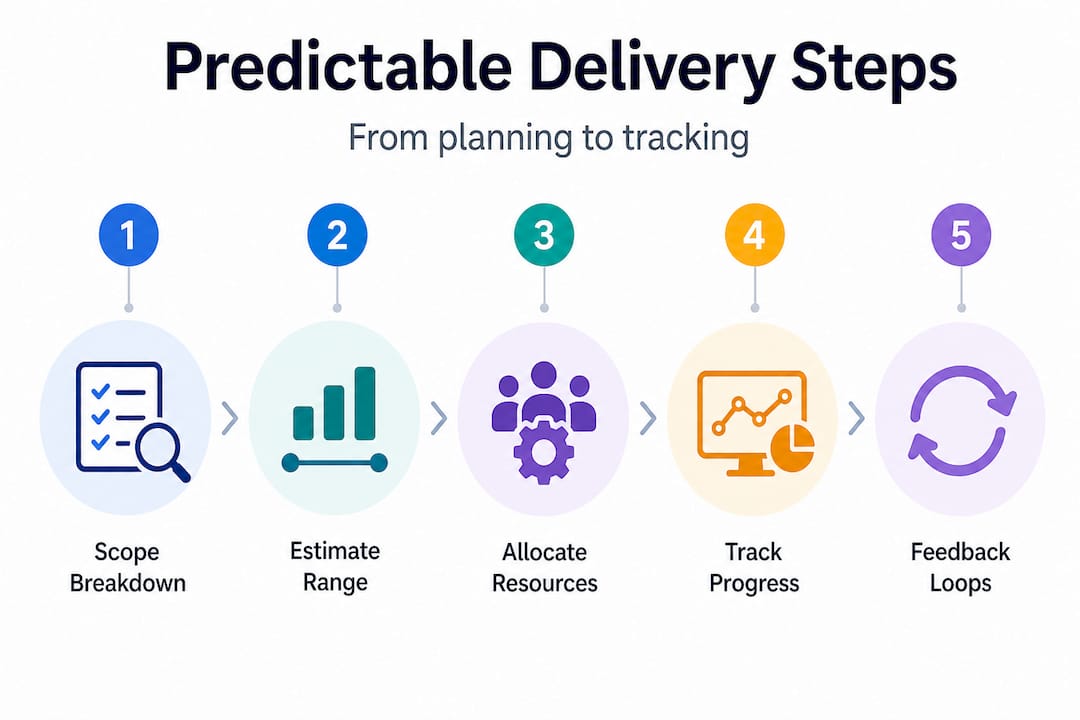
Resource allocation based on real capacity means you look at who is actually available, accounting for existing commitments, time off, and coordination overhead. Capacity planning for agile teams is a discipline in itself, and it directly determines whether your schedule is realistic or just optimistic fiction.
Earned Value Management (EVM) is the tracking engine. It integrates scope, schedule, and cost using three key metrics: Planned Value (PV, what you planned to complete by now), Earned Value (EV, what you actually completed), and Actual Cost (AC, what you spent). From these, you calculate variances and performance indices that tell you, early, whether the project is on track. A Schedule Performance Index (SPI) below 1.0 means you are behind. A Cost Performance Index (CPI) below 1.0 means you are over budget. Both are early warnings, not post-mortem findings.
Pro Tip: You do not need a sophisticated tool to start using EVM. A simple spreadsheet tracking planned versus actual completion percentage each week will reveal drift far earlier than waiting for a milestone miss.
Here is how the core frameworks compare across key dimensions:
| Framework | Primary benefit | Best used when | Complexity |
|---|---|---|---|
| WBS | Scope clarity and task ownership | Kicking off any new project | Low |
| Three-point estimation | Realistic timeline buffers | Estimating duration for uncertain tasks | Low to medium |
| Resource capacity planning | Prevents overcommitment | Assigning work across multiple people | Medium |
| Earned Value Management | Early deviation detection | Active project monitoring | Medium to high |
Finally, hybrid delivery models have grown 57% and show similar success rates when well supported. For SMBs, this often means combining a fixed-scope waterfall phase for clear deliverables with short agile sprints for evolving requirements. You get the predictability of a plan and the flexibility to adapt without blowing up your timeline.
Understanding the vocabulary behind these methods matters too. A solid grasp of essential project management terms reduces the friction of onboarding new team members and ensures everyone uses the same language when discussing project status. For a deeper look at what leading SMBs actually do, delivery best practices for SMB teams covers real operational patterns that work at scale.
Resource planning and coordination: Where most teams go wrong
Frameworks are only as good as the inputs you put into them. And the most consistently bad inputs in project planning come from resource planning and team coordination failures. This is where predictability most often falls apart, even for teams that think they have their act together.

The data is sobering. Resource limitations ignored in predictions cause overruns. Planning fallacy (the very human tendency to overestimate productivity and underestimate obstacles) drives optimistic estimates that rarely survive contact with reality. Coordination overhead consumes 20 to 30% of a team’s working time. And resource utilization above 80% reliably triggers delays.
Let’s make that concrete. If your team has five developers, each working eight hours per day, your theoretical daily capacity is 40 hours. But subtract 25% for coordination overhead (meetings, Slack, context-switching), and you are at 30 hours of actual output. Assign 38 hours of work, and you will miss your commitments every single week.
Here is a snapshot of the most common resource planning failure patterns:
| Failure pattern | What it looks like | Impact on delivery |
|---|---|---|
| Over-allocation | Person assigned 100%+ across two projects | Bottlenecks, burnout, cascading delays |
| Ignored dependencies | Task B starts before Task A is done | Rework, wasted effort, scope confusion |
| No buffer time | Schedule has zero slack | Single delay throws off entire project |
| Siloed teams | Marketing doesn’t know engineering is blocked | Missed handoffs, timeline surprises |
| No coordination rhythm | Teams sync only at milestones | Problems discovered too late |
The practical fix for over-allocation is a hard rule: cap utilization at 70 to 80% per person. That remaining 20 to 30% absorbs the unexpected. It covers the urgent bug, the client call that runs long, the day someone is sick. Optimizing team capacity is not about squeezing more out of people. It is about giving your plan room to breathe.
On coordination, the research finding that 20 to 30% of time goes to coordination overhead sounds alarming. But the solution is not less communication. It is structured communication. Weekly alignment meetings (30 minutes, standing agenda) beat ad-hoc pings and long email threads. They surface blockers before they become crises, keep dependencies visible, and reduce the cognitive overhead of “I wonder what the other team is doing.”
Pro Tip: Before assigning any task in your next project, run a quick availability check. Look at the person’s current commitments for the same two-week window. If they are already above 70%, either reassign the task or adjust your timeline. Five minutes of planning now saves a week of delay later.
Steps to improve project delivery predictability
You now have the frameworks and the failure patterns. Here is the practical sequence to make your next project more predictable. This is not theory. It is a repeatable workflow that fits the reality of a growing startup or SMB.
-
Break down your scope before estimating anything. Use a WBS to map every deliverable, sub-task, and dependency. Do not let anyone start estimating until the scope is locked. This single step removes a huge portion of later rework.
-
Build your estimates using the three-point method. For each task, get optimistic, pessimistic, and most-likely estimates from the people doing the work. Not the manager. The person who will actually do it. Aggregate these into a project timeline with visible buffers built in.
-
Check real resource availability before committing to dates. Map every team member’s current load for the project period. Confirm nobody exceeds the 70 to 80% utilization threshold. If the math doesn’t work, adjust the timeline or the scope, not the person’s workload.
-
Map your dependencies explicitly. Know which tasks cannot start until another is done. A simple dependency graph (even in a spreadsheet) prevents the chaos of discovering mid-sprint that a critical input is missing.
-
Set up a weekly coordination rhythm. A short weekly standup specifically for cross-team dependencies (not just task updates) keeps the lines of communication open and keeps blockers from sitting hidden for days.
-
Track EVM metrics every week. Calculate your SPI and CPI at the end of each week. If either drops below 0.9, investigate immediately. The benefits of capacity tracking extend beyond scheduling: regular tracking builds the data you need to improve future estimates.
-
Run a short retrospective after every delivery. What did the estimates miss? Where did coordination break down? Feed those insights back into your next project’s planning phase. Predictability improves with each cycle.
Pro Tip: Prioritize capacity-based resource planning and use EVM alongside your Last Planner System (LPS) metrics to counter the most common pitfalls: optimism bias and team silos. The combination of forward-looking capacity data and backward-looking variance tracking gives you the full picture.
Why most advice on project delivery predictability misses the mark
Most guides on this topic, including some very well-intentioned ones, treat predictability as a tooling problem. Get the right framework, use the right software, follow the checklist, and your projects will deliver on time. If only it were that simple.
Here is the harder truth. Off-the-shelf frameworks fail without custom-fit communication and feedback loops. A WBS and EVM do not prevent misaligned expectations if the product manager and the engineering lead are not having honest conversations about what is actually feasible. No methodology fixes a culture where engineers are afraid to flag that a task is taking longer than estimated, because surfacing bad news is punished rather than rewarded.
For startups and SMBs specifically, the investment that pays off fastest is not a new tool. It is alignment. That means leadership being explicit about priorities when two projects compete for the same person. It means celebrating the team member who raises a risk in week one rather than hiding it until week five. It means designing scalable agency workflows that make realistic planning the default, not the exception.
The contrarian advice we hold to: actively encourage skepticism about best-case plans. When someone presents a timeline with zero buffer, ask them: “What would need to go wrong for this to be two weeks late?” Not to be negative, but to build in the resilience that transforms a fragile plan into a robust one. Predictability is not about being optimistic. It is about being honest, early, and often.
Build predictability with the right tools and support
Process discipline gets you far, but there is a ceiling to what spreadsheets and manual tracking can achieve.
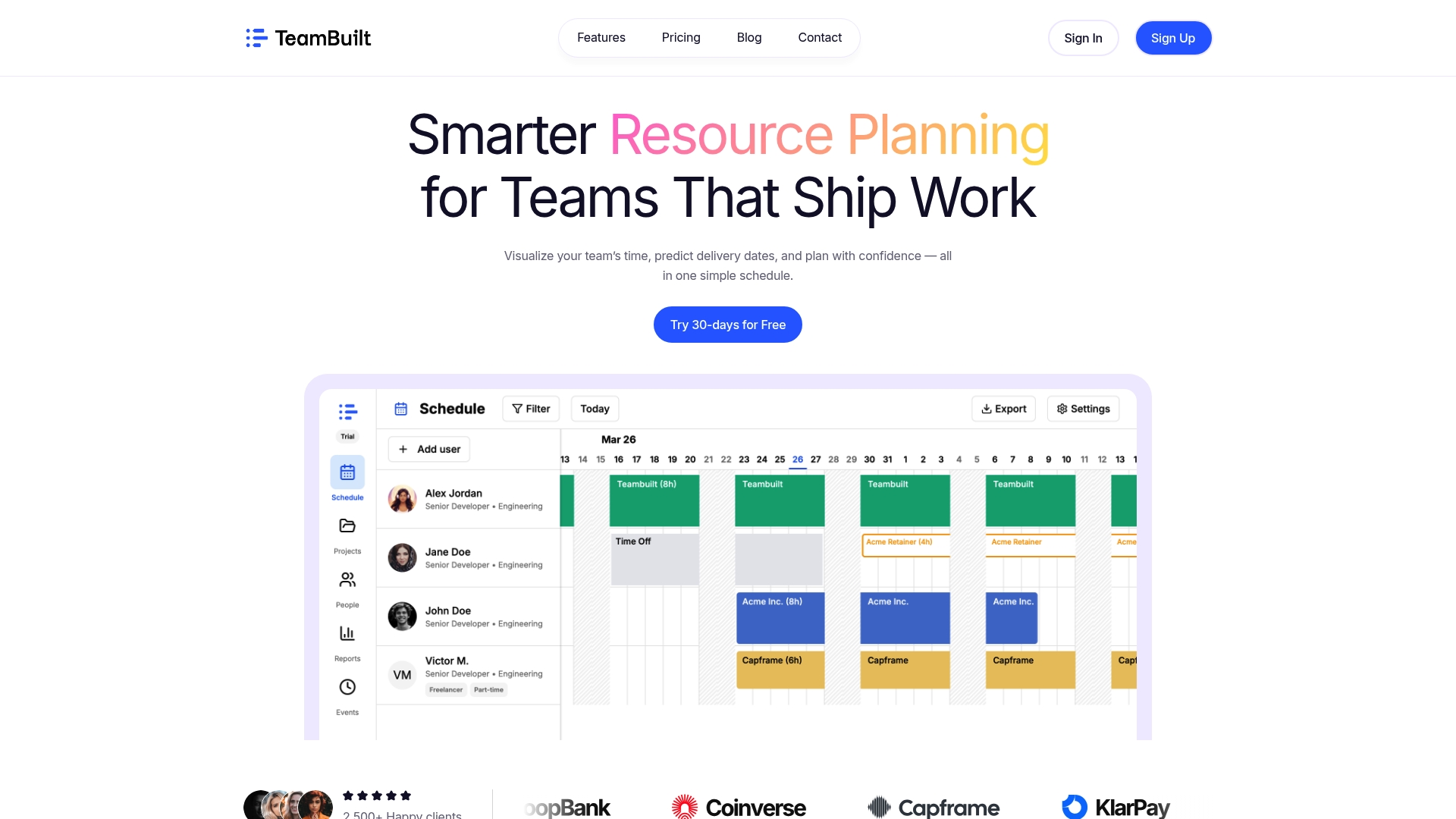
When your team is managing multiple projects across multiple teams, the coordination overhead grows fast. That is where dedicated tooling earns its keep. TeamBuilt is built specifically for this reality. The platform gives you real-time visibility into team capacity, workload visualization, and delivery forecasting based on resource availability so you can see bottlenecks before they become missed deadlines. If you want to move from reactive firefighting to genuinely predictable delivery, explore the full set of TeamBuilt platform features designed for growing SMBs and startups. You get the structure of enterprise-grade resource planning without the complexity that slows small teams down.
Frequently asked questions
What is project delivery predictability in simple terms?
It is the ability to reliably finish projects on time and within scope, with minimal surprises. Structured frameworks including WBS, realistic scheduling, and capacity-based resource allocation are the core ingredients.
How does Earned Value Management (EVM) help with predictability?
EVM integrates scope, schedule, and cost using Planned Value, Earned Value, and Actual Cost to give you early warning signals like SPI and CPI before a small deviation becomes a major overrun.
What is the recommended resource utilization rate for predictability?
Aim for 70 to 80% utilization per person. That buffer absorbs the unexpected without destroying your timeline.
Why do hybrid delivery models matter?
Hybrid models have grown 57% because they let teams lock in scope where it is clear and adapt where it is not, combining the predictability of structured planning with the flexibility to handle real-world uncertainty.
Which routines boost team coordination for predictability?
Weekly alignment meetings and regular EVM and LPS metric reviews keep dependencies visible, surface blockers early, and prevent the team silos that quietly destroy timelines.
Recommended