
Hybrid Team Coordination: A 2026 Leader's Guide



TL;DR:
- Hybrid team coordination involves intentionally aligning work and communication across remote and on-site members. Leaders must use structured tools and systems to replace informal, proximity-based cues, ensuring effective collaboration and cultural cohesion.
Hybrid team coordination is the deliberate process of aligning work, communication, and collaboration across team members who split time between remote and on-site locations. Unlike fully remote or fully in-person models, hybrid teams operate in a middle ground where shared goals, digital tools, and agreed norms must actively replace the informal alignment that physical proximity once provided. The challenge is not technology. The challenge is intentionality. Leaders who treat hybrid coordination as a passive arrangement consistently see communication gaps, uneven workloads, and fractured team culture. Those who build explicit systems get the opposite.
What is hybrid team coordination and why does it require structure?
Hybrid team coordination is the practice of managing collaboration, communication, and work delivery across a team that includes both remote and on-site members. The Scrum Alliance defines a hybrid team as a group that bridges geographic gaps through shared backlogs, digital tools, and accountability norms. That definition points to something critical: coordination does not happen automatically in hybrid settings. It must be designed.

The shift from a traditional office model to a hybrid one breaks a hidden coordination mechanism: proximity. When everyone shares a floor, managers absorb information by walking around, overhearing conversations, and reading body language. Hybrid work removes that channel entirely for remote members. Leaders must replace it with structured clarity tools, or coordination collapses into guesswork.
The standard industry term for this practice is distributed team management, though hybrid team coordination has become the dominant phrase in 2026 operational frameworks. Both terms describe the same core challenge: keeping people aligned when they are not in the same room. Treating this as a temporary adjustment is a leadership mistake. Hybrid work is a permanent operating model that requires systemic change, not a workaround.
What tools and practices make hybrid coordination effective?
Effective hybrid coordination replaces informal office interaction with structured clarity tools. The most reliable framework combines four elements: a weekly priorities document, a Decisions Log, a RACI chart, and meeting summaries with assigned action items. Each tool serves a specific function. The weekly priorities document tells every team member what matters most that week. The Decisions Log records what was decided, by whom, and why, so remote members never miss context that was shared in a hallway conversation.
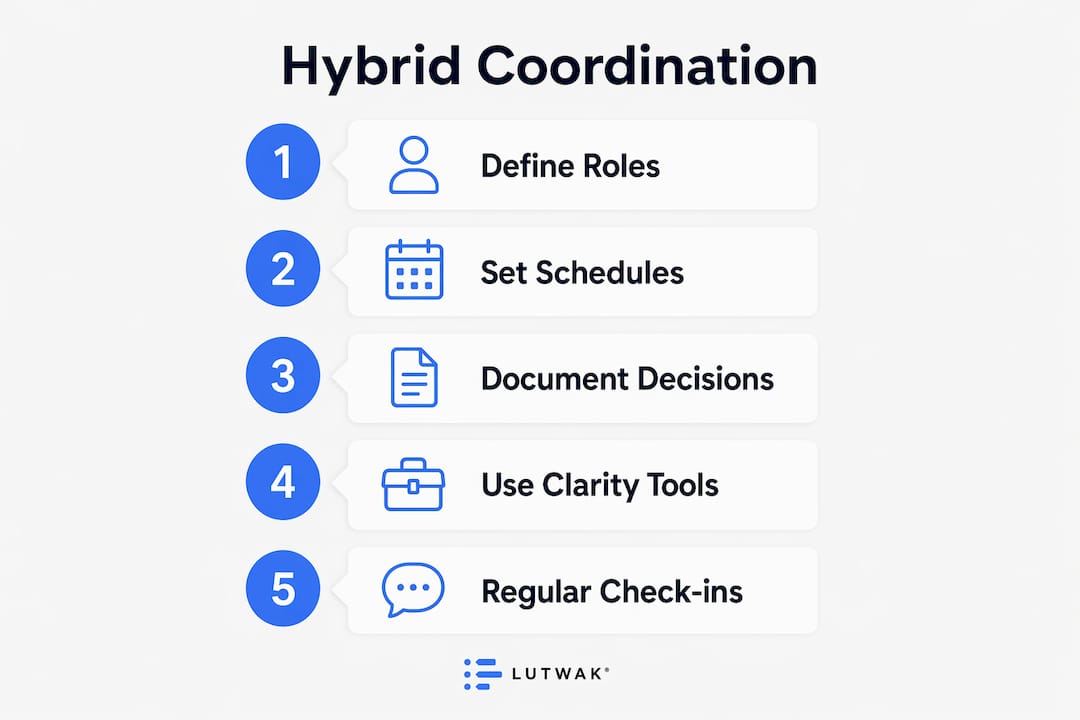
RACI charts define who is Responsible, Accountable, Consulted, and Informed on every task. They eliminate the ambiguity that causes duplicated effort or dropped work in distributed teams. Meeting summaries with action items close the loop after every call, giving asynchronous team members a written record they can act on without attending live.
Communication channel discipline is equally critical. Tool fatigue occurs when team members must monitor email, chat, video calls, and project boards simultaneously with no clear rules about which channel carries which type of message. The fix is simple: assign a designated purpose to each channel and enforce it consistently. Email handles formal decisions. Chat handles quick questions. Project boards track deliverables. Video calls handle complex discussions.
- Weekly priorities document: Shared every Monday, listing the top three to five outcomes each person is working toward that week.
- Decisions Log: A shared document updated after every significant decision, accessible to the full team regardless of location.
- RACI chart: Reviewed at project kickoff and updated when roles shift, preventing accountability gaps.
- Meeting summaries: Sent within two hours of every meeting, including decisions made and next steps with owners and deadlines.
- Channel norms: A one-page guide specifying which tool to use for which type of communication, agreed on by the full team.
Pro Tip: Run a 10-minute weekly 1:1 with each direct report covering four questions: What went well? What was hard? What are you focused on this week? What do you need from me? This single practice catches misalignment before it becomes a problem.
How does performance measurement differ in hybrid environments?
Traditional performance metrics built around hours worked or physical presence fail in hybrid teams. They measure activity, not output. A team member who sits at a desk for nine hours and produces little looks productive under an activity model. A remote contributor who delivers high-quality work in six focused hours looks underperforming. That inversion destroys trust and drives attrition.
Outcome-based performance management measures business results and progress against commitments rather than inputs or hours. MIT Sloan Management Review identifies this shift as a driver of both increased retention and productivity in hybrid teams. The practical implication is clear: define what success looks like before the work begins, then evaluate against that definition.
The concept of trust-by-reliability replaces trust-by-proximity in effective hybrid teams. Trust develops through consistent delivery and clear communication, not through physical visibility. A team member who meets commitments, responds within agreed timeframes, and flags blockers early earns trust regardless of location. This shift also makes performance evaluation fairer, since it removes the unconscious bias that favors people who are physically present.
Key practices for outcome-based performance in hybrid teams:
- Set measurable goals at the start of each sprint, project, or quarter with clear success criteria.
- Evaluate progress against commitments in weekly 1:1s, not in group settings where remote members may feel less comfortable speaking up.
- Document performance conversations so both manager and team member have a shared record.
- Separate availability expectations from output expectations. Define when team members must be reachable, then let them manage how they work within those windows.
What unique challenges do hybrid teams face?
The most underestimated challenge in hybrid team management is proximity bias. Leaders unconsciously give more attention, better assignments, and faster promotions to team members they see in person. Deliberate inclusivity is the only counter: rotating meeting times so no time zone always carries the inconvenient slot, distributing high-visibility assignments across remote and on-site staff equally, and making decisions in documented channels rather than in hallway conversations.
“Hybrid work is not a compromise between remote and office. It is a distinct operating model that requires its own systems, norms, and leadership behaviors.” This framing from current hybrid leadership research captures why leaders who import office-era management habits into hybrid settings consistently underperform.
Fractured culture is the second major risk. When on-site staff share lunch, informal jokes, and spontaneous collaboration while remote members work in isolation, two sub-cultures form. Intentional social interactions scheduled into the team calendar, such as virtual coffee chats, team retrospectives, and shared celebration of wins, prevent that split. Psychological safety also requires active maintenance. Remote team members who feel invisible stop raising problems early, which means leaders hear about issues later and at greater cost.
Pro Tip: Audit your last ten major decisions. Count how many were made in a room with only on-site staff present. If the number is above three, your decision-making process has a proximity bias problem worth fixing immediately.
Common hybrid coordination pitfalls and their fixes:
- Proximity bias in assignments: Rotate high-profile projects using a visible tracker accessible to the full team.
- Accidental exclusion from decisions: Require all decisions above a defined threshold to be documented in the Decisions Log before implementation.
- Communication overload: Enforce channel norms and conduct a monthly audit of active tools, removing any that duplicate function.
- Disconnected culture: Schedule at least one non-work team interaction per month, held in a format accessible to remote members.
How to implement intentional coordination frameworks
Explicit coordination means planning schedules, defining roles, documenting decisions, and scheduling office days to align efforts across distributed teams. Implicit coordination, the kind that happens naturally in a shared office, does not transfer to hybrid settings. Leaders who rely on it create coordination gaps that compound over time.
Designing workflows with a remote-first mindset is the most reliable way to prevent those gaps. Remote-first design means every meeting, document, and decision is structured so that a team member joining asynchronously or from a different location has full access and context. This does not mean eliminating in-person interaction. It means making in-person interaction a bonus rather than a requirement for staying informed.
The following framework gives hybrid teams a repeatable operational rhythm:
- Weekly kickoff: A 30-minute team meeting every Monday to align on priorities, surface blockers, and confirm ownership of key deliverables.
- Async updates: A shared progress tracker updated by each team member by end of day Wednesday, visible to the full team.
- Weekly 1:1s: Ten-minute check-ins between manager and each direct report, covering wins, challenges, current focus, and support needed.
- Decision documentation: Every significant decision logged within 24 hours with context, rationale, and owner.
- Monthly retrospective: A 45-minute team session reviewing what worked, what did not, and what to change in the next cycle.
| Coordination element | Purpose | Frequency |
|---|---|---|
| Weekly priorities document | Aligns team on top outcomes | Weekly |
| Decisions Log | Preserves context for async members | Ongoing |
| Progress tracker | Provides workload transparency | Twice weekly |
| 1:1 check-ins | Maintains individual alignment | Weekly |
| Team retrospective | Improves coordination systems | Monthly |
Clear communication norms reduce cognitive load and improve team efficiency. When team members know exactly where to look for information and which channel to use for which type of message, they spend less mental energy on coordination overhead and more on actual work. That shift compounds over time into measurable productivity gains.
Key Takeaways
Hybrid team coordination succeeds when leaders replace accidental proximity-based alignment with deliberate systems built around explicit communication, outcome-based performance, and inclusive decision-making.
| Point | Details |
|---|---|
| Define coordination explicitly | Hybrid teams need structured tools like Decisions Logs and RACI charts to replace informal office alignment. |
| Measure outcomes, not activity | Evaluate team members on deliverables and commitments, not hours worked or physical presence. |
| Counter proximity bias actively | Rotate assignments and document decisions to give remote and on-site staff equal access and visibility. |
| Build a repeatable rhythm | Weekly kickoffs, async updates, and monthly retrospectives create consistent coordination without micromanagement. |
| Design remote-first | Structure every meeting and document so asynchronous participants have full context and equal access. |
The coordination mistake most leaders make
The most common leadership failure I see in hybrid teams is treating coordination as something that happens between the real work. Leaders schedule the project kickoff, assign tasks, and then assume the team will self-organize across locations and time zones. They will not. Coordination is the work, especially in hybrid settings.
What I have found actually works is building the coordination infrastructure before the first deliverable is due. That means agreeing on channel norms, setting up the Decisions Log, and running the first 1:1 cycle in week one, not week four when things start breaking down. The teams that do this feel slower at the start. They are faster by month two.
The autonomy-accountability balance is also harder than it looks. Remote team members want flexibility. Leaders want visibility. The answer is not surveillance tools or mandatory camera-on policies. The answer is clear commitments with transparent tracking. When everyone can see what everyone else is working on and whether commitments are being met, trust builds without micromanagement. Teambuilt’s workload visibility approach reflects exactly this principle: make the work visible, not the worker.
Hybrid coordination done right also builds organizational resilience. Teams that have explicit systems for remote collaboration can absorb disruptions, whether a key person goes on leave, a project pivots, or the team grows quickly, without losing alignment. That resilience is worth the upfront investment in structure.
— Dima
How Teambuilt supports hybrid team coordination
Hybrid coordination requires real-time visibility into who is working on what, how much capacity each team member has, and whether delivery timelines are realistic. Teambuilt provides exactly that through centralized workload visualization, capacity tracking, and cross-team scheduling built for organizations managing multiple teams and complex workflows.
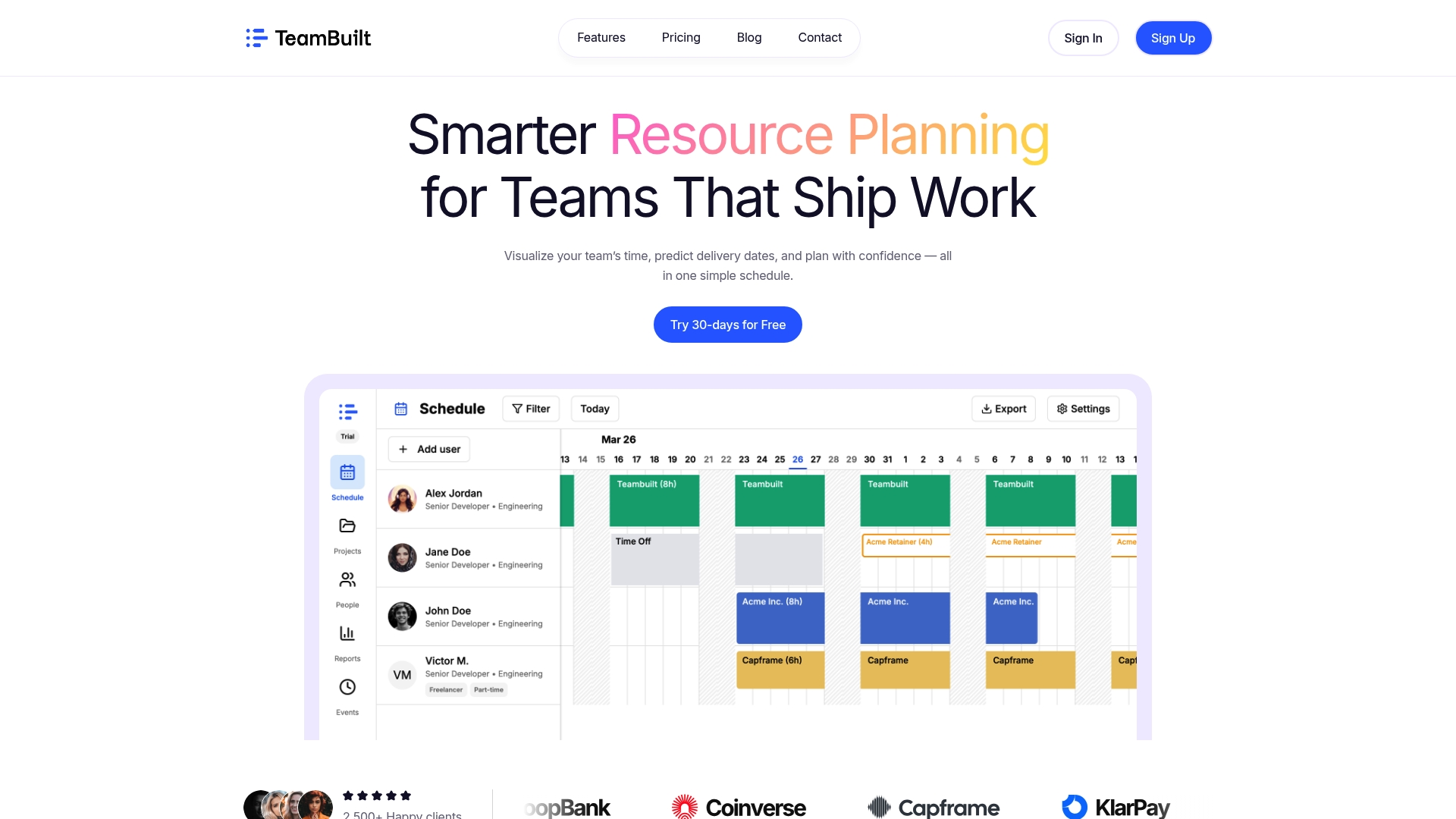
Teams using Teambuilt replace scattered spreadsheets and fragmented communication with a single planning environment where priorities, workloads, and project timelines are visible to everyone. The platform’s open API and pre-built integrations connect with the tools your team already uses, so coordination data lives in one place rather than across five disconnected apps. For leaders building out their hybrid team management practices, Teambuilt gives the operational backbone that makes intentional coordination sustainable at scale. Visit teambuilt.app to see how it works.
FAQ
What is hybrid team coordination?
Hybrid team coordination is the deliberate practice of aligning work, communication, and collaboration across team members who work both remotely and on-site. It replaces informal proximity-based alignment with structured tools, shared norms, and explicit decision-making processes.
What are the biggest challenges of hybrid team coordination?
Proximity bias, fractured team culture, and tool fatigue are the three most common challenges. Leaders address them through inclusive scheduling, documented decision-making, and clear communication channel norms.
How do you measure performance in a hybrid team?
Outcome-based metrics tied to deliverables and commitments replace activity-based measures like hours worked or physical presence. MIT Sloan Management Review links this shift to higher retention and productivity in hybrid environments.
What does “remote-first” mean for hybrid teams?
Remote-first design means every meeting, document, and decision is structured so that team members joining asynchronously or from a different location have full context and equal access, making in-person presence a benefit rather than a requirement.
How often should hybrid teams hold coordination check-ins?
Weekly 1:1s between managers and direct reports, combined with a weekly team kickoff and a monthly retrospective, provide the minimum coordination rhythm for most hybrid teams to stay aligned without creating meeting overload.
Recommended