
Key Features for SaaS Project Platforms in 2026



TL;DR:
- Effective SaaS project platforms combine AI automation, real-time collaboration, and secure integrations to support team delivery. Choosing the right platform depends on your team’s workflow, security needs, and growth plans, with migration testing crucial to avoid data loss. Teambuilt offers open API connectivity, real-time scheduling, and resource forecasting for managing multiple projects across distributed teams.
Key features for SaaS project platforms are the core capabilities that determine whether a platform helps your team deliver projects on time or creates more friction than it solves. The best SaaS project management tools, including Linear, Notion, ClickUp, and Asana, compete on a specific set of must-have SaaS tools: AI automation, real-time collaboration, security compliance, and deep integrations. Choosing wrong costs you more than a migration headache. It costs you team adoption, project visibility, and delivery predictability. This guide breaks down every critical capability you need to evaluate before committing to a platform.
1. What are the top AI-powered automation features in SaaS project platforms?

AI-driven automation is the single biggest differentiator among SaaS project platforms in 2026. The shift from passive data storage to active, predictive automation defines which tools actually accelerate delivery and which ones just track it.
The most valuable AI capabilities in project management tools include:
- Predictive task assignment: AI analyzes team capacity and past performance to assign work to the right person automatically.
- Delay prediction: The system flags at-risk tasks before they miss deadlines, not after.
- Auto-prioritization: Tools like Linear surface the highest-impact work based on sprint goals and team velocity.
- Workflow optimization: ClickUp Brain, ClickUp’s AI assistant, rewrites task descriptions, summarizes threads, and generates subtasks from a single prompt.
- Agile and hybrid support: AI-powered platforms adapt to Scrum sprints, Kanban boards, and hybrid methodologies without manual reconfiguration.
The practical impact is real. AI-driven systems assign tasks, predict delays, and enhance delivery cycles in hybrid team setups where manual coordination breaks down fastest. That means fewer status meetings and more time on actual work.
Pro Tip: When evaluating a platform’s AI maturity, ask for a live demo of its prediction accuracy on a real project scenario. A tool that can only summarize text is not the same as one that can forecast a delivery date based on current resource load.
2. How do real-time collaboration features benefit SaaS project teams?
Real-time collaboration is not a nice-to-have. It is the feature that determines whether remote and hybrid teams stay aligned or drift into silos. The best SaaS project features in this category go well beyond shared task lists.
Core collaboration capabilities every platform should offer include:
- Live task updates: Changes appear instantly across all team members without a page refresh.
- Instant messaging and comments: Threaded comments on tasks keep context attached to work, not buried in Slack.
- Shared dashboards: Project managers and operations leads see the same real-time view of progress.
- Guest access and multi-role permissions: External collaborators, clients, and contractors get scoped access without seeing sensitive internal data.
- Mobile compatibility: Asana leads in mobile experience among major platforms, which matters when your team is traveling or on-site.
Multi-role permissions deserve special attention. A platform that forces you to choose between full access and no access creates security gaps. Granular permission tiers let you give a client visibility into their project without exposing your entire pipeline. For agencies and SMBs managing multiple client accounts, this feature alone justifies platform selection.
3. Why are security and compliance critical features for SaaS project platforms?
Security is not optional for professional teams. SOC 2 compliance and GDPR adherence are mandatory for any SaaS platform handling client or employee data in 2026. A platform without these certifications is a liability, not a tool.
The non-negotiable security features for any serious platform are:
- Role-Based Access Control (RBAC): Limits data exposure by granting permissions based on job function, not individual trust.
- Multi-tenant data isolation: Ensures one organization’s data cannot bleed into another’s, critical for platforms serving multiple clients.
- Comprehensive audit logs: Records every action taken in the system, which is a core requirement for SOC 2 compliance.
- Enterprise Single Sign-On (SSO): Connects the platform to your existing identity provider, reducing password fatigue and unauthorized access.
- Multi-factor authentication (MFA): Adds a second verification layer that blocks the majority of credential-based attacks.
- Encrypted data storage: Protects data at rest and in transit from interception.
Enterprise SSO, MFA, and encrypted storage are the baseline for any platform your legal or finance team will touch. MVP timelines for building these features into a SaaS product typically run 8–12 weeks, which explains why newer platforms sometimes skip them early. That is a red flag when you are evaluating vendors.
Pro Tip: Ask every vendor for their SOC 2 Type II report, not just Type I. Type II covers a period of operational compliance, not just a point-in-time audit. The difference matters when your clients ask for proof.
4. What role do integrations and scalability play in SaaS project platforms?
A SaaS project platform that cannot connect to your existing tools creates a parallel workflow. Integrations with CRM, Slack, Microsoft Teams, and accounting software are not bonuses. They are the connective tissue that keeps your tech stack from fragmenting. For a deeper look at what modern integration requirements look like, the 2026 SaaS integrations guide covers the full picture.
Cloud-based accessibility on infrastructure like AWS or Vercel gives distributed teams reliable, global access without VPN dependencies. That reliability directly affects adoption. If the platform is slow or unavailable in a key region, your team works around it instead of through it.
Scalability follows a similar logic. A platform that works for a 10-person team should not require a full migration when you reach 100 people. The best platforms offer tiered pricing and feature sets that grow with your organization without forcing a disruptive switch.
| Capability | Small teams (under 25) | Mid-size teams (25–200) | Enterprise (200+) |
|---|---|---|---|
| Native integrations | Slack, Google Workspace | CRM, accounting, HR tools | Custom API, SSO, ERP |
| Storage and data limits | Usually unlimited on paid tiers | Expanded file storage, audit logs | Dedicated infrastructure |
| Admin controls | Basic roles | Department-level permissions | RBAC, compliance dashboards |
| Support tier | Email or community | Priority support | Dedicated account manager |
5. Comparing popular SaaS project platforms based on key features
No single platform wins every category. The right choice depends on your team’s workflow style, technical tolerance, and budget.
| Platform | Workflow style | AI features | Mobile experience | Best for |
|---|---|---|---|---|
| Linear | Opinionated, high-speed | Auto-prioritization, Cycles | Good | Engineering teams |
| Notion | Flexible, document-first | Basic AI writing tools | Moderate | Knowledge-heavy teams |
| ClickUp | Highly customizable | ClickUp Brain AI assistant | Good | Operations and cross-functional teams |
| Asana | Structured, task-focused | Limited automation | Excellent | Project managers and agencies |
Linear enforces opinionated workflows to maintain speed and simplicity. That is a deliberate design choice, not a limitation. Teams that want maximum flexibility will find Linear frustrating. Teams that want to move fast without configuring everything will find it liberating.
ClickUp tops custom workflows but has a complex setup. That complexity has a real cost. New team members take longer to onboard, and misconfigured workflows create more noise than clarity. Asana’s polished interface and strong mobile experience make it the safest choice for non-technical project managers.
Migration between platforms carries its own risks. Linear to Notion migration via CSV is the easiest path, while moving from Asana to Linear loses subtask hierarchies entirely. Before switching, audit your task structure and test the import process on a sample project. Broken task hierarchies after migration are one of the most common and costly surprises teams face.
Key Takeaways
The most effective SaaS project platforms combine AI automation, real-time collaboration, SOC 2-compliant security, and deep integrations to support teams at every stage of growth.
| Point | Details |
|---|---|
| AI automation is the top differentiator | Platforms with predictive task assignment and delay forecasting outperform basic task trackers. |
| Security compliance is non-negotiable | SOC 2 Type II and GDPR compliance protect your data and satisfy client requirements. |
| Integrations drive adoption | Connecting to Slack, CRM, and accounting tools keeps workflows unified and reduces tool-switching. |
| Platform choice depends on workflow style | Linear suits engineering speed; ClickUp suits customization; Asana suits structured project management. |
| Migration risk is real | Test data export and import before switching platforms to avoid losing subtask hierarchies. |
What I’ve learned from watching teams pick the wrong platform
The most common mistake I see is teams choosing a platform based on feature count. ClickUp has more features than almost any competitor. That does not make it the right choice for a 15-person agency that needs to onboard a new client every two weeks.
Opinionated workflow tools like Linear maintain performance by limiting complexity. That sounds like a constraint until you watch a team spend three weeks configuring ClickUp’s custom fields and still not agree on how to use them. Speed of adoption matters more than depth of features for most teams under 50 people.
The second mistake is underestimating security requirements until a client asks for a compliance report. By then, you are either scrambling to find documentation or switching platforms under pressure. Evaluating SOC 2 and GDPR readiness at the start of your selection process saves that pain entirely.
My honest recommendation: match the platform to your team’s actual workflow complexity, not your aspirational one. If your team runs two-week sprints and ships software, Linear or Asana will serve you better than a fully customizable tool that requires a dedicated admin. If you manage cross-functional projects with finance, HR, and operations all in one place, ClickUp or a resource-focused platform like Teambuilt gives you the visibility you actually need. For teams building out their workflow automation practices, starting simple and adding complexity later is always the right sequence.
— Dima
How Teambuilt fits into your SaaS project platform decision
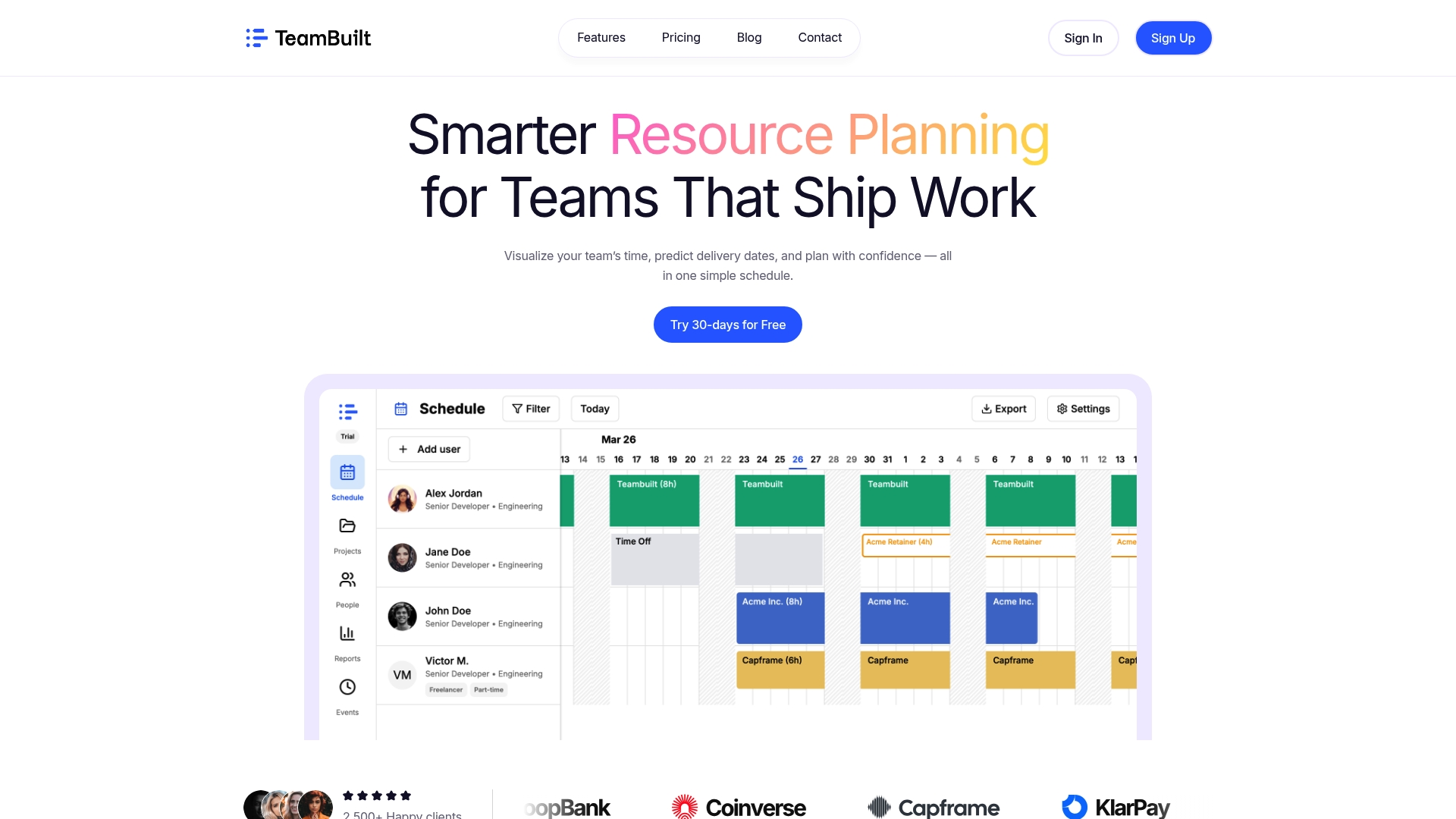
Teambuilt is built for teams that need more than a task list. It combines real-time team scheduling, workload visualization, and delivery date forecasting based on actual resource availability. Those are the capabilities that matter when you are managing multiple projects across multiple teams and need to answer “when will this ship?” with confidence rather than guesswork.
Teambuilt connects to your existing tools via open API and pre-built integrations, so it fits into your current stack rather than replacing it. Its privacy-focused infrastructure meets the security standards that growing startups, SMBs, and agencies need when handling client data. If you are ready to replace scattered spreadsheets with a centralized planning tool, explore Teambuilt and see how it handles your team’s specific workflow.
FAQ
What are the key features for SaaS project platforms?
The key features for SaaS project platforms include AI-powered automation, real-time collaboration, role-based access control, third-party integrations, and cloud-based accessibility. These capabilities directly determine how well a platform supports project delivery and team coordination.
How do I choose between SaaS project management tools?
Match the platform to your team’s workflow style and technical tolerance. Engineering teams benefit from Linear’s speed, while operations-heavy teams get more from ClickUp or Teambuilt’s resource planning capabilities.
Is SOC 2 compliance required for SaaS project platforms?
SOC 2 compliance is mandatory for any platform handling client or employee data in a professional context. Ask vendors for their SOC 2 Type II report, which covers ongoing operational compliance rather than a single audit point.
What is the biggest risk when migrating between SaaS platforms?
The biggest risk is losing task hierarchy and subtask data during import. Migrating from Asana to Linear, for example, drops subtasks entirely. Always test the import process on a sample project before committing to a full migration.
Do SaaS project platforms support hybrid and remote teams?
Yes. Cloud-based platforms hosted on infrastructure like AWS provide reliable global access for hybrid and remote teams. Features like mobile compatibility, guest permissions, and async task comments are specifically designed for distributed work.
Recommended