
Organizational Planning Guide for Business Leaders



TL;DR:
- Organizational planning is a continuous, disciplined process that aligns vision with strategic goals, tactics, and resources. Effective plans incorporate multiple frameworks, validate capacity, and adapt through regular reviews and explicit trade-offs. Using tools like Teambuilt supports real-time execution management, preventing common failures before Q2.
Organizational planning is the disciplined process of aligning your company’s vision with strategic goals, tactical execution, and resource allocation to achieve sustained growth and adaptability. Most organizations treat planning as an annual ritual rather than a continuous management system, and that gap is where execution breaks down. This guide walks through the proven 7-step planning process, the most useful strategic planning frameworks from SWOT to OKRs to the Balanced Scorecard, and the governance practices that keep plans alive between reviews. Whether you lead a 20-person startup or a 500-person agency, the principles here apply directly to how you set goals, allocate resources, and adapt when conditions change.
What are the essential steps in an organizational planning process?
Organizational planning connects vision to execution by defining strategic goals, mapping tactical steps, aligning structure and resources, and adapting continuously. The 7-step process below is not a checklist you complete once. Each step feeds the next, and the final step loops back to the first.

Step 1: Define vision, mission, and values. Your vision describes the future state you are building toward. Your mission explains why the organization exists today. Your values define the non-negotiable behaviors that govern how you operate. Without this foundation, every subsequent planning decision lacks a reference point.
Step 2: Conduct a current state assessment. Use SWOT analysis to map internal strengths and weaknesses alongside external opportunities and threats. Pair this with a capability assessment that identifies which skills, systems, and processes you have today versus what your strategy requires. The gap between current state and desired state is where your planning work lives.
Step 3: Set clear, strategic goals aligned to your vision. Goals must be specific, time-bound, and measurable. OKRs (Objectives and Key Results) work well here because they separate the qualitative objective from the quantitative results that confirm you achieved it. Limit yourself to three to five strategic goals per planning cycle. More than that and accountability diffuses.
Step 4: Develop tactical plans that translate goals into initiatives. Each strategic goal needs a set of concrete initiatives with owners, milestones, and success criteria. This is where strategy becomes a work plan. Teams should be able to read a tactical plan and know exactly what they are responsible for delivering by when.
Step 5: Align organizational structure to support strategy execution. Structure follows strategy, not the other way around. If your strategy requires cross-functional product delivery but your org chart is siloed by function, execution will stall. Review reporting lines, decision rights, and team compositions at this stage.
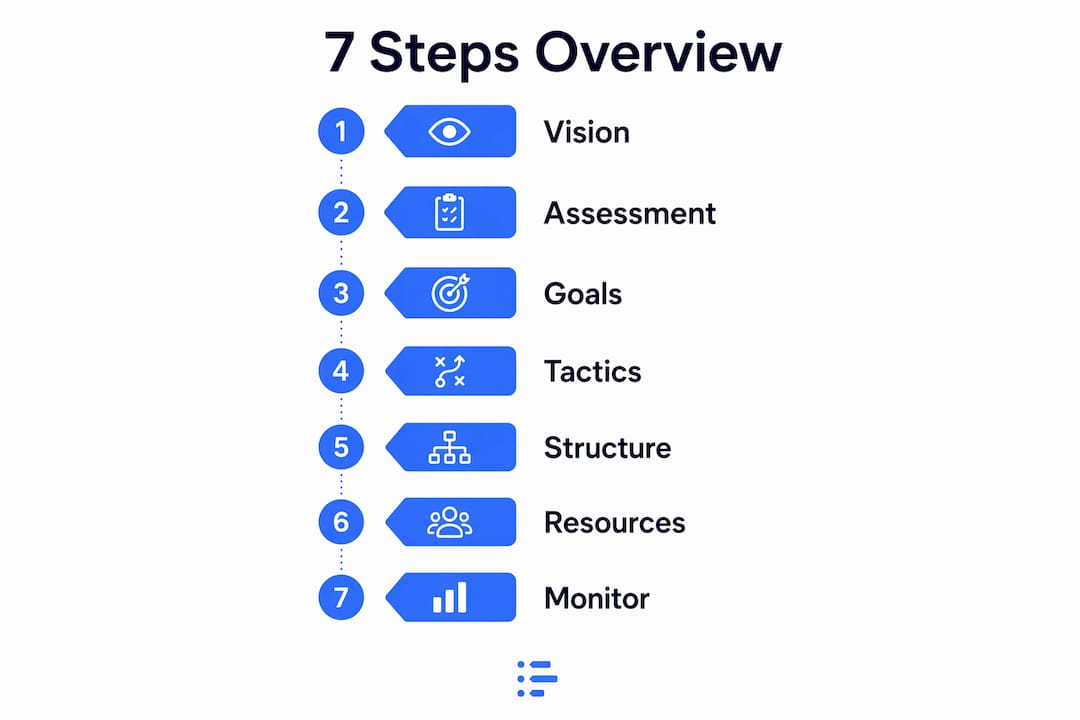
Step 6: Allocate resources including budget, personnel, and technology. Effective resource allocation requires mapping people, technology, and capital to initiatives by strategic importance, then balancing against risks and buffers. Governance tools like RACI matrices and dependency roadmaps are critical outputs of this step. See the resource allocation section below for detailed techniques.
Step 7: Monitor progress and adapt based on feedback loops. Annual planning translates 3 to 5 year strategic plans into specific 12-month objectives with targets, timelines, and accountability, typically taking 8 to 12 weeks with quarterly reviews. Those quarterly reviews matter. Regular quarterly reviews improve returns by 31%, which means the cadence of your review process is itself a performance lever.
Pro Tip: Build your planning calendar before your planning content. If you do not schedule the review meetings, the strategy review never happens.
Which planning frameworks actually improve strategic thinking?
Choosing the right framework depends on your planning stage, your organization’s maturity, and the specific question you are trying to answer. No single framework covers everything. The table below maps the most widely used frameworks to their best use cases.
| Framework | Best used for | Key output |
|---|---|---|
| SWOT Analysis | Current state assessment, early-stage planning | Strengths, weaknesses, opportunities, threats map |
| OKRs | Goal-setting and team alignment | Objectives with 3-5 measurable key results each |
| Balanced Scorecard | Strategy execution tracking across four perspectives | KPI dashboard tied to financial, customer, process, and learning goals |
| Porter’s Five Forces | Competitive positioning and market entry decisions | Competitive intensity score across five dimensions |
| McKinsey 7S | Organizational alignment and change management | Alignment map across strategy, structure, systems, staff, skills, style, and shared values |
| Ansoff Growth Matrix | Growth strategy selection | Risk-mapped options across market penetration, development, product development, and diversification |
The Strategy Execution Canvas is worth adding to this list. It breaks strategic intent into execution-ready components by analyzing capabilities, constraints, and risks, then defining metrics for tracking and learning. It is particularly useful for leadership teams that have a strategy document but struggle to convert it into accountable work.
In practice, most organizations benefit from combining two or three frameworks rather than committing to one. Use SWOT to assess your current state, OKRs to set goals, and the Balanced Scorecard to track execution. Run these frameworks in structured planning workshops where cross-functional leaders contribute data, not just the executive team. That participation is what converts a framework from a slide deck into a shared operating model.
- Use SWOT at the start of every annual planning cycle, not just during strategic resets.
- Limit OKRs to three objectives per team per quarter to maintain focus.
- Review Balanced Scorecard metrics monthly, not just at quarter-end.
- Apply Porter’s Five Forces when entering a new market or responding to a new competitor.
- Use McKinsey 7S before any significant reorganization to identify misalignments before they become execution problems.
What are effective techniques for resource allocation in planning?
Resource planning must precede resource commitment to avoid false capacity assumptions and project delays. This is the most consistently violated principle in organizational planning, and it is the primary reason projects stall in Q2 after a confident Q1 kickoff.
Resource planning should be grounded in project scope baseline, schedule, and budget envelope, and it must be revisited if any of these constraints change. PMBOK 8 is explicit on this point: analyzing resource gaps, threats, and availability must happen before acquisition decisions are made. Skipping this step means you are committing people and budget to work before you know whether the capacity actually exists.
The impact-versus-effort prioritization method is one of the most practical tools for focusing resource allocation decisions. Plot each initiative on a two-by-two grid where one axis represents strategic impact and the other represents resource effort required. High-impact, low-effort initiatives get funded first. High-impact, high-effort initiatives get sequenced carefully. Low-impact initiatives get deferred or cut.
Governance tools that make resource allocation explicit include:
- RACI matrices that assign Responsible, Accountable, Consulted, and Informed roles for every major initiative. Validating RACI assignments against real team availability prevents unreliable plans that assign responsibility without capacity.
- Dependency roadmaps that surface cross-team dependencies before they become blockers during execution.
- Assumption threshold documents that define the conditions under which a resource plan needs to be revisited. For example: if headcount changes by more than 15%, the plan goes back to leadership for reallocation.
Workforce planning aligns staffing with strategic objectives through capability assessment, forecasting needs, skill gap identification, and action plans. This stepwise approach is what separates organizations that hire reactively from those that build toward a defined capability target. For a detailed breakdown of SMB workforce planning, the process maps directly to the resource allocation steps above.
Pro Tip: Separate initiative prioritization from resource commitment timing. Approving an initiative does not mean you fund it immediately. Gate resource consumption to the quarter when capacity is confirmed.
How does continuous monitoring keep organizational plans relevant?
Planning is not a document. It is a management habit. Trade-off decisions must be made explicitly by leadership to maintain plan relevance and strategic conviction throughout the year. Organizations that treat their annual plan as a fixed contract rather than a living hypothesis lose the ability to respond when conditions change.
The monitoring architecture that keeps plans adaptive has three layers. The first layer is KPI tracking using a mix of leading and lagging indicators. Lagging indicators like revenue and headcount tell you what happened. Leading indicators like pipeline coverage, sprint velocity, and employee engagement scores tell you what is likely to happen. Both matter, but leading indicators give you time to act.
| Monitoring layer | Cadence | Primary tool |
|---|---|---|
| Operational KPIs | Weekly | Dashboard or project management tool |
| Tactical plan review | Monthly | Team lead meetings with milestone tracking |
| Strategic goal review | Quarterly | Leadership offsite or structured review session |
| Full plan reassessment | Annually | Planning cycle with updated SWOT and goal-setting |
The second layer is scenario planning. At each quarterly review, leadership should stress-test the plan against two or three alternative scenarios. What happens to the plan if a key hire falls through? What if a major client churns? Scenario planning does not predict the future. It prepares your decision-making process so you can respond faster when conditions shift.
The third layer is assumption management. Successful annual planning requires converting plans into adaptive living hypotheses that leadership believes in and owns, not static documents. Every plan rests on a set of assumptions about market conditions, team capacity, and competitive dynamics. Document those assumptions explicitly and define the threshold at which each assumption triggers a plan review. AI-enhanced planning processes can improve organizational performance by making strategic decisions more data-driven and timely, particularly when monitoring large volumes of operational data across teams.
Key takeaways
Effective organizational planning requires a continuous 7-step cycle that connects vision to execution through structured goal-setting, disciplined resource allocation, and adaptive quarterly reviews.
| Point | Details |
|---|---|
| Start with vision and values | Every planning decision needs a reference point; define these before setting goals. |
| Use frameworks in combination | Pair SWOT for assessment, OKRs for goal-setting, and Balanced Scorecard for execution tracking. |
| Validate resource capacity before committing | RACI assignments and dependency maps must reflect actual availability, not assumed availability. |
| Build monitoring into the planning calendar | Quarterly reviews improve returns by 31%; schedule them before the planning cycle begins. |
| Treat plans as living hypotheses | Document assumptions and define thresholds that trigger leadership review when conditions shift. |
Why most planning processes fail before Q2
The most common failure I see is not a bad strategy. It is a strategy that was never operationalized. Leadership spends six weeks in planning workshops, produces a polished deck, and then hands it to managers who have no idea how to connect it to their team’s daily work. The plan sits in a shared drive and collects digital dust.
The second failure is RACI as theater. I have reviewed resource plans where the same three people are listed as “Responsible” across fourteen initiatives simultaneously. Nobody validated whether those people had the capacity. The plan looked complete on paper and was completely unworkable in practice. Validating RACI assignments against real availability is not a bureaucratic step. It is the difference between a plan that executes and one that collapses in the first sprint.
The third failure is treating trade-off conversations as optional. When two initiatives compete for the same engineering team, someone has to decide which one wins. If leadership avoids that conversation during planning, the conflict surfaces during execution at the worst possible time, usually when a deadline is already at risk. Explicit trade-off decisions by leadership are what keep plans credible and owned.
My practical advice: spend 30% of your planning time on the strategy and 70% on the governance model that will keep the strategy alive. Who reviews what, when, and with what authority to change course? That governance design is the actual product of your planning process.
— Dima
How Teambuilt supports your planning and resource workflows
Translating a well-designed organizational plan into daily execution requires visibility that spreadsheets and disconnected tools cannot provide. Teambuilt gives project managers, operations leads, and CTOs a centralized platform for real-time resource scheduling, workload visualization, and delivery forecasting based on actual team capacity.
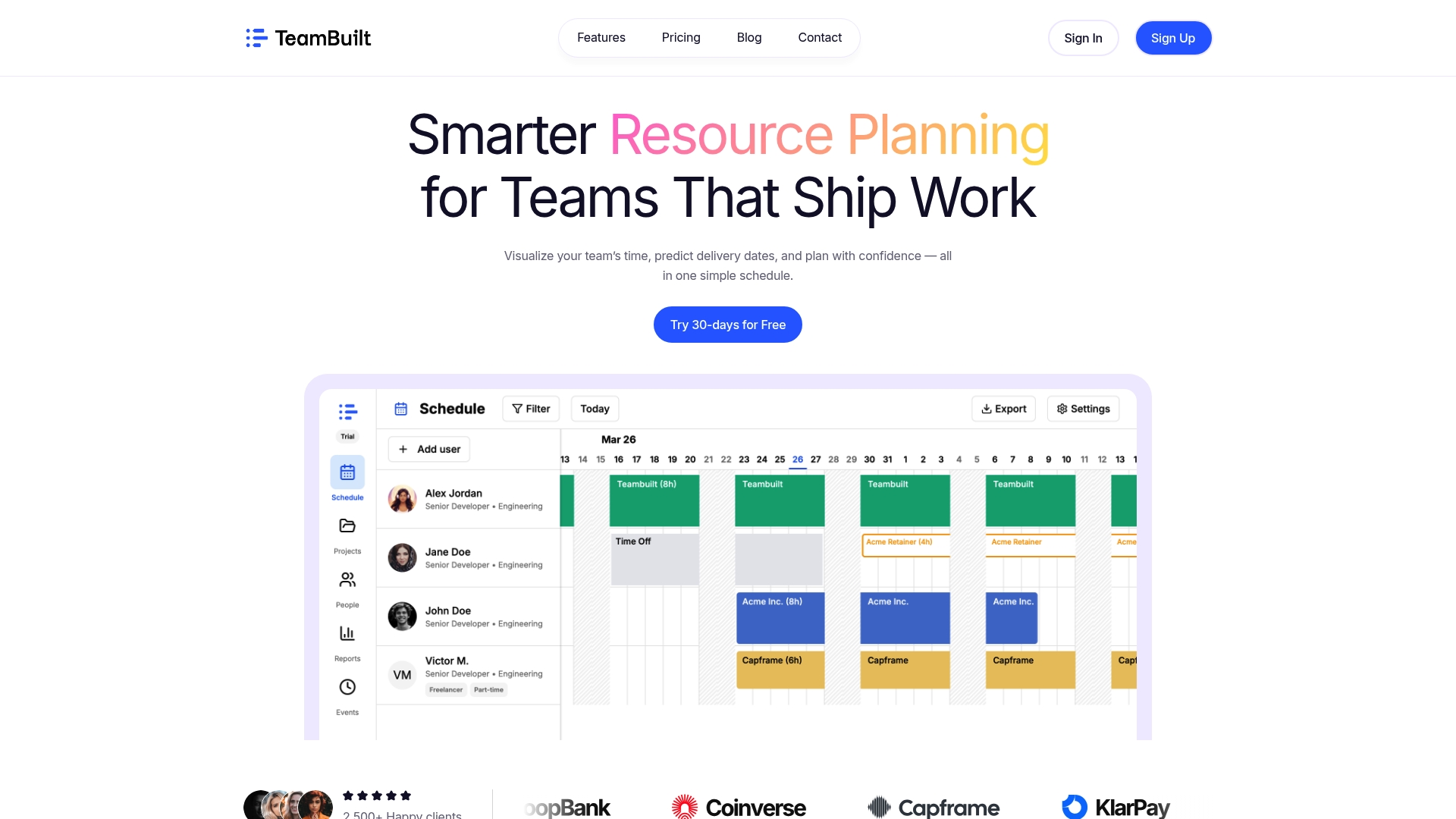
When your planning process produces RACI assignments, dependency maps, and quarterly milestones, Teambuilt is where those outputs live and stay current. Capacity tracking shows you when a team is over-allocated before it becomes a delivery problem. Forecasting tools let you model the impact of a new initiative against existing commitments before you approve it. For organizations moving away from scattered workflows, Teambuilt’s resource planning tools connect strategic priorities directly to team schedules, so your plan stays a living document rather than a static artifact.
FAQ
What is organizational planning?
Organizational planning is the systematic process of aligning a company’s vision, strategic goals, tactical initiatives, and resources to achieve defined outcomes. It operates as a continuous cycle rather than a one-time annual event.
How many steps are in a standard organizational planning process?
Most proven frameworks use a 7-step process covering vision definition, current state assessment, goal-setting, tactical planning, structural alignment, resource allocation, and ongoing monitoring with adaptation.
Which planning framework is best for a growing SMB?
OKRs combined with a simplified Balanced Scorecard work well for most SMBs. OKRs provide focus and accountability at the team level, while the Balanced Scorecard ensures you are tracking performance across financial, customer, and operational dimensions.
How often should organizational plans be reviewed?
Strategic goals should be reviewed quarterly, operational KPIs weekly or monthly, and the full plan reassessed annually. Regular quarterly reviews have been shown to improve returns by 31% compared to annual-only review cycles.
What is the biggest mistake in resource allocation during planning?
Committing resources before validating actual team capacity. Assigning responsibility in a RACI matrix without confirming that the named individuals have the bandwidth to deliver is the most common cause of execution failure in otherwise sound plans.
Recommended