
Project Management Trends 2026: What PMs Need to Know


TL;DR:
- By 2026, project management will be fundamentally transformed by AI-driven workflows, hybrid methodologies, and evolved governance.
- PMs will shift from task execution to decision curation, stakeholder leadership, and validating AI outputs, requiring skills like AI fluency and ethical judgment.
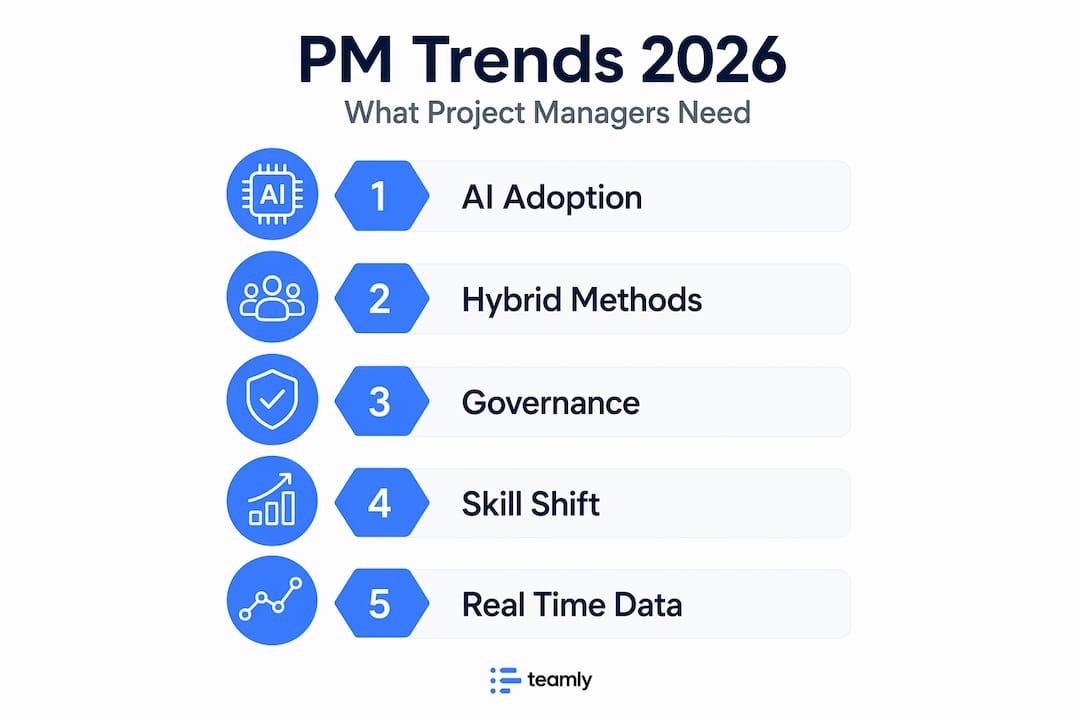
The project management trends 2026 brings are not incremental. They are structural. AI adoption rates have nearly doubled year over year, with 48% of workers using AI daily and 82% of senior leaders planning AI integration into project workflows by the end of 2026. Yet only 20% of project managers have practical hands-on AI experience. That gap is where careers will diverge. This article breaks down the trends actually reshaping how projects run, what skills you need to close that gap, and how your organization can govern AI adoption before it governs you.
Table of Contents
- Key Takeaways
- Top project management trends 2026: the big picture
- How AI changes daily PM work and required skills
- Hybrid methodologies: why flexibility wins
- How to build AI fluency and govern it well
- My take on leading through the AI shift
- See how Teambuilt supports your 2026 workflows
- FAQ
Key Takeaways
| Point | Details |
|---|---|
| AI reshapes PM roles, not replaces | PMs shift from task execution to decision curation, stakeholder leadership, and AI output validation. |
| Hybrid is the new standard | Blending agile and predictive methods based on project complexity outperforms rigid adherence to either approach. |
| Governance must come first | Define AI decision rights and ownership before deploying autonomous workflows to avoid accountability gaps. |
| AI fluency is a career skill | PMs who can validate AI outputs and apply ethical judgment will lead; those who cannot will fall behind. |
| PMOs are evolving fast | Leading PMOs now measure success by benefits realization, not task completion or reporting frequency. |
Top project management trends 2026: the big picture
The shift happening right now is not about swapping one tool for another. It is a fundamental change in how projects are planned, executed, and governed. Here are the forces driving it.
AI is moving from experimentation to operations
82% of senior leaders plan AI integration in project workflows by year-end 2026, but the gap between intention and actual production use is striking. Only 1 in 9 enterprises currently run AI agents in production, and over 40% of agentic AI projects are projected to be canceled by 2027 due to costs, unclear value, and risk control failures. That tells you the ambition is real, but governance has not caught up.
What is working right now:
- Automated status reporting. AI tools aggregate data across tools, communications, and financials to produce real-time dashboards without manual input. 45% of PMs spend a full day per week on manual reporting that AI can eliminate.
- Predictive risk monitoring. Portfolio-level AI scans patterns across projects to flag schedule and budget risks before they surface in status meetings.
- Autonomous task routing. Agentic workflows handle rule-based, repetitive tasks so PMs can focus on judgment-dependent decisions.
PMOs are becoming enterprise enablement engines
The era of the PMO as a reporting hub is closing. Leading PMOs now prioritize benefits realization over task completion as their core performance metric. That means clear value baselines, ownership of outcomes, and continuous measurement against business goals rather than delivery milestones. It is a more accountable role, and it requires PMs to speak fluently in business outcomes, not just project status.

Agile vs. Waterfall is no longer the debate
The fit-for-purpose hybrid approach has replaced the Agile versus Waterfall debate entirely. In 2026, mature organizations select methods based on initiative risk and complexity, not ideology. More on that in the methodology section below.
How AI changes daily PM work and required skills
This is where the trends in agile project management and AI integration collide with career reality. Understanding the trend is one thing. Knowing what it demands from you personally is another.
The task shift is already happening
AI-enabled PM roles now center on decision curation rather than task execution. Creative direction, hybrid team leadership, and technology stewardship are the new core activities. In practice, this means your value is no longer in producing data. It is in interpreting data, making judgment calls, and managing the humans and systems around you.
The critical new skills look like this:
- AI fluency. You do not need to build models. You need to understand what AI outputs mean, when to trust them, and when to override them.
- Output validation. AI errors are often subtle. PMs who catch them before they cascade into project decisions are invaluable.
- Governance knowledge. ISO 42001, the AI management system standard, is emerging as essential knowledge for PM leaders managing AI lifecycle, risk, and ethics in project environments.
- Ethical judgment. 50% of organizations plan AI-free competency evaluations specifically to protect human judgment from atrophy. The ability to think independently and ethically is becoming a differentiator.
Pro Tip: Build a personal calibration baseline for any AI tool you use. Run its outputs manually for two weeks before relying on them. You will catch the error patterns and build calibrated trust rather than blind trust.
Shadow AI is a real governance risk
When teams adopt AI tools without organizational approval, shadow AI risks emerge. These include data leakage, inconsistent decision quality, and accountability gaps when something goes wrong. Many organizations fail AI scaling because they treat AI deployment as an IT release rather than an operating model change. The fix is establishing human-in-the-loop decision rights and clear RACI ownership before any autonomous workflow goes live, not after.
The PMP exam content update in 2026 now incorporates AI, sustainability, and stakeholder engagement, which confirms these are no longer niche competencies. They are baseline expectations for the profession.
Hybrid methodologies: why flexibility wins
The future of project management is not Agile. It is not Waterfall either. It is the deliberate combination of both, selected based on what each project actually needs.
How hybrid delivery works in practice
| Approach | Best for | Key controls |
|---|---|---|
| Agile sprints | High uncertainty, evolving requirements | Backlog prioritization, sprint reviews |
| Predictive phases | Regulatory, fixed-scope, or hardware-dependent work | Stage gates, change control boards |
| Hybrid blend | Mixed complexity, multi-team programs | Portfolio sequencing, iterative delivery within fixed structure |
The key word is “fit-for-purpose.” A software feature team might run two-week sprints inside a program that uses quarterly stage gates for go/no-go decisions. That is not methodological confusion. That is good engineering. Hybrid delivery adapts methods to initiative risk and complexity rather than forcing every project through the same process template.
For practical guidance on blending delivery approaches in multi-team environments, the specific framing matters: governance controls at the portfolio level, flexibility at the execution level.
AI makes hybrid delivery more precise. AI-powered forecasting can model delivery scenarios across different methodology choices, giving leadership real data on trade-offs before committing to an approach. That turns a philosophical conversation into a quantitative one.
How to build AI fluency and govern it well
Knowing the trends is not enough. Here is how organizations that are actually succeeding in 2026 are approaching adoption.
-
Audit current AI competencies. Survey your team. Map who has practical experience with AI tools versus theoretical awareness. The gap between the two is where your training investment should go.
-
Pilot low-risk, rule-based workflows first. Start with autonomous agent pilots on repetitive, rule-based tasks before touching judgment-dependent decisions. Status report generation, meeting note summarization, and risk registry updates are strong starting points.
-
Define decision rights before deployment. Every AI-assisted decision needs a human owner. Before you deploy any AI feature, document who reviews outputs, who can override, and who is accountable for the outcome. This is not bureaucracy. It is risk management.
-
Embed AI literacy into performance management. If AI fluency is a key project management skill for 2026, it needs to show up in role expectations, hiring criteria, and performance reviews. Treating it as optional guarantees inconsistent adoption.
-
Treat rollout as change management. Rolling out AI is a change management challenge that requires communication and empathy. Team resistance often comes from fear of irrelevance, not technical confusion. Address that directly and early.
Pro Tip: Create a shared AI usage log for your team. When someone finds a prompt that produces reliable outputs for a recurring task, document it. This builds institutional knowledge instead of letting every individual reinvent the same wheel.
For teams looking for concrete workflow automation examples to pilot, starting with reporting and scheduling tasks produces the fastest visible returns with the lowest governance risk.
My take on leading through the AI shift
I have watched a lot of technology waves hit the project management profession. The instinct is always the same: either over-index on the technology or dismiss it entirely. Both are mistakes.
What I have learned is that AI amplifies whatever you already are as a PM. If you are strong on stakeholder management, AI gives you more time to do it. If you are weak on critical thinking, AI will accelerate that atrophy. The technology does not change your fundamental job. It raises the stakes on doing it well.
The most underrated skill heading into the rest of this decade is what I call trust calibration: knowing precisely when to rely on AI outputs and when to override them. Blind trust gets you burned. Blanket rejection means you are doing manual work your competitors are not. The middle path requires judgment, and judgment requires experience with the tools.
My honest advice: do not wait for your organization to build an AI training program for you. Pick one repetitive task you do every week. Find an AI tool that touches it. Use it for 30 days and document what it gets right and what it gets wrong. That is how you build real fluency, not by watching demos or reading trend reports.
Human-in-the-loop is not a technical design choice. It is a leadership philosophy. PMs as socio-technical system governors who orchestrate hybrid human-AI teams and protect ethical accountability layers, that framing actually captures what the job is becoming. Own it before someone else defines it for you.
— Dima
See how Teambuilt supports your 2026 workflows
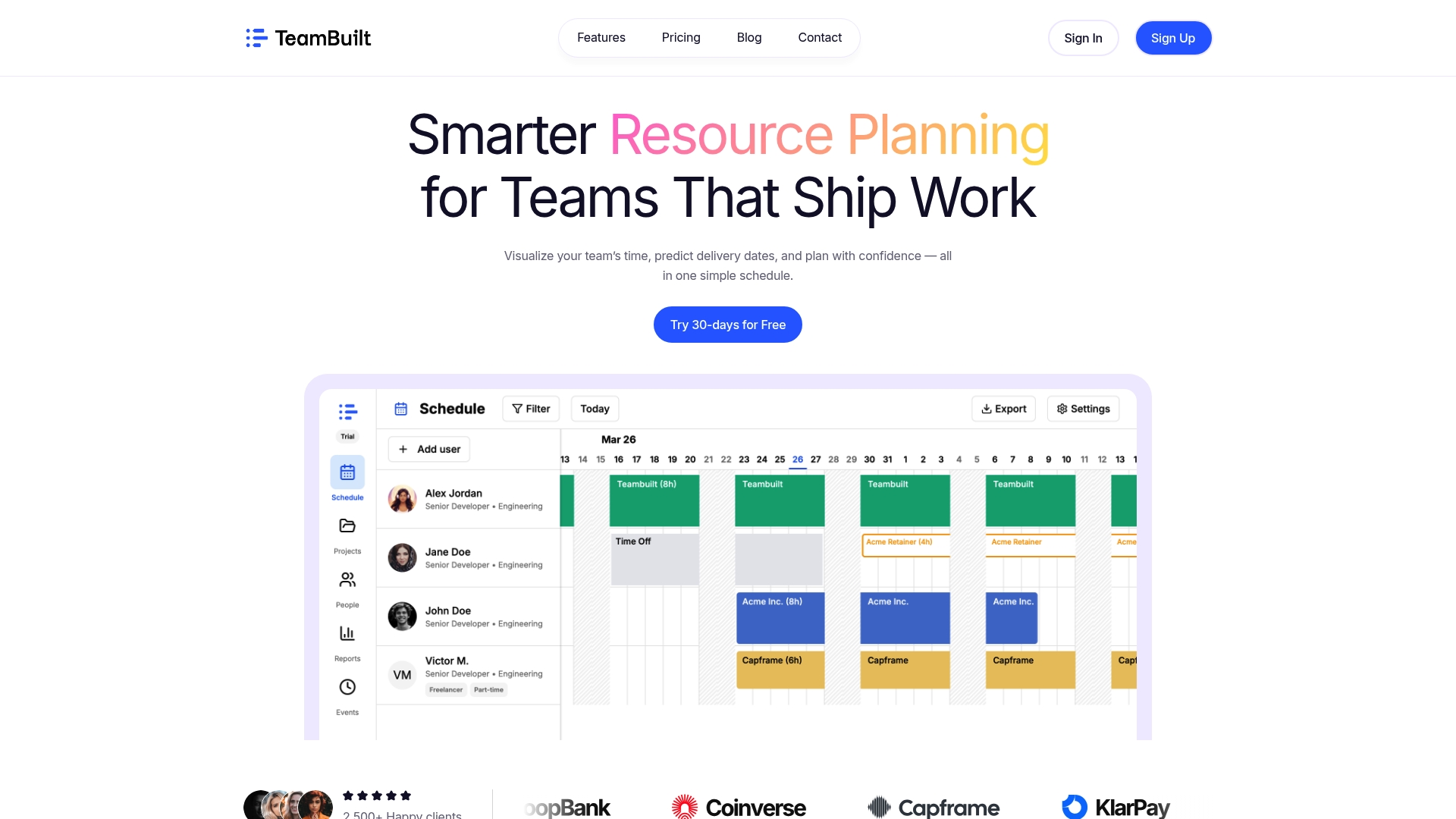
The project management trends reshaping 2026 all point in the same direction: real-time visibility, delivery predictability, and cross-team coordination are no longer nice-to-have features. They are operational requirements. Teambuilt is built for exactly this environment. Its real-time workload visualization, AI-assisted forecasting, and capacity tracking give project managers and executives the data they need to make decisions fast, without relying on manual spreadsheet updates or scattered tools.
If you manage multiple teams and need a clearer picture of who is working on what and when delivery is actually at risk, explore Teambuilt and see how it fits your organization’s planning workflow.
FAQ
What are the top project management trends for 2026?
The top project management trends 2026 centers on AI adoption in workflows, the rise of hybrid methodologies blending agile and predictive approaches, PMO evolution toward benefits realization, and a sharp focus on AI governance and PM skill development.
Will AI replace project managers in 2026?
No. AI automates repetitive and reporting tasks, but PM roles shift toward decision curation, stakeholder leadership, and AI output validation. Human judgment remains the critical control layer.
What key project management skills matter most in 2026?
AI fluency, output validation, ethical judgment, and governance knowledge (including ISO 42001) are the defining skills. Stakeholder management and change leadership also grow in importance as AI handles more transactional work.
How should organizations govern AI in project management?
Establish human-in-the-loop decision rights and clear RACI ownership before any AI deployment. Treat AI rollout as an operating model change, not just a software release, and monitor usage continuously to catch shadow AI risks early.
What is hybrid project management and why is it the standard in 2026?
Hybrid project management blends agile and predictive methods based on each initiative’s risk and complexity. It replaced the rigid Agile versus Waterfall debate because it delivers better outcomes across diverse project types without forcing a single process on every team.
Recommended