
Resource planning: optimize team performance and avoid conflicts


TL;DR:
- Missed deadlines often result from overloaded teams and poorly updated planning systems rather than bad intentions. Effective resource planning involves mapping out skills, capacity, and project timelines to prevent bottlenecks and improve predictability for growing teams. Regular, collaborative reviews and centralized tools enable teams to adapt proactively, reducing chaos and supporting sustainable growth.
Missed deadlines rarely come from bad intentions. They come from overloaded teams, invisible bottlenecks, and planning that lives in someone’s head or a shared spreadsheet no one updates. For growing startups and SMBs, this pattern is painfully common: a project kicks off smoothly, then two sprints in, your best engineer is pulled onto three other initiatives, a designer is waiting on feedback, and the delivery date quietly slips. This guide walks you through a proven, step-by-step resource planning process designed to break that cycle, reduce workload conflicts, and give your team the clarity it needs to deliver consistently.
Table of Contents
- What is resource planning and why does it matter?
- Step-by-step resource planning process
- How to handle resource constraints and forecasting challenges
- Best practices and common mistakes in SMB resource planning
- Our take: Why resource planning gets ignored—and how to make it work for real teams
- Take your resource planning further with Teambuilt
- Frequently asked questions
Key Takeaways
| Point | Details |
|---|---|
| Structured process matters | Following a clear, step-by-step resource planning process aligns teams and prevents conflicts. |
| Handle constraints proactively | Anticipate bottlenecks by regularly reviewing capacity and skill alignment to reduce delays. |
| Review and adapt | Update resource plans at every major project milestone or when variables shift for maximum performance. |
| Pair planning with execution | Resource plans are most effective when integrated with concrete action plans, not used in isolation. |
What is resource planning and why does it matter?
Resource planning means systematically mapping out how your people, skills, budgets, and tools are distributed across projects over time. It is not just a scheduling exercise. It is how you make sure the right person is working on the right thing at the right moment, without being stretched too thin or sitting idle.
For scaling teams, the absence of real resource planning creates a cascade of problems. Teams get overcommitted. Burnout climbs. Talent quietly updates their resumes. And leadership loses visibility into whether the business can actually deliver on its commitments.
The benefits of getting this right are concrete. Better planning reduces miscommunication, aligns workload across teams, and supports sustainable growth without constant firefighting. Resource planning for SMBs specifically helps growing organizations avoid the trap of reactive hiring and last-minute reshuffling.
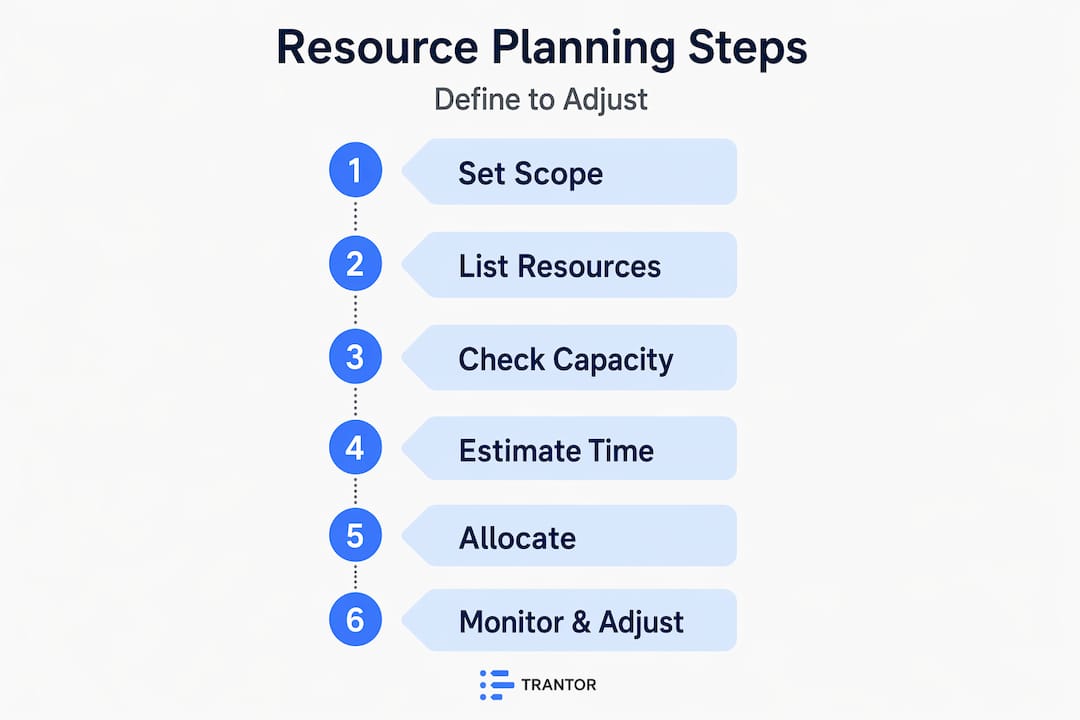
The core steps in resource planning follow a clear progression: define scope and objectives, identify required resources, assess current availability, estimate quantities and timelines, allocate and schedule, then monitor and adjust continuously.
Here is a quick look at the impact of structured versus unstructured resource planning:
| Planning approach | Typical outcome |
|---|---|
| Ad hoc / reactive | Missed deadlines, overloaded staff, high turnover |
| Basic scheduling | Improved visibility, partial conflict reduction |
| Systematic resource planning | 20-30% fewer bottlenecks, better delivery predictability |
| Collaborative, tool-supported | Real-time visibility, proactive conflict resolution |
Key reasons resource planning matters for SMBs and startups:
- Reduces bottlenecks by making workload visible before problems hit
- Aligns team capacity with actual project demand rather than assumed availability
- Improves morale because people know what they are working on and why
- Supports forecasting so you can say yes or no to new projects with confidence
- Protects delivery dates by identifying scheduling conflicts weeks in advance
“The difference between reactive and proactive resource management is not just efficiency. It is the difference between teams that survive and teams that scale.”
Step-by-step resource planning process
Now that you understand the stakes, here is how to actually build and run a resource planning process your team will use consistently.
1. Define project scope and objectives
Start before a single task is assigned. Understand what the project requires to succeed: deliverables, timelines, quality standards, and dependencies. Without this foundation, every resource estimate downstream will be off.
2. Identify required resources
List the roles, skills, and tools you need. Be specific. “A developer” is not enough. You need a back-end engineer with API integration experience available for six weeks. This specificity is what prevents skill-gap surprises mid-project.
3. Assess current availability and capacity
Check who is actually free and at what percentage. Most teams assume availability without measuring it. Someone working at 100% on another project cannot absorb new work without something slipping. The core steps in resource planning always include a clear-eyed capacity assessment at this stage.

4. Estimate quantities and timelines
Match task volume to person-hours. Factor in ramp time, meetings, and the reality that no one works eight fully productive hours per day. A realistic estimate beats an optimistic one every time.
5. Allocate and create a schedule
Assign resources, set milestones, and build in buffer. Use step-by-step team scheduling to sequence tasks based on dependencies and availability, not just urgency.
6. Monitor, adjust, and forecast
This is where most plans fall apart. Treat your resource plan as a living document. Review it at milestones. Update it when scope changes. The PMBOK 8 framework structures this as Plan Resource Management, Estimate Resources, Acquire, Develop Team, Manage Team, and Monitor/Control, a sequence that keeps planning connected to execution throughout.
Here is how the two main balancing techniques compare:
| Technique | What it does | When to use it |
|---|---|---|
| Resource leveling | Adjusts timelines to balance workload | When deadlines are flexible |
| Resource smoothing | Keeps deadlines fixed, adjusts resource intensity | When deadlines are locked in |
| Reactive planning | Responds to crises as they emerge | Unavoidable in true emergencies |
| Proactive planning | Anticipates conflicts using capacity planning strategies | Default approach for healthy teams |
Pro Tip: Pair your resource plan with a detailed execution plan, not just a business model canvas. The canvas tells you what resources you need conceptually. The execution plan tells you exactly when, who, and how much.
How to handle resource constraints and forecasting challenges
Even the best-designed resource plans hit turbulence. Competing priorities emerge. A key team member takes leave. A client changes scope. Here is how to stay ahead of these disruptions rather than scrambling to catch up.
The most common resource constraints teams face include:
- Competing projects pulling the same people in different directions simultaneously
- Skill shortages where no one on the team has the expertise a task requires
- Sudden hard deadlines that compress planned timelines without reducing scope
- Shifting priorities from leadership that redirect resources without formal replanning
- Scope creep that silently adds work without adding capacity
The most effective mitigation strategies combine scenario planning and skill-matching with structured leveling and smoothing techniques. Scenario planning means running “what if” exercises before constraints materialize. What happens if your lead designer is out for two weeks? What if a client doubles the deliverable volume at week three? Mapping those scenarios in advance means you are not improvising when they happen.
Skill-matching goes hand in hand with this. Know who on your team can flex across functions. A developer who understands UX can bridge a gap. A project manager who has done technical writing can absorb documentation tasks. Building a simple skills matrix takes a few hours and saves weeks of confusion later.
Proactive planning reduces bottlenecks by 20 to 30% compared to reactive, ad hoc approaches. That is not a marginal gain. For a 20-person company running four simultaneous projects, that difference often separates profitable delivery from budget overruns.
Use delivery forecasting strategies to model completion dates dynamically based on actual team availability, not just the original estimate. When you update resource allocation mid-project, your forecasted delivery date should update automatically.
To optimize team capacity during constraint periods, follow these principles:
- Freeze low-priority work before pulling resources from committed projects
- Communicate trade-offs to stakeholders immediately when capacity is reallocated
- Use buffer capacity (planned slack) rather than stretching people to 110%
- Review and update your risk register when constraints appear
Pro Tip: After every major disruption, hold a 30-minute retrospective focused specifically on the resource constraint. Document what triggered it, how it was resolved, and what the process change should be. Teams that do this consistently build institutional knowledge that prevents repeat failures.
Best practices and common mistakes in SMB resource planning
You can follow every step correctly and still run into problems if foundational habits are missing. Here are the five most common mistakes SMBs make, followed by the practices that fix them.
Common mistakes to avoid:
- No central visibility: Resource plans living in individual inboxes or disconnected spreadsheets means no one has the full picture. Conflicts stay hidden until they explode.
- Planning only for the near term: Focusing exclusively on the next two weeks leaves teams blindsided by the capacity crunch that was visible on the six-week horizon.
- Underestimating ramp time: New hires or people switching projects need time to get up to speed. Treating them as immediately fully productive is a planning error.
- Neglecting skill overlap: If only one person can do a critical task, that is a single point of failure. Build redundancy into your skills planning.
- Skipping regular reviews: A resource plan reviewed once at project kickoff and never again is already out of date by week two.
Best practices that stick:
Standardize your planning templates so every project manager starts from the same baseline. When the format is consistent, reviews are faster and handoffs are cleaner. Connect resource planning to resource allocation and workflow at the team level, not just the project level.
Communicate trade-offs transparently. When leadership requests a new initiative, your resource plan should immediately show what existing work gets pushed or who gets stretched. That conversation is healthy. The alternative, quietly absorbing new work without flagging the cost, is not.
Use scenario planning as a standard planning practice, not an emergency tool. Embed HR planning strategies into your quarterly resource reviews so that hiring decisions follow demand signals rather than gut instinct.
Payroll typically represents 60 to 70% of operating expenses at seed-stage startups. That means your resource plan is also your most important cost management tool. Tracking people costs alongside project plans is not optional when you are operating with tight margins and high growth ambitions.
“The difference between ad hoc and systematic planning is the difference between fighting fires and enabling growth.”
Pro Tip: If you use a business model canvas to map your key resources, treat it as a starting point, not a plan. Pair every canvas with an execution plan that shows exactly who does what and when. The canvas answers “what.” The execution plan answers “how and when.”
Our take: Why resource planning gets ignored—and how to make it work for real teams
Here is the honest truth: most teams know they need better resource planning. They just keep deprioritizing it because it feels like overhead when everything is moving fast.
We have seen this pattern repeatedly with fast-scaling teams. The founders are focused on revenue. The team leads are focused on shipping. And the resource plan, if one exists at all, is a color-coded spreadsheet that is three weeks out of date. When things break, the assumption is that more people or more hours will fix it. But adding capacity to a poorly planned system just creates more chaos at higher cost.
The paradox is this: the teams that invest time upfront in capacity mapping and skill alignment consistently outperform those that do not, not just on delivery metrics, but on team morale and retention. People stay at companies where they feel managed fairly, where they are not constantly surprised by impossible workloads and last-minute reprioritizations.
Our insight is that the solution is not a more sophisticated framework. It is making resource planning visible, lightweight, and genuinely collaborative. Stop treating it as a planning department exercise. Make it a team ritual. When engineers and designers are part of the capacity review, they flag conflicts earlier, surface risks faster, and feel more ownership over outcomes.
One missed capacity review can cascade into weeks of downstream chaos. A critical task gets assigned to someone already at full capacity. They quietly deprioritize it. The dependency shifts. The delivery date moves. Stakeholders lose trust. All of that is preventable with a 30-minute review that became a ritual rather than an afterthought.
A practical starting point: run one “resource refresh” session per month. Bring your team leads together, review current allocations versus actual bandwidth, and surface anything that looks like a conflict in the next four to six weeks. Teams that do this almost always find at least one hidden conflict they would have discovered much later and more painfully. You can connect this to project timeline management so that every timeline adjustment triggers a resource review automatically.
The goal is not a perfect plan. It is a plan that gets updated regularly enough to stay useful.
Take your resource planning further with Teambuilt
You have walked through the full resource planning process: defining scope, mapping capacity, handling constraints, and building habits that last. The next step is making all of this easier to do consistently, without the spreadsheet juggling or manual updates.
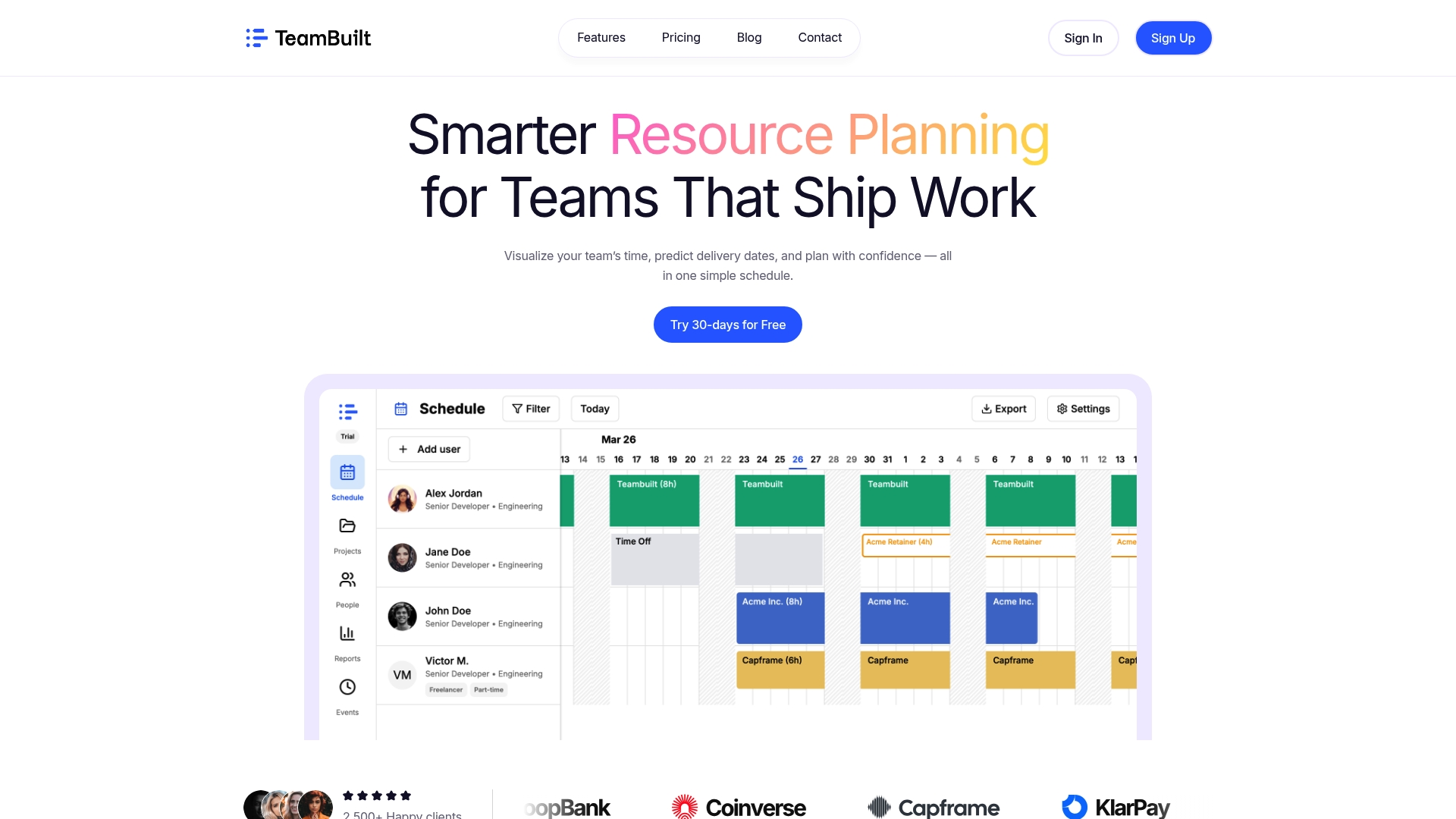
Teambuilt is built specifically for teams like yours. The platform gives you real-time visibility into team capacity, workload distribution, and project timelines in one centralized place. You can see who is over-allocated, forecast delivery dates based on actual availability, and coordinate across teams without the back-and-forth. Explore the full set of Teambuilt features to see how resource scheduling, utilization tracking, and cross-team planning work together to replace scattered workflows with a system your whole team will actually use.
Frequently asked questions
What is the first step in resource planning?
The first step is to define project scope and objectives so you know precisely what resources are needed before any assignments are made.
How often should resource plans be updated?
Resource plans should be reviewed at each major project milestone and whenever priorities, team capacity, or project requirements shift, because outdated plans create the same problems as no plan at all. The goal is to monitor and adjust resources continuously, not just at kickoff.
What’s the difference between resource leveling and smoothing?
Resource leveling adjusts timelines to balance workloads, while smoothing keeps deadlines fixed and redistributes task intensity within available capacity, making it the right choice when delivery dates cannot move.
How can startups handle skill gaps during resource planning?
Use scenario planning and skill-matching to redistribute work based on who can flex into adjacent roles, and use identified gaps to inform near-term training or hiring decisions.
Why do most resource plans fail in startups?
Most fail because teams rely on reactive, ad hoc approaches rather than structured, scenario-based planning and regular capacity reviews, which means conflicts surface as crises rather than early warnings.
Recommended
- Optimize Team Capacity: A Practical Guide for Growing Teams | Teambuilt Blog
- Optimize Team Capacity: A Practical Guide for Growing Teams | Teambuilt Blog
- Team scheduling: optimize resource allocation and workflow | Teambuilt Blog
- Streamline your team scheduling workflow: max efficiency | Teambuilt Blog