
Top 6 tasklly.webflow.io Alternatives for Team Resource Planning 2026


Juggling team schedules, project timelines, and resource capacity across multiple spreadsheet tools creates confusion and results in missed deadlines for growing companies. Most team resource planning software locks essential features like capacity forecasting or advanced reporting behind expensive plans or lacks native integrations that reduce manual updates. This comparison covers transparent pricing, workload visualization, and collaboration features across top alternatives so you can choose a planning platform that keeps your teams aligned without hidden costs or missed connections.
Table of Contents
Teambuilt
At a Glance
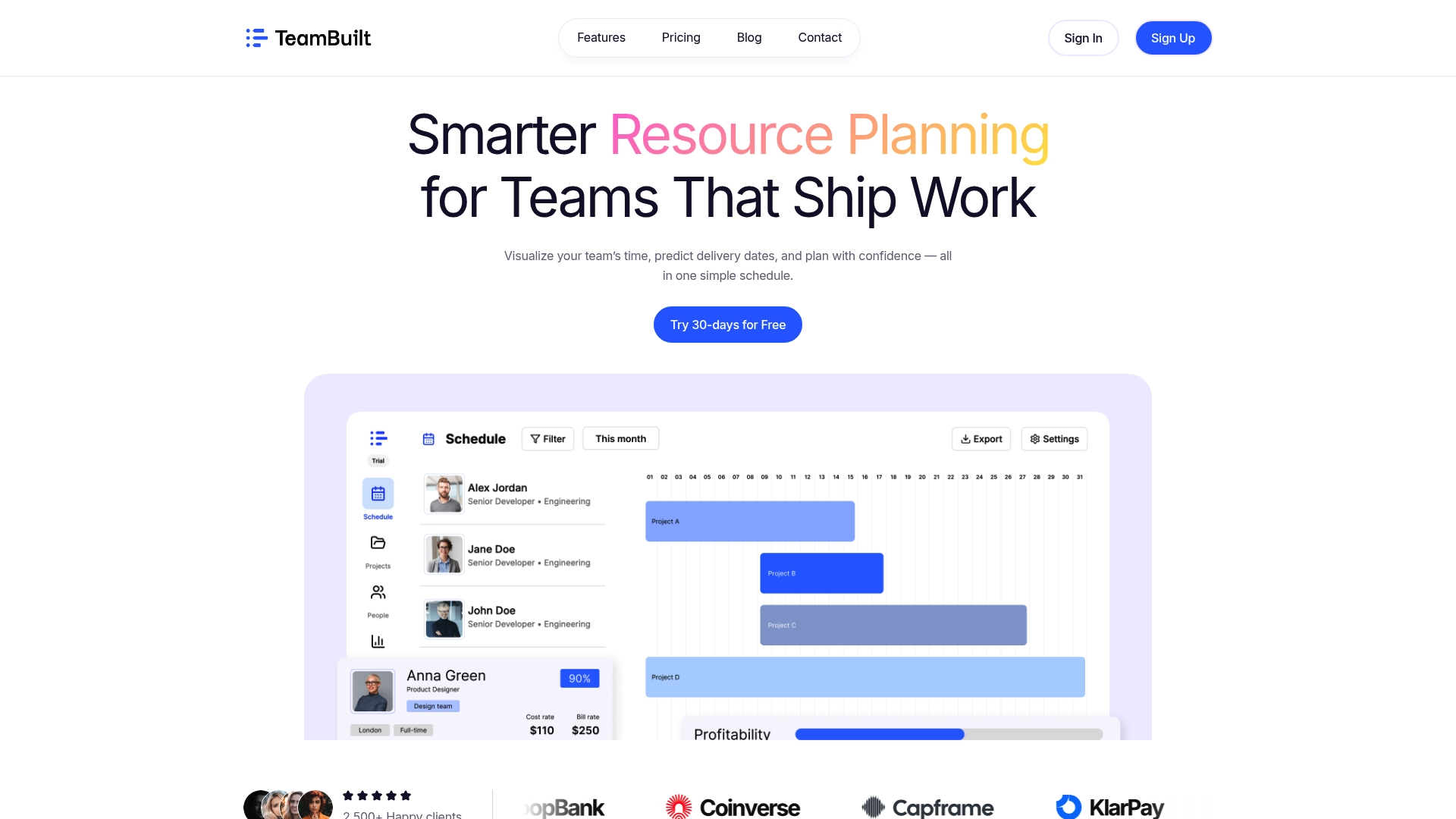
Teambuilt offers a free tier and paid plans starting at $3.6 per user per month billed annually, which makes low-cost, seat-based planning feasible for growing teams. The product centers on live visibility into who is busy and when, turning resource shifts into immediate replanning signals.
Core Features
- Team scheduling visualization that maps availability across people and teams in a single view.
- Real-time project forecasts and delivery dates that update as capacity changes so timelines stay connected to workload.
- Capacity and workload tracking with utilization metrics to identify overbooked resources.
- Cross-team coordination tools to reconcile dependent work across departments and reduce conflicts.
Key Differentiator
Unified, real-time visualization of team workload and project timelines that scales with organization size is the capability Teambuilt highlights. That single view keeps capacity and delivery dates linked so planners see the downstream effect of assigning or shifting work.
Pros
- Visual planning halves the mental overhead of juggling spreadsheets. When a task is moved, the schedule and utilization numbers update in the same interface.
- Forecasting ties resource capacity directly to delivery dates, giving you a defensible timeline to share with stakeholders rather than a guess pulled from email threads.
- The platform reduces spreadsheet sprawl by centralizing availability, utilization, and project timelines in one place.
- Integrates via an open API and ready-made connectors so you can push assignments from your PM or HR systems rather than reentering work.
- Designed for teams that need to adapt quickly; planners can reassign people and see the forecasted delivery impact within seconds.
Cons
- The visual planning model has a learning curve for new users, especially those coming from spreadsheet-first workflows.
Who It’s For
Project managers, resource managers, and operations leads at startups and growing companies that juggle multiple teams and shifting priorities. Useful for agencies that need to avoid overbooking and for product teams that need delivery forecasts tied to actual capacity.
Unique Value Proposition
Real-time linkage between resource capacity and forecasted delivery dates. That connection changes planning from reactive firefighting into a repeatable practice where a single capacity adjustment recalculates delivery confidence across affected projects.
Real World Use Case
A startup coordinates three product squads and a QA pool. When a sprint gets overloaded, planners slide capacity from one squad to QA, and the forecasted delivery dates for the affected epics update immediately. Client communications reflect the revised dates without reworking separate status documents.
Pricing
Free tier available. Paid plans are listed as $4 per user per month (Pro) and $3.6 per user per month (Growth) when billed annually. The pricing model supports per-seat scaling for teams that add contractors or hires over time.
Website: https://teambuilt.app
SmartTask
At a Glance
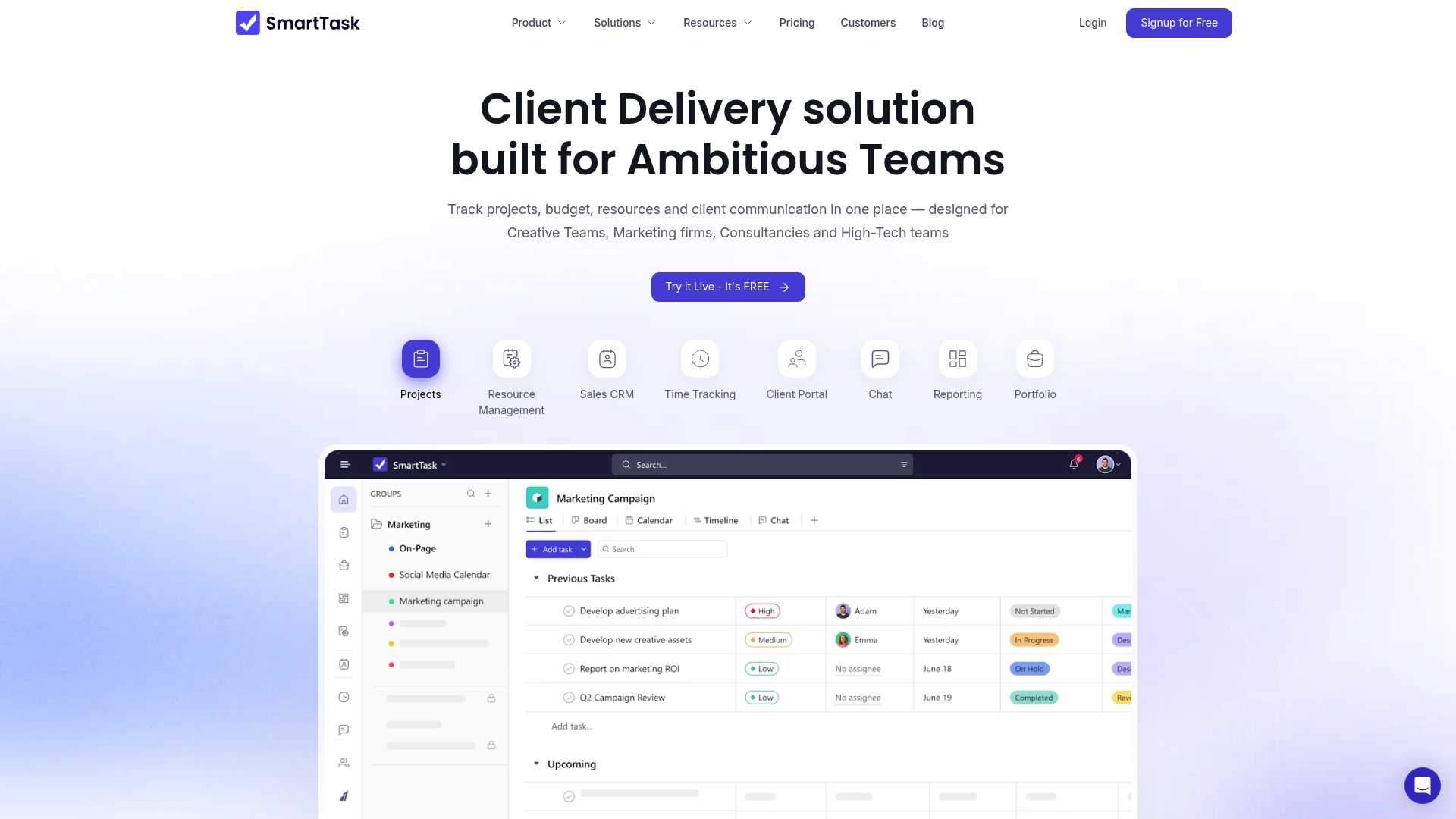
A Premium plan at $4 per user per month and a Business plan at $8 per user per month make SmartTask a notably low-cost all in one option with a usable free tier. It bundles project management, AI driven resource planning, CRM, time tracking, and client portals for teams sized about 5 to 50.
Core Features
- Project management: task lists, milestones, portfolio views, and customizable Kanban, timeline, calendar, and dashboard layouts.
- Resource management: AI driven planning and capacity balancing to reduce over allocation and surface conflicts.
- Time tracking: built-in timers and exportable logs for client billing and utilization reports.
- CRM and client portals with white labeling and custom domains for external collaboration.
- Automation, recurring tasks, auto scheduling, file sharing from cloud services, and reporting with activity logs.
Key Differentiator
SmartTask combines project management, resource planning, CRM, and client collaboration with process mapping support in a single product. That package targets small to medium creative and consulting teams looking to replace multiple point tools, not large multi team enterprises that need centralized cross team planning like TeamBuilt.
Pros
- Quick onboarding and an intuitive interface let new team members start contributing in days instead of weeks.
- Flexible views let project managers switch between Kanban, timeline, and portfolio perspectives without rebuilding workflows.
- Resource management and Time tracking in the same product reduce the number of subscriptions you pay for and simplify billing.
- Positive vendor responsiveness and an active development roadmap reported by users means feature gaps are addressed regularly.
- Cost structure with low per user pricing makes consolidating tools financially attractive for small agencies.
Cons
- Brand recognition is lower than major competitors, which can raise procurement questions for risk-averse buyers.
- Pricing transparency for large deployments is limited; enterprise quotes require contacting sales and can delay budget planning.
- Independent third party reviews are relatively scarce, leaving some evaluators to rely on vendor materials and user anecdotes.
When It May Not Fit
If you manage dozens of teams and need enterprise grade forecasting, audit trails, or detailed cross team capacity modeling, SmartTask may feel lightweight. Large organizations that require published enterprise pricing or broad independent reviews will find the vendor maturity less reassuring than incumbent providers.
Notable Integrations
- Slack
- Microsoft Teams
- HubSpot
- Trello
- Jira
- Notion
- Monday.com
- Salesforce
Who It’s For
Teams of roughly 5 to 50 employees in marketing, creative, consulting, or small software groups that want one place for tasks, resource planning, client work, and billing. Good where replacing a handful of point tools reduces overhead and license costs.
Real World Use Case
A mid sized marketing agency runs campaigns, tracks billable hours, and delivers client reports from SmartTask. Branded client portals speed approvals while built in time logs feed invoices, removing separate time and CRM subscriptions.
Pricing
Free tier available. Premium at $4 per user per month and Business at $8 per user per month. Enterprise plans are available by contacting sales for custom terms and volume discounts.
Website: https://smarttask.io
Upbase
At a Glance
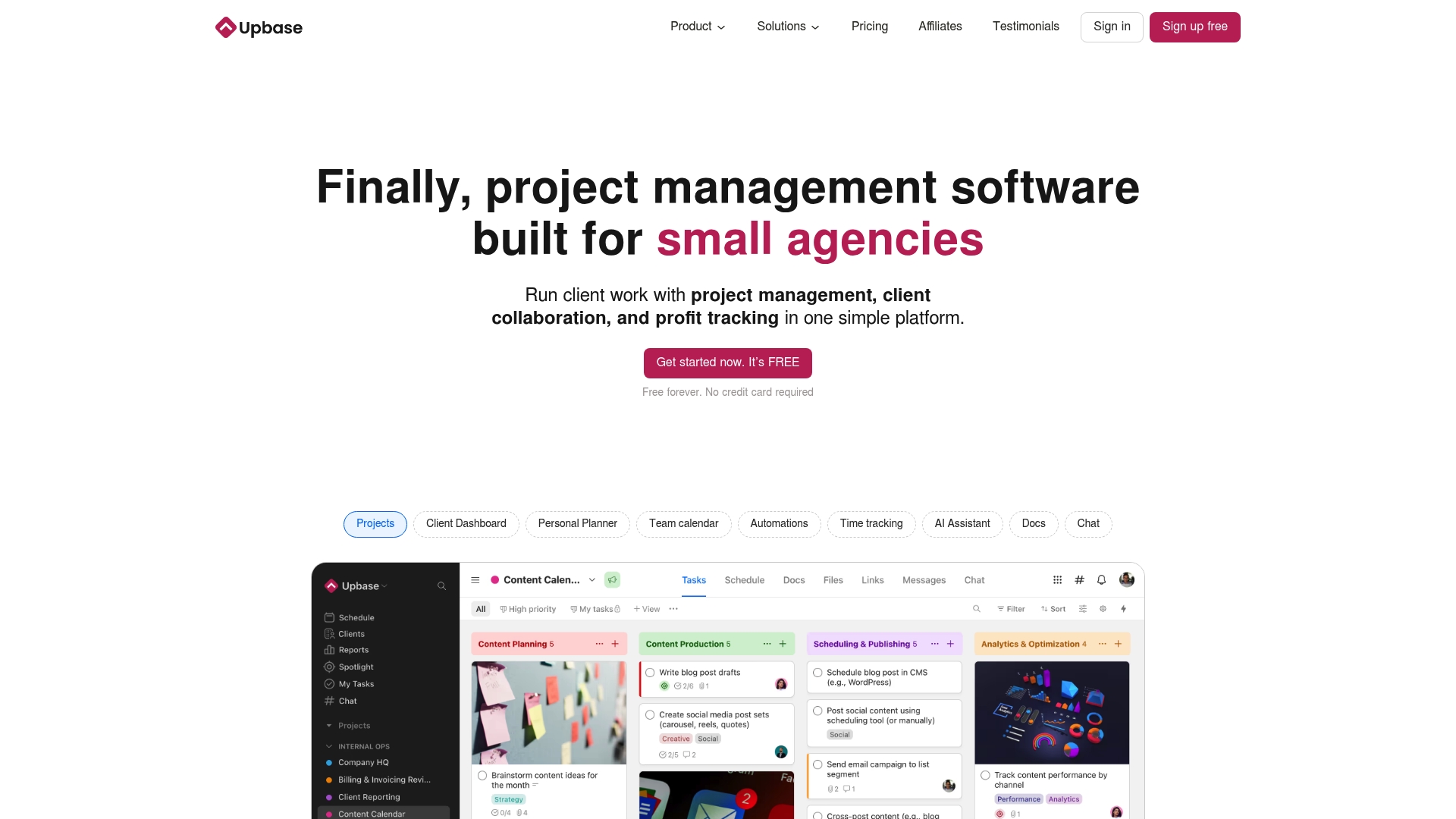
Free forever plans with paid tiers starting at $10 per user per month and an unlimited plan at $99 per month make Upbase a low-risk option for small agencies and freelancers who want to test client workflows without vendor lock-in. The platform bundles client management, time tracking, and profitability reporting in one workspace.
Core Features
Upbase centralizes client work with client dashboards, tasks, a Daily Planner, and built-in time tracking tied to timesheets and estimates. It includes docs and knowledge bases, file sharing, messaging, visual timelines, automations, and calendar sync with Google Calendar. An AI productivity assistant helps draft notes and summarize threads.
Key Differentiator
Upbase targets client-focused teams by combining granular sharing controls with profitability tracking so you can show clients what was delivered and what it cost. That mix of client visibility plus billable hours inside the same project view is the platform’s main operational advantage over generic task apps.
Pros
- Outstanding price-to-value ratio for small teams. The free forever tier plus $10 per user starting plans reduce the cost barrier when you add contractors or test features.
- Client dashboards centralize client-facing status, approvals, and files so account managers stop duplicating updates across email threads and Slack.
- Built-in Time tracking and timesheets connect directly to project profitability reporting, helping you see margin per client without exports.
- Clean, minimal UI makes onboarding fast; teams I worked with were productive the same day they switched from spreadsheets.
- Responsive support and active development mean frequent small improvements based on customer feedback.
Cons
- Mobile app features lag the desktop experience. Reviewers and customers report gaps in editing docs and time entry on mobile devices.
- Lacks some advanced project controls common in enterprise PM tools, such as resource leveling across dozens of projects or enterprise-grade permission hierarchies.
- No clear separation between personal task lists and shared client projects, which can clutter individual workflows in mixed-use accounts.
When It May Not Fit
If you run a larger delivery organization that needs resource forecasting across hundreds of assignments or strict enterprise security controls, Upbase will feel narrow. Teams requiring deep portfolio reporting, advanced permission trees, or native large-scale resource leveling should look elsewhere.
Who It’s For
Small marketing and creative agencies, independent consultants, and freelancers who manage multiple clients and bill hours will get the most value. Upbase suits teams that want client transparency, simple profitability tracking, and a single place for files, chat, and time.
Real World Use Case
A boutique marketing agency replaced three tools with Upbase: a task board, time tracker, and shared drive. Account managers publish client dashboards, creatives log billable time against tasks, and finance pulls profitability from the same project—cutting month-end reconciliation time significantly.
Pricing
Free forever tier available. Paid plans start at $10 per user per month for standard features. An unlimited plan is offered at $99 per month for unlimited users, useful for small agencies that want predictable billing.
Website: https://upbase.io
MagicTask
At a Glance
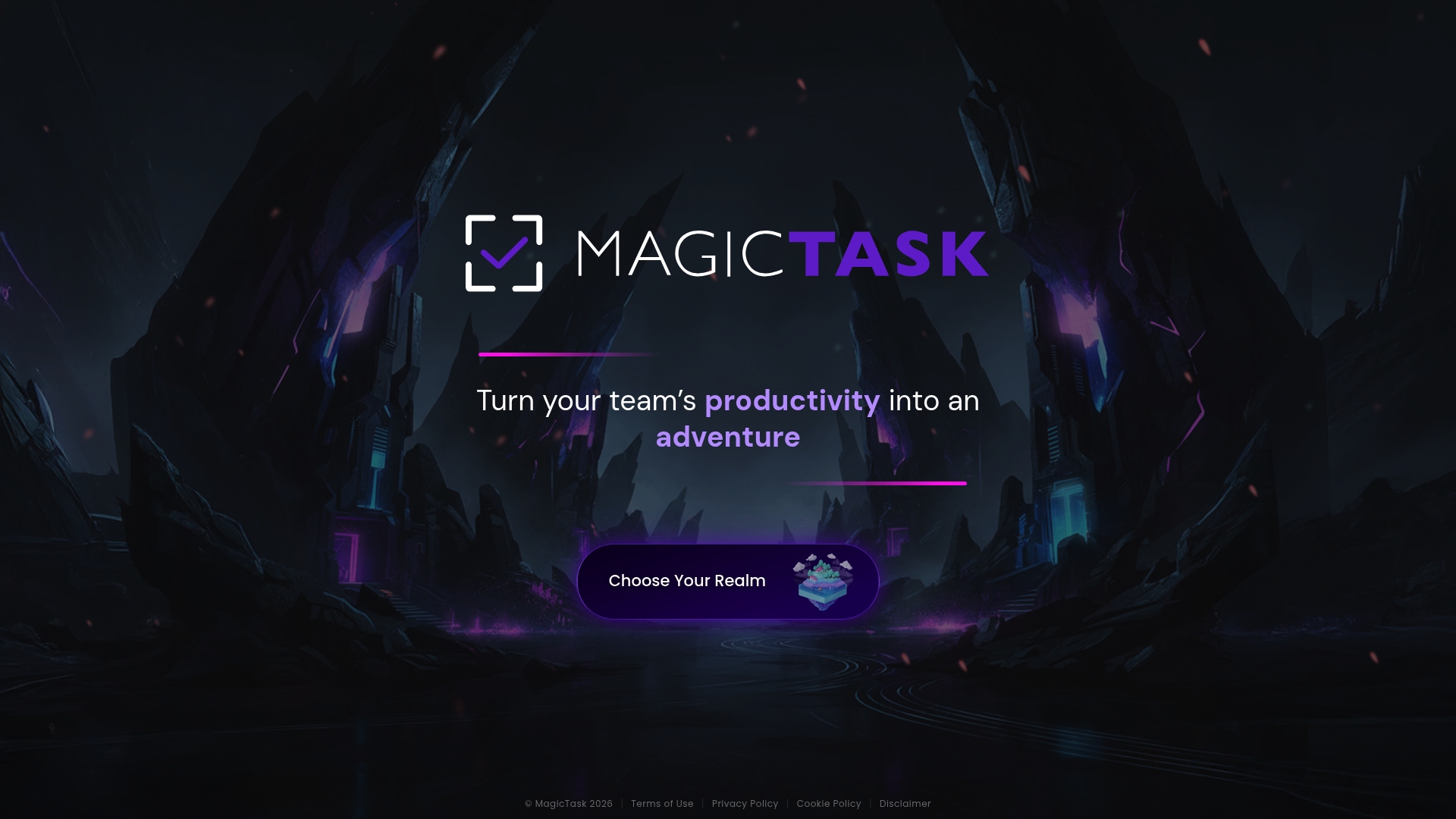
MagicTask centers task management around a realm picker and gamified progression, turning lists into themed challenges that aim to raise daily engagement. The interface favors simplicity and play over deep project controls, and support is available via Discord and Slack channels.
Core Features
MagicTask offers gamification layered on basic task lists, plus a realm-based organization model that groups work by theme. Tasks are quick to create and edit, and core collaboration features let teams comment, assign, and track small workflows.
The product also publishes resources like a blog and ebooks to help teams use gamified patterns.
Key Differentiator
MagicTask’s defining choice is theatrical task grouping: the realm mechanic reframes routine work as short, themed campaigns. That makes the product a behavioral tool as much as a task board, designed to nudge participation through point-style rewards and visible progression.
Pros
-
Simple list creation lets teams onboard in minutes. The minimal UI reduces training time for nontechnical contributors.
-
Gamified rewards tend to increase visible participation during sprints and short campaigns, which helps managers track engagement without heavy reporting.
-
Realm organization makes recurring efforts feel distinct, useful for marketing cycles or release milestones that benefit from a thematic wrapper.
-
Support via community channels like Discord and Slack provides quick informal help and peer tips for setup and tactics.
Cons
-
The feature set is intentionally narrow, so advanced project controls such as dependency mapping, workload balancing, or time tracking are absent.
-
Integrations are limited or undocumented in the product data, which forces teams to rely on manual exports or third-party connectors for automation.
-
Independent coverage is sparse, so there is limited third-party validation of long term reliability or scalability.
When It May Not Fit
If you manage multi-phase programs with complex dependencies or need enterprise reporting, MagicTask will feel too basic. Large teams that require SSO, detailed audit logs, or native time sheets should look elsewhere. Also avoid it if your workflow depends on out-of-the-box integrations with core finance or HR systems.
Who It’s For
Small to medium teams that prioritize morale and short-term engagement over deep resource planning. Product marketing groups, creative teams, and remote squads looking to inject playful incentives into daily task work will get the most value.
Real World Use Case
A marketing team used MagicTask during a month-long campaign to convert repetitive editorial tasks into themed realms. Team members completed microchallenges, shared progress in Discord, and the manager saw participation rise without adding status meetings.
Pricing
Pricing details were not provided in the product data. The vendor appears to position MagicTask as an engagement-first offering; contact the vendor or visit the product site for current plans, trials, or enterprise options.
Website: https://magictask.io
DoneDone
At a Glance
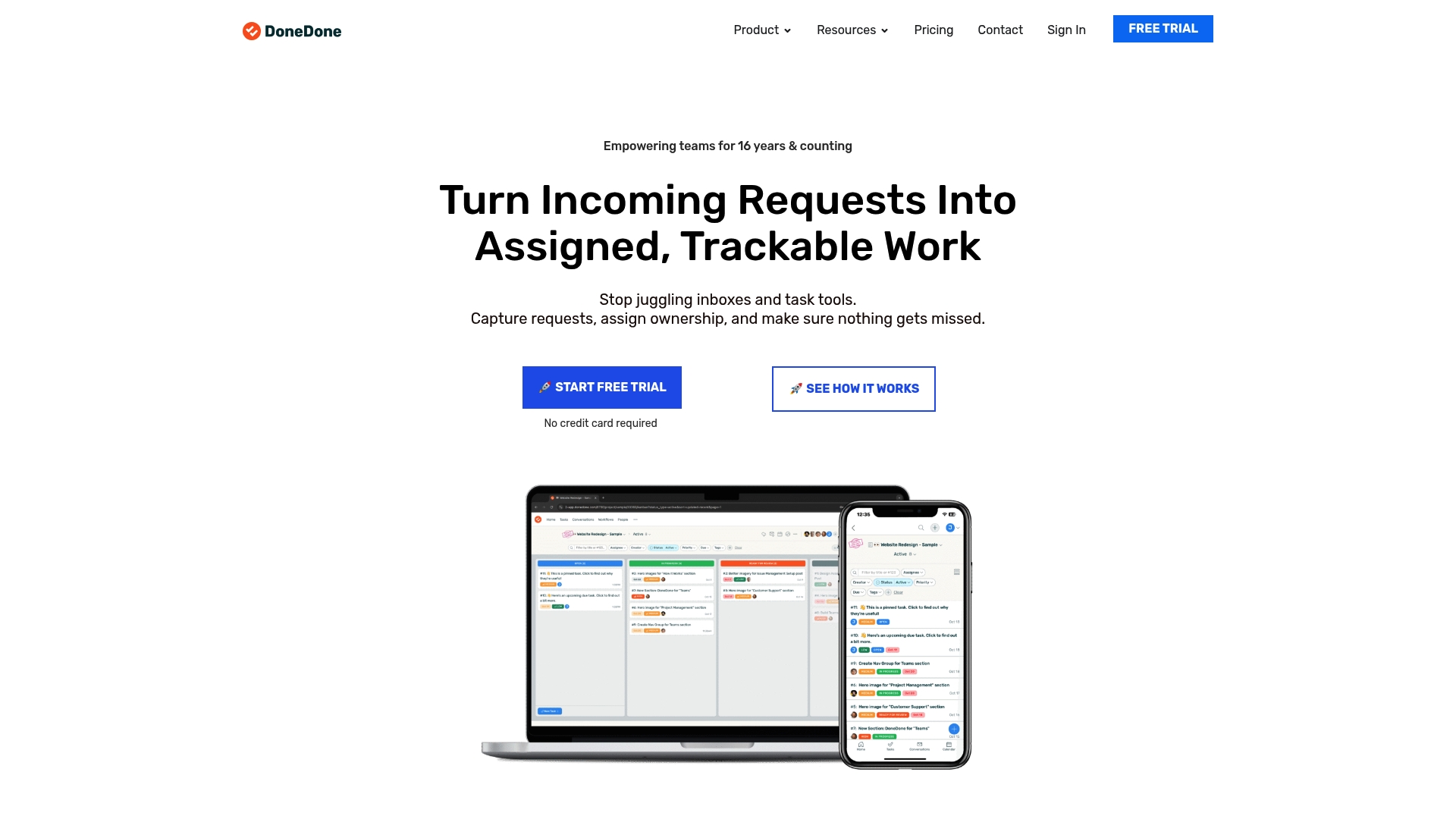
Helping teams since 2009, DoneDone combines issue tracking and a lightweight help desk into a single interface that gets teams productive fast. The product emphasizes quick setup and a no-friction workflow for small to medium teams that do support and task work in the same place.
Core Features
- Task Management with workflows, checklists, scheduled tasks, and guest user support for external collaborators.
- Help Desk features including shared mailboxes and email-to-task conversion so incoming requests become actionable items.
- Automation for auto assignment, scheduled tasks, and custom workflow rules that reduce repetitive triage.
- Organizational tools like tags, filters, Kanban boards, and internal comments for clarifying work.
Key Differentiator
DoneDone’s practical blend of support and project tasks is tuned for teams that do both work and customer requests without a dedicated ops role. That focus makes it narrower than TeamBuilt, which targets multi-team forecasting, capacity planning, and resource modeling.
Pros
- Quick onboarding. Minimal configuration and a predictable layout get new users contributing within hours rather than days.
- Shared Inbox centralizes email requests and prevents lost tickets, which helps small support teams keep response times steady.
- Automation cuts repetitive triage work with rules that auto assign and schedule follow ups.
- Good external collaborator support. Guest user features let clients or contractors view only what they need to see without full seats.
- Combines support and task views so teams stop switching between separate tools and lose context.
Cons
- Some users report friction with account management, including membership redemption and administrative controls.
- Limited presence on major review platforms suggests a smaller user base and fewer public references to draw on.
- Not built for dense enterprise needs. Feature depth for complex workflows and large-scale user administration is limited.
When It May Not Fit
If your organization requires advanced resource forecasting, capacity modeling, or cross-team dependency management, DoneDone will feel thin. Large support centers that need detailed user provisioning or single sign-on at scale should look elsewhere.
Notable Integrations
DoneDone connects to email through forwarding and email-to-task conversion, which is the primary integration listed by the vendor. That link makes it easy to treat inbound messages as tickets without manual entry.
Who It’s For
Small to medium teams that handle customer requests and internal tasks in the same system. Useful for digital agencies, product teams with light support loads, and organizations that prefer a single, low-overhead tool over separate help desk and project platforms.
Real World Use Case
A four-person agency routes client support email into DoneDone, converts messages to tickets automatically, assigns each ticket to an owner, and tracks progress with checklists. Internal comments replace long email threads and speed up resolution.
Pricing
The vendor lists tier-based plans and a free trial on the website, with feature tiers that scale from basic help desk needs to fuller team workflows. Visit the vendor site for exact plan details and current trial offers.
Website: https://donedone.com
Airtable
At a Glance
Airtable pairs a relational database with a no-code app builder plus AI features in the same workspace, letting teams turn tables into lightweight apps without hiring engineers. That combination is the clearest reason teams pick it for cross-functional workflows.
Core Features
Relational bases with linked records and field types let you model customers, projects, or inventory without SQL. Custom interfaces turn those tables into focused apps for specific roles.
Advanced automation tools trigger multi-step workflows and can call AI actions for summarization or field generation. Built-in views include grid, calendar, kanban, and gallery for different planning styles.
Permissions and governance controls support workspace roles and shared bases, while reporting and dashboards provide visual summaries for stakeholders.
Key Differentiator
The single workspace that supports data modeling, app-like interfaces, and AI-assisted automation is Airtable’s defining angle. That mix lets product teams and operations build internal tools fast while keeping the underlying data structured and queryable.
Pros
-
Flexible data modeling lets you link records across tables, which replaces many ad hoc spreadsheets and reduces reconciliation work.
-
The interface builder turns bases into role-specific apps; project managers can hide fields and show only the views their teams need.
-
Powerful automation reduces manual handoffs. Triggers, conditional logic, and AI actions handle routing and light data cleanup without code.
-
Broad collaboration features include real-time updates and guest access, making it simple to share boards with clients or contractors.
-
Extensive integration options mean you can push data to Slack, CRM systems, or analytics pipelines without building a custom connector.
Cons
-
Complex configurations have a steep learning curve. Building normalized schemas and reliable automations requires planning and some technical familiarity.
-
Reporting on very large datasets is limited; filtering and aggregation slow down once bases grow beyond a few hundred thousand records.
-
The mobile app can feel clumsy for deep workflows, which frustrates users who need full functionality on phones.
-
Support response quality varies by plan level, which can stretch onboarding times for teams without a dedicated admin.
When It May Not Fit
If your workflow requires heavy analytics across millions of rows or high-concurrency transactional workloads, Airtable will feel constrained. Also avoid it when you need native, built-in time tracking or advanced financial forecasting out of the box.
Notable Integrations
- Slack, Google Drive, Salesforce, Jira, Zendesk, Zapier, Microsoft Outlook, Google Calendar.
These integrations cover common collaboration, CRM, and ticketing flows so you can automate notifications, attach files, and sync events without middleware.
Who It’s For
Teams that want to build custom operational apps without full engineering support. Product managers, marketing ops, agencies, and small platform teams who need structured data plus flexible views will get the most value.
Real World Use Case
A marketing agency consolidates campaign briefs, assets, and vendor rates into one base, builds a lightweight client-facing interface, and automates weekly performance snapshots to Slack. That replaces three separate tools and cuts reporting time by several hours each week.
Pricing
Free tier available. Paid plans start at $20 per user per month billed annually, with higher tiers and enterprise options for SSO, advanced governance, and priority support.
Website: https://airtable.com
Comparative Analysis Section
Choosing the ideal team resource planning software requires an understanding of how each product’s features and focus areas align with your operational needs. Here, we analyze the tradeoffs between the options reviewed in the article to provide clarity for specific use cases.
Task Coverage and Versatility
The breadth of tasks a platform can support often determines its value to organizations. Teambuilt excels in real-time capacity tracking linked to delivery forecasts, ensuring rapid adjustments in response to workload fluctuations. This capability reduces planning reaction times and fosters data-driven decision making. SmartTask, on the other hand, appeals to smaller teams due to its bundled CRM, time tracking, and project management features—a combination that reduces the need for additional software purchases but might lack the depth required by larger organizations needing detailed cross-team coordination.
Ease of Adoption
Ease of onboarding and interface intuitiveness are crucial factors, especially for teams transitioning from other tools. Teambuilt offers a unified visibility system that integrates with external tools, enhancing flexibility but introducing a learning curve for spreadsheet-centric teams. Comparatively, MagicTask provides an immediately accessible, gamified task management approach, making it advantageous for teams seeking high engagement and morale improvements over planning capabilities. This difference highlights distinct priorities and use cases between the platforms.
Best Fit Scenarios
- Choose Teambuilt if your organization requires detailed capacity utilization metrics and instantaneous adjustment forecasting, suitable for medium to large teams juggling dynamic project schedules.
- Select SmartTask for smaller, resource-focused teams who benefit from consolidated project and client management capabilities.
- Opt for MagicTask when team motivation and quick onboarding are immediate priorities over deep project planning requirements.
- Pick Upbase for freelancers or small consultancies keen on maintaining granular project profitability insights directly tied to built-in client transparency.
- Consider DoneDone for teams needing integrated help desk and task management to simplify support workflows.
Our Pick
Teambuilt remains the recommended choice for teams prioritizing tracking of workload and project delivery expectations, where the unified visual approach and API integrations provide clear advantages. It may not suit teams solely requiring CRM or motivational environments, where options like SmartTask or MagicTask better align with their needs.
Team Resource Planning Software Comparison
Evaluate these software options based on their features, differentiators, and limitations to choose the best fit for your needs.
| Product | Best for | Key differentiator | Pricing | Notable limitation |
|---|---|---|---|---|
| Teambuilt | Startups and growing teams with resource agility | Real-time capacity and delivery date sync | Free tier; Paid from $3.6/user/month | Learning curve for users transitioning from spreadsheets |
| SmartTask | Small agencies integrating PM and CRM tools | Combines project management and client portals | Free tier; Paid from $4/user/month | Limited enterprise deployment transparency |
| Upbase | Small agencies needing client-facing profitability tracking | Client dashboards and profitability monitoring | Free tier; Paid from $10/user/month | Mobile app functionality lags behind desktop version |
| MagicTask | Teams boosting morale through gamified task management | Tasks grouped by themed realms | Not disclosed | Narrow feature set lacks dependency mapping and robust integration options |
| DoneDone | Teams handling both internal and client support tasks | Combined support and task management in one interface | Feature-tier pricing; Free trial | Limited scalability for enterprise-grade requirements |
| Airtable | Teams requiring custom app-like workflows with data | Combines databases with no-code app-building flexibility | Free tier; Paid from $20/user/month | Handling of very large datasets can slow operations |
Unlock Real-Time Team Resource Planning with Teambuilt
Managing multiple teams while predicting delivery dates can feel overwhelming when relying on scattered spreadsheets and disconnected tools. This article highlights the frustrations of lacking unified visibility into team capacity and workload, key challenges in finding reliable tasklly.webflow.io alternatives. Teambuilt provides live scheduling visualization, capacity tracking, and project forecasting designed specifically for growing companies balancing dynamic priorities across teams.
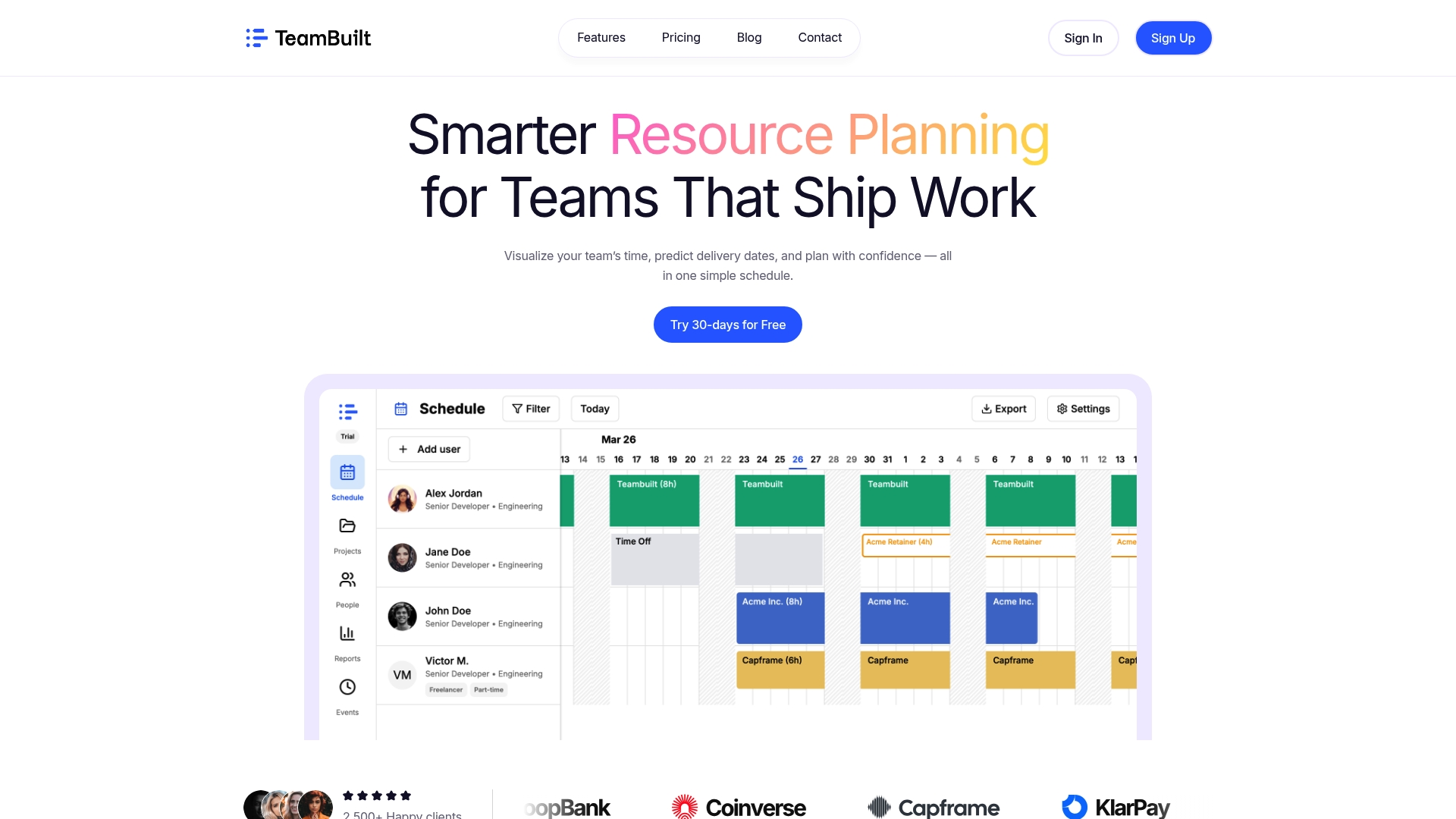
See how Teambuilt turns capacity shifts into instant updates, reducing overbooking risks and connecting resource availability directly with delivery timelines. Visit Teambuilt to discover how you can centralize planning, enhance cross-team coordination, and gain confident delivery forecasts. Import your data and experience real-time workload visualization that simplifies complex resource planning in minutes.
Frequently Asked Questions
How does Teambuilt’s real-time project forecasting work?
Teambuilt provides real-time project forecasts and delivery dates that update automatically as team capacity changes. This is achieved through its capacity and workload tracking features, which ensure that timelines remain aligned with actual workload. Users can rely on these accurate timelines for better planning and stakeholder communication.
What is the difference between SmartTask and Teambuilt?
SmartTask combines project management, resource planning, CRM, and client collaboration, making it great for small teams seeking an all-in-one solution. In contrast, Teambuilt focuses on real-time visibility into team workload and capacity, which is essential for organizations that need to avoid overbooking team members and manage multiple dependent teams effectively.
Which platform is better for creative agencies, Teambuilt or Upbase?
Upbase is particularly suited for client-focused teams, combining client management and profitability tracking, which is great for smaller agencies testing workflows without commitment. Conversely, Teambuilt excels in providing real-time linkage between resource capacity and delivery forecasts across larger, more complex teams that need immediate replanning capabilities.
Can I use Teambuilt if my team is smaller than five members?
Teambuilt is designed for startups and growing teams, making it suitable even if your team is small. Its pricing starts at $3.6 per user per month when billed annually, allowing teams of any size to benefit from professional resource planning without significant upfront costs.
What unique feature does Teambuilt offer for cross-team coordination?
Teambuilt provides cross-team coordination tools that help reconcile dependent work across departments, effectively reducing conflicts. This allows project managers to adjust resources on the fly, reducing the risk of overlap and mismanagement in complex environments.
Recommended