
Team Communication Essentials for Leaders in 2026



TL;DR:
- Miscommunication hampers trust, delays projects, and fosters second-guessing within teams. Establishing clear channels, response expectations, and protocols creates a shared operating system that improves collaboration and accountability. Reinforcing norms through rituals and leadership modeling ensures long-term effectiveness of communication practices.
Miscommunication costs teams more than lost time. It erodes trust, stalls projects, and creates a culture where people second-guess every message they send. The team communication essentials covered in this guide are not about adding more meetings or sending longer emails. They are about giving your team a shared operating system: clear channels, defined response expectations, and protocols that make collaboration feel less like guesswork and more like a well-run relay race. Whether you lead a remote team, a hybrid squad, or a growing agency, the structure here will help you build communication that actually holds.
Table of Contents
- Key Takeaways
- 1. Team communication essentials: criteria and foundations
- 2. Choosing the right communication channels
- 3. Running meetings that actually produce outcomes
- 4. Managing urgent communication and incident response
- 5. Async communication norms and response expectations
- 6. Building long-term communication habits that stick
- My honest take on why communication norms actually matter
- See how Teambuilt supports your communication system
- FAQ
Key Takeaways
| Point | Details |
|---|---|
| Define channel purposes upfront | Assign every tool a specific use case so team members stop guessing where to post. |
| Set response time windows explicitly | Written norms for reply speed reduce anxiety and protect deep work time. |
| Turn meeting talk into tracked tasks | Action items with owners and deadlines close the gap between decisions and delivery. |
| Build an incident communication system | Pre-assigned roles and severity templates prevent chaos when something breaks. |
| Treat async as the default, sync as the exception | Reserve real-time meetings for decisions that genuinely need live dialogue. |
1. Team communication essentials: criteria and foundations
Before picking tools or writing norms, you need a framework for evaluating whether your communication practices actually work. Good communication is not just frequent. It is clear, channel-appropriate, and backed by agreements the whole team has signed off on.
A communication charter gives your team the operational rules that convert vague expectations into concrete behavior. The best ones are built in a single two-hour session and produce 6 to 10 concrete agreements rather than a list of aspirational values nobody reads again.
Here is what every solid communication foundation should cover:
- Channel assignments: Which tool handles which type of message, and why
- Response time expectations: Default windows for urgent versus standard requests, by channel
- Meeting norms: Cadence, required roles (facilitator, note-taker), and documentation standards
- Decision-making process: Who has final say, how disagreements get escalated, and where decisions are recorded
- Working agreements: Agreed hours for availability, off-hours message expectations, and how to flag a blocker
Pro Tip: Write your working agreements in a shared doc and review them every quarter. Norms drift when teams grow or change. A short quarterly check-in catches gaps before they become friction.
2. Choosing the right communication channels
The most common mistake teams make is treating every tool as interchangeable. When everything lands in Slack, people treat every message as urgent. When everything goes to email, nothing feels timely. Scaling teams need multiple channels assigned to different purposes, and those assignments need to be explicit.
| Channel | Best use case | Avoid using it for |
|---|---|---|
| Slack or Teams | Quick questions, status updates, blockers | Long decisions, sensitive feedback |
| Formal communication, external partners | Fast-moving async threads | |
| Video calls | Complex discussions, alignment sessions | Simple yes/no decisions |
| Docs (Notion, Confluence) | Decisions, knowledge base, SOPs | Real-time conversation |
Once the table is agreed on, communicate it to the team with examples. Abstract rules like “use docs for decisions” get ignored. Concrete examples like “after every meeting, post the final decision in the project’s Notion page before end of day” actually stick.
A few norms worth codifying explicitly:
- Reserve @channel tags in Slack for messages that affect the entire group right now
- Use email when a thread involves more than two external stakeholders or requires a formal record
- Default to async video tools (Loom, for instance) when you need to explain something complex but do not need a real-time response
- Keep documentation current, because a knowledge base no one trusts is worse than having none at all
Pro Tip: Pin your channel norms doc in every Slack channel description. New team members find it immediately, and it saves you the “where do I post this?” question repeatedly.
3. Running meetings that actually produce outcomes
Meetings fail when they are used as the default for things that could have been a Slack message or a shared doc. They succeed when they are reserved for decisions, creative work, or conversations where real-time dialogue adds something a written thread cannot.
Every meeting should open with a stated objective and a written agenda shared at least 24 hours in advance. This is not formality for formality’s sake. It lets participants arrive prepared, which cuts the time spent catching everyone up.
The part most teams skip is the action item table. Meeting minutes should include assigned owners and concrete deadlines to prevent missed next steps. A simple format works well:
| Action item | Owner | Deadline |
|---|---|---|
| Draft revised project scope | Jordan | Friday, March 7 |
| Share vendor shortlist with team | Alex | Tuesday, March 4 |
| Update Notion with final decision | Morgan | By end of meeting day |
High-accountability teams go one step further: they confirm every action item verbally before closing the meeting. The owner repeats the task and the deadline out loud. It takes two minutes and eliminates the “I thought someone else was handling that” follow-up.
Pro Tip: Distribute meeting minutes within 24 hours of the meeting. Waiting longer lets momentum die and increases the chance that action items slip through without follow-through.
4. Managing urgent communication and incident response
When something breaks, communication either holds the team together or makes the situation worse. Teams without a defined incident communication system tend to flood every channel with duplicate updates, leave stakeholders in the dark, or over-communicate noise while under-communicating facts.
The fix is a pre-built structure. Incident communication requires defined roles, channels, templates, and update cadence before anything goes wrong. You cannot design your process in the middle of a crisis.
Here is what a basic incident communication structure looks like:
- Incident commander: One person owns all external and internal updates during the incident. No one else posts public status updates.
- Severity tiers: Define at least three levels (P1, P2, P3) with clear criteria for each, like customer-impacting outages versus internal bugs.
- Update cadence: For P1 incidents, post a status update every 30 minutes even if nothing has changed. Silence reads as confusion.
- First acknowledgment: Send the first message within 15 minutes of detection. Trust depends more on early acknowledgment than on technical resolution speed.
- Post-incident review: Document what happened, what was communicated, and what will change. Share it with the team within 48 hours.
For lower-severity events, async Slack updates are sufficient. Reserve synchronous war rooms for highest-severity issues that require rapid, real-time coordination across multiple people. Treating every incident as a P1 war room burns your team out fast.
Track your effectiveness with metrics like mean time to acknowledge (MTTA) and time to first customer update. These numbers tell you whether your communication system is actually working or just feeling busy.
5. Async communication norms and response expectations
One of the least glamorous and most impactful things you can do for effective team collaboration is write down exactly how fast people are expected to reply to different types of messages. Without this, people either respond to everything immediately (destroying focus) or respond to nothing on time (creating frustration and missed deadlines).
Here is a practical tiered system that works for most remote and hybrid teams:
- Urgent blockers in Slack: Expected response within 4 business hours during working hours. If no response, escalate using a defined path (tag the manager, move to email).
- Standard questions or requests: Response expected within one business day for non-blocking items.
- FYI messages or announcements: No response required unless the sender specifically asks for confirmation.
- Email threads: Two business days is a reasonable default for internal correspondence.
- After-hours messages: No expectation of response until the next working day unless the sender explicitly marks it as urgent using an agreed signal.
The critical insight here is that fewer than 5 to 10 percent of messages are actually urgent. When teams define urgency clearly, most people realize they were treating every message as a priority. That recognition alone changes behavior.
Pro Tip: Ask team members to update their Slack status when they are in deep work. A simple " focused until 2pm" status sets expectations without requiring a meeting or a message.
For async-first team norms, the goal is not silence. It is informed, predictable availability. When your team knows who is online, when handoffs happen, and where to find answers without interrupting someone, the whole group works better.
6. Building long-term communication habits that stick
Writing a communication charter is the easy part. Getting a team to follow it six months later is where most leaders struggle. Norms decay not because people reject them but because nobody reinforces them.

The most reliable approach is to embed norms into existing rituals. During weekly stand-ups, briefly name a communication win or a gap you noticed. When someone violates a channel norm (posting a complex decision in Slack instead of docs), point it out in a lightweight way without making it a confrontation. Build a short norm review into your quarterly team retrospective.
Leaders also need to model the behavior they want to see. If you define response windows but then send Slack messages at 11pm expecting replies, you have already broken the system. The communication strategies for teams that last are the ones leaders visibly follow first.
When new team members join, walk them through the communication charter in their first week. Make it a concrete onboarding item, not a doc buried in a shared drive. Pair it with a short conversation about why each norm exists. People follow rules better when they understand the reasoning behind them.
My honest take on why communication norms actually matter
I have worked with teams that had detailed communication charters and teams that had none. The difference is not subtle. When I led projects with no defined channel norms, people would post blockers in the wrong channel, wait days for a response, and then escalate by tagging everyone in a panic. The problem was never laziness or bad intent. It was ambiguity.
In my experience, the moment you write down something as simple as “Slack is for same-day questions, Notion is for decisions,” the whole dynamic shifts. People stop second-guessing where to post. They stop pinging each other unnecessarily because the expected reply window is visible and agreed upon.
What I have found actually works is not a perfect charter. It is a good enough charter combined with a leader who reinforces it consistently. I have seen beautifully designed communication frameworks ignored completely because leadership did not model them. And I have seen simple, three-page norm docs transform a team’s output because one manager kept pointing back to the agreements in every meeting.
The uncomfortable truth is that most communication breakdowns are not tool problems. They are norm problems. And the answer is always simpler than people expect: write it down, agree on it together, and then do not stop talking about it.
— Dima
See how Teambuilt supports your communication system
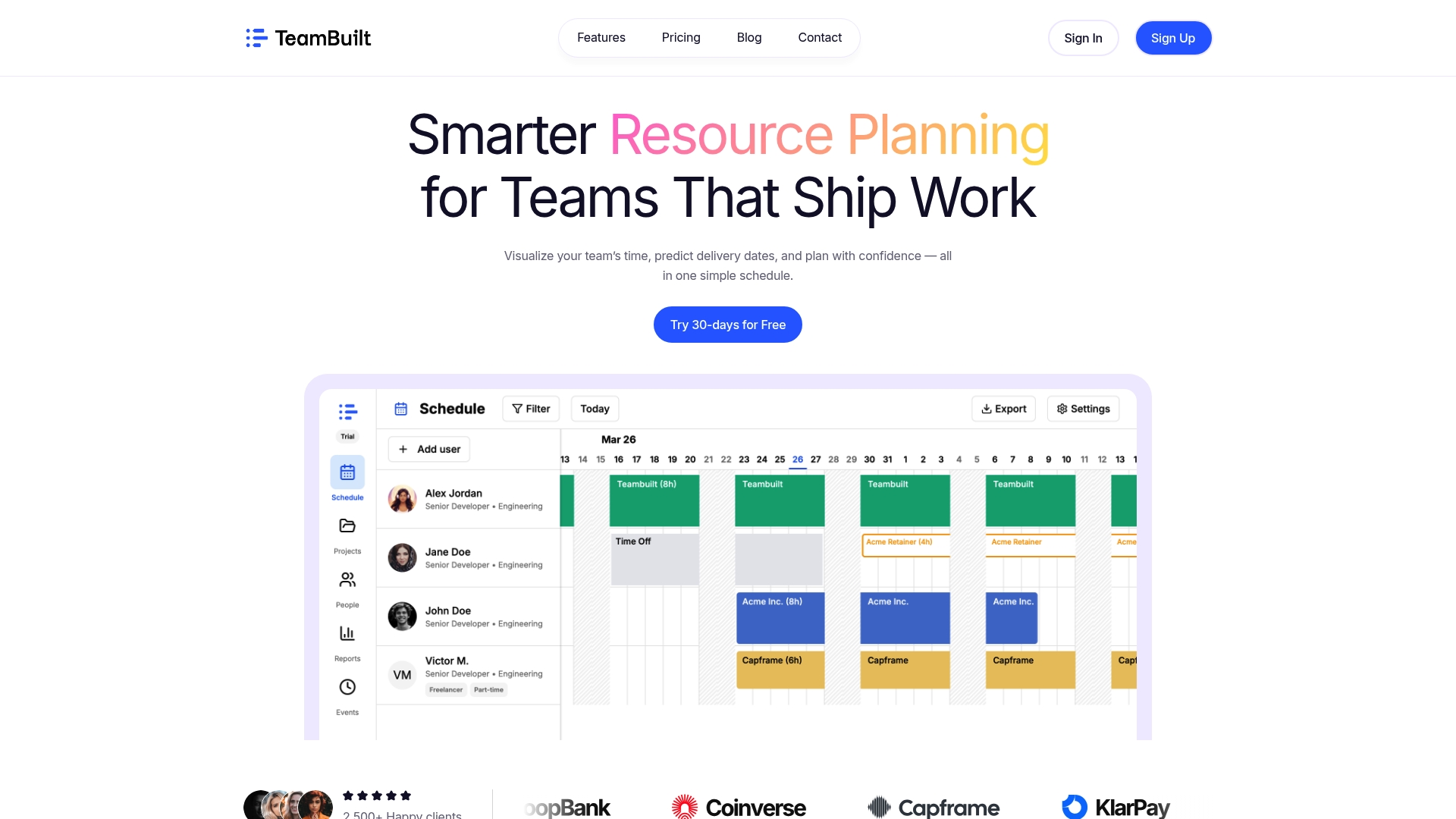
Teambuilt gives team leaders a centralized space to coordinate across teams, track workloads, and keep project timelines visible to everyone involved. When your communication norms point to shared documents and assigned owners, Teambuilt makes sure those owners know exactly what they are carrying and when delivery is expected. You stop relying on scattered threads and start working from a single source of truth your whole team can access in real time. If you are ready to turn your communication charter into a live operating system for your team, explore Teambuilt and see how it fits your workflow.
FAQ
What should a team communication charter include?
A communication charter should define channel assignments, response time expectations, meeting norms, and decision-making protocols. Most effective charters cover 6 to 10 specific agreements built collaboratively in a focused session.
How fast should teams respond to Slack messages?
For time-sensitive questions, a response within 4 business hours during working hours is a solid standard. Standard non-blocking messages can wait up to one full business day.
When should a team use a meeting vs. an async update?
Meetings work best for decisions that require real-time dialogue, alignment on complex topics, or situations where back-and-forth is unavoidable. Async updates via docs or recorded video cover most other scenarios without interrupting focused work time.
What metrics matter in incident communication?
Track mean time to acknowledge (MTTA), time to first customer update, and consistency of update cadence. Structured roles and templates before an incident occurs are what make those numbers improve.
How do you make communication norms stick over time?
Embed norms into weekly rituals like stand-ups and quarterly retrospectives. Leaders need to model the behavior publicly, and new team members should receive a walkthrough of the charter in their first week, not just a document link.
Recommended