
Team Reporting Frameworks: 7 Examples That Work



TL;DR:
- Team reporting frameworks provide structured methods for teams to collect, organize, and communicate progress efficiently to stakeholders. The most effective formats are short, specific, and action-oriented, with examples including scorecards, sprint reports, and status summaries tailored to different audiences. Automating data collection and synthesis with AI and standardized components enhances clarity, accountability, and decision-making across growing teams.
Team reporting frameworks are structured, repeatable systems that define how teams collect, organize, and communicate progress to stakeholders. The right examples of team reporting frameworks give project managers a consistent method to surface risks, track milestones, and drive decisions without burying anyone in noise. Tools like Jira, Confluence, and AI-driven pipelines have made these frameworks faster to run and easier to scale. The core principle stays the same: every report should trigger a decision or a conversation, not just log activity.
1. examples of team reporting frameworks that actually get used

The most effective team reporting models share one trait. They are short enough to write consistently and specific enough to act on. Standard reporting frameworks are segmented into operational, status, and executive reports, with weekly sprint or scorecard formats combining core metrics and narrative summaries to prevent information overload.
Here are seven proven formats worth knowing:
- Weekly team scorecard: Combines 3–7 core metrics, a top-line summary, milestone tracking, blockers with owners, and next steps. Takes roughly 10 minutes to write.
- Sprint report: Outward-facing summary of shipped work, blockers, and upcoming tasks. Designed for async delivery via Slack or Confluence.
- Executive summary report: High-level strategic alignment document for leadership. Focuses on outcomes, not tasks.
- Operational status report: Day-to-day tracking for internal teams. Covers execution health and resource flags.
- OKR progress report: Tracks objective and key result progress on a weekly or bi-weekly cadence. Pairs well with quarterly reviews.
- Incident or risk report: Documents blockers, dependencies, and escalations. Triggers immediate owner response.
- Hybrid reporting framework: Blends sprint-level detail with executive-level summary. Common in agencies and product teams serving multiple stakeholders.
Pro Tip: Pick one format per audience. Executives need outcomes. Operators need blockers. Mixing both in one report satisfies neither.
2. what a weekly team scorecard looks like in practice
The weekly scorecard is the most widely used team progress reporting example because it fits every team size and cadence. A well-structured scorecard includes five sections: a top-line summary, 3–7 core metrics, milestone tracking, blockers with clear ownership, and next steps with decision logs.
The key is pairing every metric with an action. A metric without a linked decision or discussion adds noise, not value. If your cycle time increased by 20%, the report should name the owner and the proposed response, not just flag the number.
The scorecard format works especially well for teams using Jira for execution data and Confluence for narrative context. Jira feeds the metrics. Confluence holds the story. Together, they give stakeholders a complete picture without requiring a meeting.
3. sprint reports: outward-facing team progress reporting
Sprint reports are not the same as retrospectives. Sprint reports face outward toward stakeholders and summarize shipped work, blockers, and upcoming tasks using templates built for async environments like Slack and Confluence. Retrospectives face inward and focus on team process.
Tools like Gitmore automate data collection for sprint metrics including PR counts and cycle time. That automation removes the manual input step that causes most teams to skip reporting altogether. When the data populates automatically, the writer focuses on interpretation, not data entry.
A strong sprint report answers three questions: What did we complete? What is blocking us? What comes next? Any report that cannot answer all three in under two minutes is too long for its audience.
4. how ai-driven workflows transform team reporting models
Automated reporting pipelines now handle the most time-consuming parts of creating team reports. Automated workflows using tools like n8n and AI pipelines running multi-stage processing reduce manual reporting work by hours each week.
The pipeline typically runs in four stages:
- Collect: Pull raw data from Jira, GitHub, Slack, and other sources on a scheduled trigger.
- Correlate: Match data points across tools to identify patterns and dependencies.
- Compact: Filter noise before passing data to the AI synthesis layer. Overloading AI with raw data worsens report quality, so this step is not optional.
- Synthesize: Use an AI model to generate a narrative summary from the compacted data set.
AI models like Anthropic’s Claude (Haiku for speed, Sonnet for depth) handle the synthesis step well when given clean, structured inputs. The output is a draft narrative that a human editor reviews before distribution.
Pro Tip: Never skip the compaction step. Feeding a select, filtered data set to the AI synthesis agent produces executive-ready summaries. Feeding it everything produces noise.
5. key components every reporting framework needs
Effective team performance frameworks share a consistent set of components regardless of format. Clear ownership across tools, standardized definitions, and consistent update practices form the backbone of any reporting model that scales.
The table below maps the core components to their purpose:
| Component | Purpose |
|---|---|
| Outcome metrics | Measure progress toward goals, not just activity |
| Milestone tracking | Show whether delivery is on schedule |
| Execution health | Flag capacity issues and workflow bottlenecks |
| Blockers with owners | Assign accountability and trigger resolution |
| Next steps and decision log | Connect reporting to action |
One component that most teams undervalue is the decision log. Documenting what was decided, by whom, and when prevents the same conversation from recurring every week. It also gives new stakeholders context without requiring a briefing.
Expert Sanjiv Ranjan stresses that defining data ownership prevents AI hallucination and ensures consistent, actionable insights across automated reports. That principle applies equally to manual frameworks. If two people define “done” differently, your milestone tracking is unreliable before anyone reads it.
6. status reports vs. progress reports: know the difference
Status reports are outward-facing for stakeholders and focus on progress against plans. Progress reports are inward-facing and operational. Many teams confuse the two, which produces bloated documents that serve neither audience well.
A status report answers: Are we on track? A progress report answers: What did we do and what is next? Sending a progress report to an executive is like handing a surgeon a supply inventory instead of a patient chart. The data is accurate but useless for the decision at hand.
Separating these two report types is one of the highest-leverage changes a project manager can make. It cuts report length, sharpens communication, and reduces the number of follow-up questions from stakeholders. You can find collaborative planning templates that already separate these formats by audience, which removes the design work from your plate.
7. adapting frameworks to team size and growth stage
The right reporting structure depends on where your organization sits in its growth curve. Reporting structures evolve with revenue. Smaller companies report more directly to CEOs, while larger organizations adopt CRO and CFO roles with hybrid models that balance strategic and operational needs.
Here is how reporting models typically shift by stage:
- Early stage (under $5M ARR): Centralized reporting directly to founders or CEO. One weekly scorecard covers everything.
- Growth stage ($5M–$30M ARR): Functional leads own their reports. A weekly ops review aggregates them.
- Scale stage (above $30M ARR): Hybrid models separate executive summaries from operational dashboards. Finance and RevOps own the synthesis layer.
Decentralized reporting works well for speed but creates siloed data. Centralized reporting gives leadership a clean view but slows teams down. Hybrid models solve both problems by letting teams own their operational reports while a central function owns the executive layer.
The most common mistake at every stage is report bloat. Teams add sections to reports without removing old ones. A quarterly audit of your reporting stack, asking what each report triggers and who reads it, prevents this from accumulating.
Key takeaways
The most effective team reporting frameworks pair standardized components with clear ownership, so every report triggers a decision rather than just logging activity.
| Point | Details |
|---|---|
| Separate report types by audience | Status reports go to stakeholders; progress reports stay internal and operational. |
| Use the five-component scorecard | Include metrics, milestones, execution health, blockers with owners, and a decision log. |
| Automate with a compaction layer | Filter raw data before AI synthesis to produce focused, executive-ready summaries. |
| Match framework to growth stage | Centralized models suit early-stage teams; hybrid models fit organizations above $5M ARR. |
| Audit your reporting stack quarterly | Remove reports that trigger no decisions and serve no named audience. |
The part most teams skip
I have reviewed reporting setups across dozens of project teams, and the single most consistent failure is not the format. It is the missing decision log. Teams spend real effort building scorecards and sprint reports, then distribute them with no record of what was decided or who owns the follow-up. The report becomes a status theater performance, not a management tool.
The second failure is mixing operational and strategic content in the same document. I have seen 12-page weekly reports that include both a CEO-level revenue summary and a list of open pull requests. Nobody reads the whole thing. The executive skims to the summary and misses the blockers. The engineer ignores the revenue section entirely. Both audiences leave the report less informed than they should be.
My honest recommendation: start with the weekly scorecard format, enforce agreed definitions of terms like “done” and “at risk” before you write your first report, and add automation only after your manual process is stable. Automating a broken process produces bad reports faster. Automating a clean process produces good reports with almost no effort.
The workflow automation examples that actually stick are the ones built on top of a reporting discipline that already works. Get the discipline right first.
— Dima
Put your reporting framework into practice with Teambuilt
Building a reporting framework is one thing. Running it consistently across multiple teams and projects is another. Teambuilt gives project managers a centralized platform to track capacity, visualize workload, and connect reporting data to real delivery timelines. It integrates with Jira and Slack, so your execution data feeds directly into your reporting layer without manual exports.
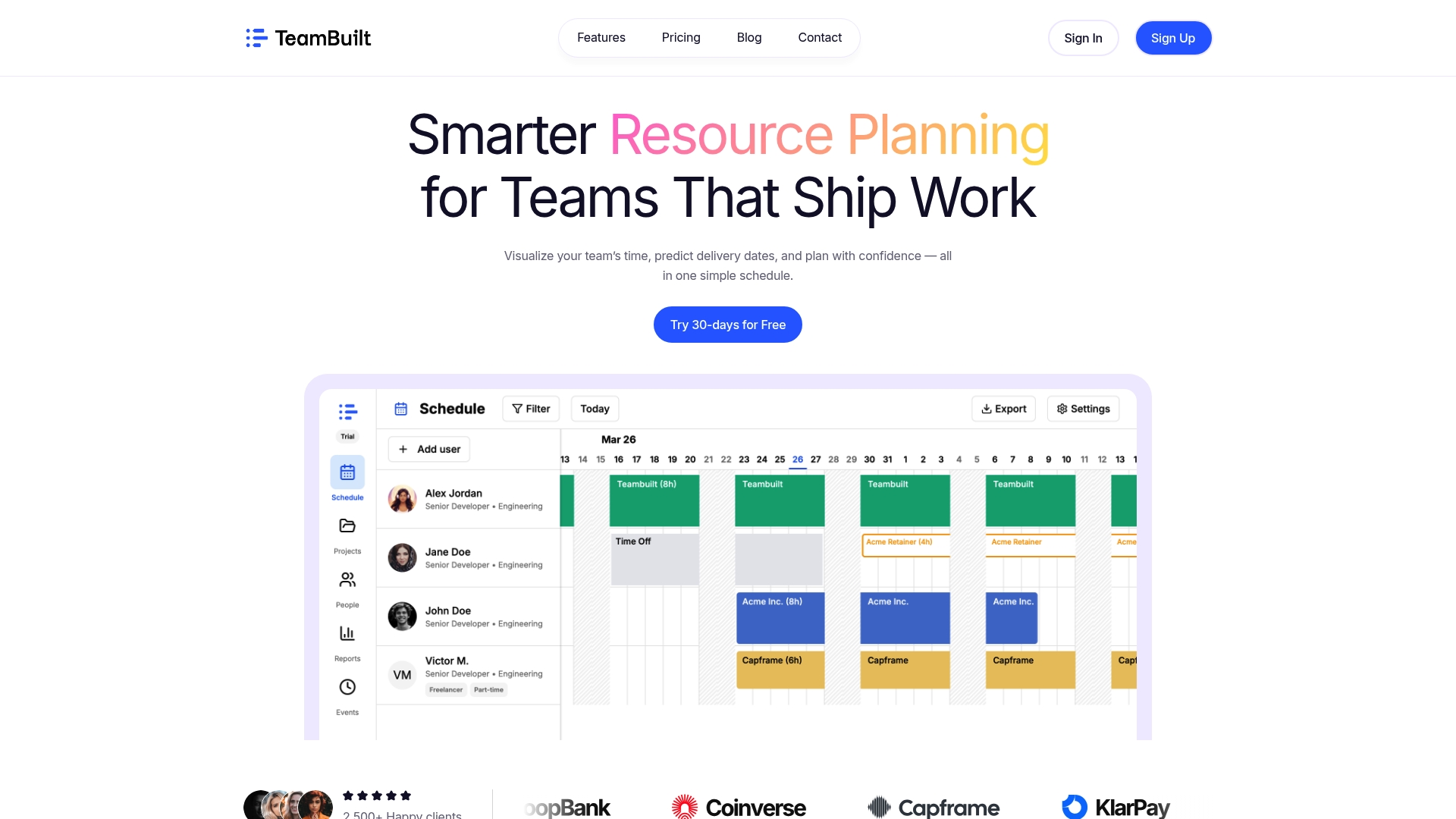
Teams using Teambuilt replace scattered spreadsheets and disconnected status updates with a single source of truth for scheduling, utilization, and progress tracking. If you are ready to move from ad hoc updates to a repeatable reporting system, explore Teambuilt and see how it fits your current workflow.
FAQ
What is a team reporting framework?
A team reporting framework is a structured system that defines what data to collect, how to organize it, and how to communicate it to specific audiences. It typically includes metrics, milestone tracking, blockers, and next steps in a repeatable format.
How is a status report different from a progress report?
Status reports are outward-facing documents for stakeholders that measure progress against a plan. Progress reports are internal and operational, detailing completed work and upcoming tasks for the team itself.
How many metrics should a weekly team scorecard include?
A weekly team scorecard should include 3–7 core metrics. Fewer than three lacks substance; more than seven creates noise and reduces the chance that any single metric drives a decision.
When should teams start automating their reporting workflows?
Teams should automate reporting only after their manual process is stable and definitions are standardized. Automating before that point accelerates inconsistency rather than fixing it.
What is the biggest mistake teams make with reporting frameworks?
The most common mistake is omitting a decision log. Without a record of what was decided and who owns the follow-up, reports become documentation exercises rather than management tools.
Recommended