
Tech Team Coordination Model: A Manager's Guide



TL;DR:
- A tech team coordination model is a structured framework that guides goal alignment, decision authority, and communication. It minimizes coordination failures by establishing governance layers, clear roles, and optimal asynchronous and synchronous practices. Implementing an effective model reduces structural issues and improves delivery across distributed teams.
A tech team coordination model is a structured framework that organizes how technology teams align their goals, communicate processes, and share accountability to deliver projects efficiently. Most engineering organizations lack a governance layer that manages state, accountability, and decision authority, which causes frequent coordination failures. Understanding what is a tech team coordination model gives team leaders the foundation to fix structural problems before they become delivery disasters.
The industry term for this concept is organizational coordination design, and it covers everything from communication cadences to decision authority maps. Frameworks like Team Topologies, the Spotify model, and Amazon’s two-pizza teams each represent a different answer to the same question: how do we get multiple people to move in the same direction without constant meetings?
What is a tech team coordination model, and why does it matter?
A tech team coordination model defines the rules, roles, and rhythms a technology team uses to make decisions and ship work. Without one, teams default to ad hoc communication, which creates bottlenecks, duplicated effort, and missed deadlines.
The core insight from Team Topologies, developed by Matthew Skelton and Manuel Pais, is that effective coordination minimizes cognitive load by removing unnecessary dependencies rather than adding more people or communication channels. That principle flips the instinct most managers have. When coordination breaks down, the reflex is to add a standup or a Slack channel. The real fix is to redesign who depends on whom.
Coordination models also define governance layers. A governance layer records declared working states, ownership maps, and decision authority, enabling handoffs and decisions without synchronous meetings even across time zones. This is the structural backbone that most teams skip, and its absence is the single most common cause of coordination failure in distributed organizations.
Core components of a tech team coordination model
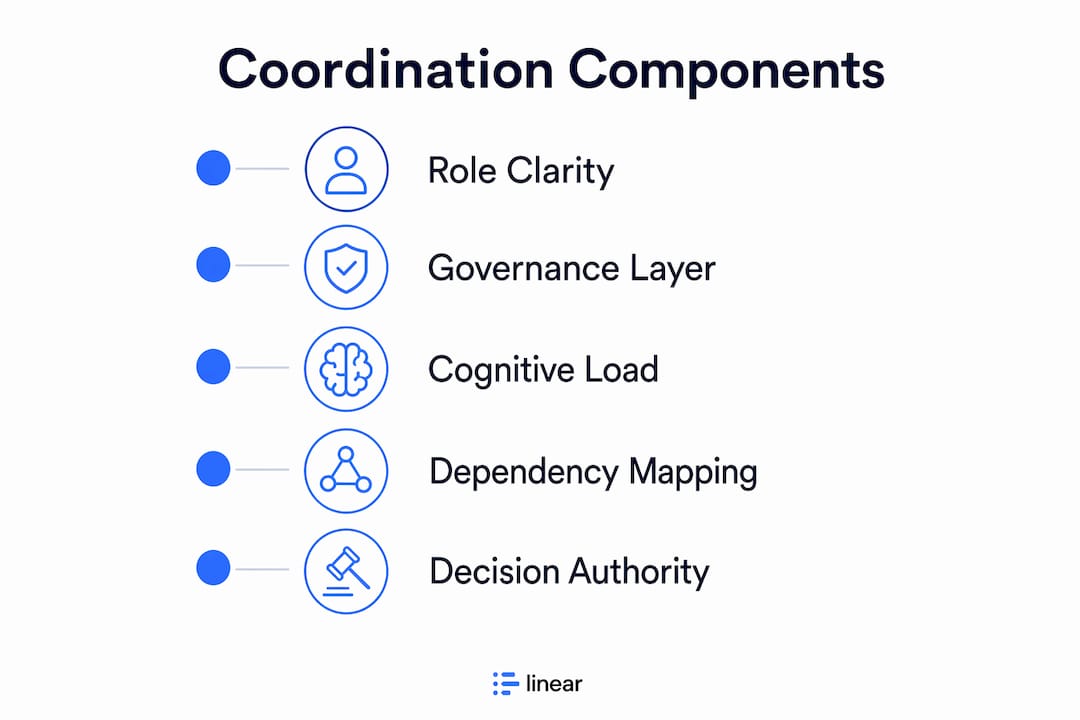
Every effective coordination model addresses four building blocks: communication mechanisms, role clarity, governance layers, and cognitive load management.
Communication mechanisms fall into two categories:
- Synchronous overlap: Teams need only 3–4 hours of daily overlap for effective distributed coordination. Anything beyond that erodes deep work capacity.
- Async defaults: Written artifacts like RFCs (Request for Comments), ADRs (Architecture Decision Records), and decision logs replace real-time discussion for non-urgent decisions.
Role clarity means every team member knows what decisions they own and which ones require escalation. Frameworks like DACI (Driver, Approver, Contributor, Informed) and RAPID assign one person as Decision Driver, which prevents accountability gaps and decision paralysis.
Governance layers capture declared states and ownership maps. Without this layer, context lives in people’s heads and disappears when someone goes on vacation or changes teams.

Cognitive load management is the design principle from Team Topologies that says teams should own only what they can fully understand. When a team’s scope exceeds its cognitive capacity, coordination overhead rises and quality drops.
Pro Tip: Map your team’s current dependencies before choosing a coordination model. If more than three teams must approve a single decision, your structure is the problem, not your communication tools.
How do coordination models solve alignment and communication challenges?
Misalignment between product managers and engineers is structural, not personal. Shared OKRs and joint rituals align incentives and reduce tension between the two groups. That distinction matters because most leaders try to fix alignment through better communication when the actual fix requires changing how goals are set and measured.
The alignment gap is a specific and common failure mode. It occurs when a team verbally agrees in a meeting but each person leaves with a different mental model of what was decided. Explicit written documentation resolves this gap. Written decisions and acceptance criteria reduce requirement ambiguities and delivery failures more reliably than any amount of follow-up conversation.
Meetings themselves often add coordination cost without fixing the underlying issue. A meeting produces alignment only if it ends with a written record of what was decided, who owns it, and what the next action is. Without that record, the same conversation repeats in two weeks.
Here is a practical sequence for resolving alignment failures:
- Identify the gap type. Determine whether the misalignment is structural (conflicting incentives, unclear ownership) or informational (missing context, ambiguous requirements).
- Write the decision down. After every meeting that produces a decision, publish a decision log within 24 hours.
- Assign a single owner. Use DACI or RAPID to name one person responsible for each decision or deliverable.
- Set shared OKRs. Link product delivery metrics and engineering health metrics to the same quarterly objectives.
- Review the governance layer. Check whether your team’s declared states and ownership maps are current and accessible to everyone.
“The best coordination is often invisible. When architecture is decoupled and interfaces are clear, teams rarely need to coordinate at all.” — John McFadyen, tech lead and coordination overhead researcher.
How to implement a coordination model in your organization
Practical implementation starts with three decisions: how much synchronous time your team actually needs, who owns which decisions, and where your written record lives.
For cross-team coordination in distributed environments, set a fixed overlap window of 3–4 hours per day and treat everything outside that window as async by default. Publish response-time SLAs so team members know when to expect replies. Async-first teams ship faster across time zones than co-located teams because they protect deep work and reduce interruption costs.
Decision authority requires a written map. List every recurring decision type your team faces, then assign a Driver using DACI or RAPID. Assigning one Decision Driver with clear roles prevents accountability gaps and the decision paralysis that slows delivery.
Documentation standards need enforcement, not just encouragement. After every meeting that produces a decision, the assigned owner publishes a summary to a shared, searchable location. This is not optional overhead. It is the mechanism that makes async coordination possible.
Adapt the model to your organization’s size. Small teams of 5–8 people can use lightweight governance: a shared decision log and a weekly async update. Larger organizations with multiple teams need explicit ownership maps, published working agreements, and a dedicated coordination role.
Pro Tip: If your coordination struggles persist beyond 12 weeks, the root cause is typically structure, such as wrong staffing or unclear ownership, not communication or tooling. Structural causes require organizational redesign, not more meetings.
The table below shows how coordination model complexity should scale with team size:
| Team size | Recommended model type | Key governance artifact |
|---|---|---|
| 1–8 people | Lightweight async | Shared decision log |
| 9–25 people | Role-based with DACI | Ownership map + decision log |
| 26–75 people | Team Topologies streams | Working agreements + ADRs |
| 75+ people | Federated governance | Full governance layer + state declarations |
Comparing popular tech team coordination frameworks
Four frameworks dominate the conversation on team coordination in tech: Team Topologies, the Spotify model, Amazon’s two-pizza teams, and Google’s Project Aristotle findings.
Team Topologies organizes teams into four types: stream-aligned, platform, enabling, and complicated-subsystem. Its coordination style is role-based and focuses on minimizing cognitive load through clear team interfaces. It works best for organizations with multiple interdependent product teams.
The Spotify model decentralizes coordination through squads, tribes, chapters, and guilds. It prioritizes team autonomy and works well when teams are mature enough to self-organize. The model struggles in organizations where accountability is unclear or where teams lack strong individual ownership cultures.
Amazon’s two-pizza teams enforce a hard size limit: if two pizzas cannot feed the team, it is too large. Cross-functional teams optimize for autonomy, accountability, or psychological safety depending on their model. Amazon’s version optimizes for accountability by keeping ownership surfaces small and clear.
Google’s Project Aristotle identified psychological safety as the strongest predictor of team performance. Its coordination implication is that teams need an environment where members can raise concerns and flag misalignment without fear. This is a cultural layer that sits on top of any structural model.
| Framework | Coordination style | Primary focus | Best fit |
|---|---|---|---|
| Team Topologies | Role-based, decoupled | Cognitive load reduction | Multi-team product orgs |
| Spotify model | Decentralized, autonomous | Team autonomy | Mature, self-organizing teams |
| Amazon two-pizza | Accountability-first | Ownership clarity | Fast-moving product teams |
| Google Aristotle | Safety-first | Psychological safety | High-stakes, creative teams |
For collaborative project planning, the right framework depends on your organization’s primary pain point. If decisions are slow, use a model that clarifies authority. If teams are burning out from meetings, use a model that enforces async defaults.
Key takeaways
A tech team coordination model works when it combines a governance layer, clear decision authority, and async-first communication defaults to reduce structural misalignment.
| Point | Details |
|---|---|
| Governance layer is non-negotiable | Record declared states, ownership, and decision authority to enable async handoffs. |
| Sync time has a ceiling | Limit synchronous overlap to 3–4 hours daily to protect deep work capacity. |
| Alignment gaps are written problems | Publish decision logs after every meeting to prevent verbal agreement from diverging into different actions. |
| Structure beats communication | If coordination fails for more than 12 weeks, redesign the structure, not the communication tools. |
| Framework choice depends on pain point | Choose Team Topologies for cognitive load, Spotify for autonomy, or two-pizza teams for accountability. |
Why most coordination problems are structural, not behavioral
Most managers I have worked with reach for communication tools first when coordination breaks down. They add a standup, create a new Slack channel, or schedule a weekly sync. Those moves feel productive. They rarely fix anything.
The real problem is almost always structural. Teams are too large, ownership is unclear, or incentives are misaligned. No tool resolves a situation where two teams share ownership of the same codebase with no written agreement about who decides what. That requires an organizational design change.
The shift toward async-first collaboration is not a trend driven by remote work. It is a recognition that synchronous communication is expensive. Every hour of meetings is an hour of deep work lost. The teams I have seen ship the most consistently are the ones that treat writing as their primary coordination tool, not talking.
The governance layer concept is the most underused idea in tech team management. Most organizations have communication tools, project trackers, and meeting rituals. Very few have a single, authoritative record of who owns what decision, what the current declared state of each team is, and who has authority to change it. Building that record is the highest-leverage coordination investment a manager can make.
The future of coordination in tech organizations points toward smaller, more autonomous teams with explicit interfaces, written-first cultures, and governance layers that make context available without requiring a meeting. Leaders who build that infrastructure now will spend far less time managing coordination failures later.
— Dima
Teambuilt’s role in tech team coordination
Putting a coordination model into practice requires more than a framework on paper. You need visibility into who is working on what, where capacity is constrained, and when delivery timelines are at risk.
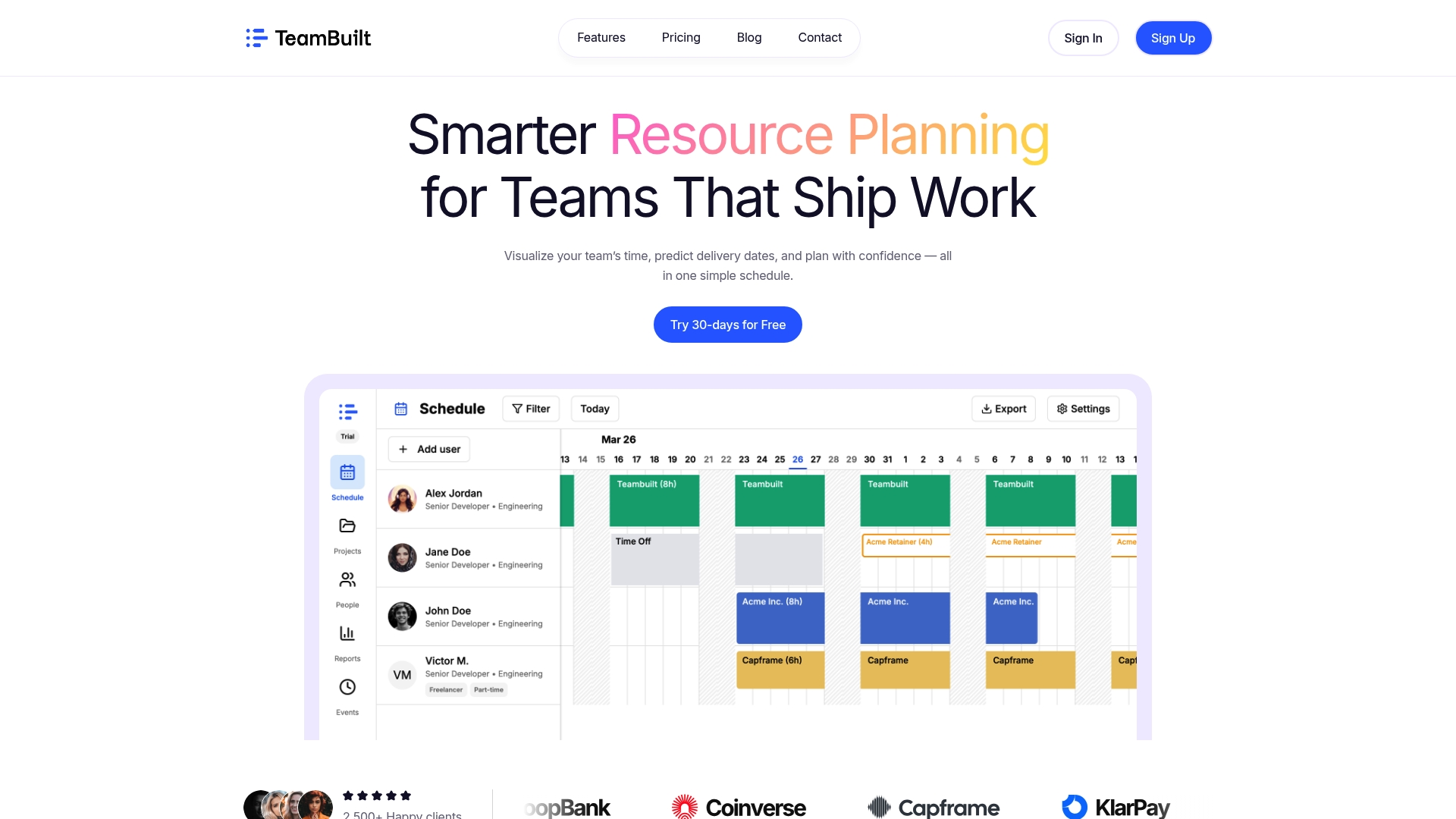
Teambuilt gives team leaders and managers a centralized platform for real-time team scheduling, workload visualization, and cross-team capacity tracking. The platform replaces scattered spreadsheets with a single source of truth for resource availability and project timelines. For organizations building or refining their coordination model, Teambuilt provides the operational infrastructure that makes governance layers and async workflows practical at scale. Visit Teambuilt to see how the platform supports coordination across multiple teams and complex workflows.
FAQ
What is a tech team coordination model?
A tech team coordination model is a structured framework that defines how technology teams align goals, assign decision authority, and communicate to deliver projects. It covers governance layers, communication mechanisms, and role clarity.
How does a governance layer improve team coordination?
A governance layer records declared working states, ownership maps, and decision authority, enabling teams to hand off work and make decisions without synchronous meetings. Most engineering organizations lack this layer, which causes frequent coordination failures.
What is the alignment gap in tech teams?
The alignment gap occurs when team members verbally agree in a meeting but leave with different understandings of what was decided. Written decision logs and explicit acceptance criteria close this gap.
How many hours of synchronous overlap do distributed teams need?
Distributed teams need only 3–4 hours of daily synchronous overlap for effective coordination. Anything beyond that reduces deep work capacity and increases coordination overhead.
Which coordination framework is best for a growing tech team?
The right framework depends on your primary pain point. Team Topologies works best for reducing cognitive load across multiple teams. Amazon’s two-pizza model works best when accountability and ownership clarity are the core challenge.
Recommended