
The Role of Business Intelligence in Planning


TL;DR:
- Business intelligence transforms raw data into actionable insights that enhance strategic decision-making and planning efficiency. It shifts roles within organizations, empowering operational managers with autonomy and requiring explicit workflow redesigns to sustain value. Effective BI integration depends on a strong data foundation, collaboration across systems, and organizational governance to realize its full planning potential.
Business intelligence (BI) is defined as the process of transforming raw organizational data into structured, actionable insights that drive strategic decisions. The role of business intelligence in planning is not peripheral. It sits at the center of how modern organizations allocate resources, set objectives, and respond to market shifts. Tools like Microsoft Power BI, Python-based analytics pipelines, and integrated dashboards have moved BI from a reporting function into a core planning capability. The organizations that treat BI as infrastructure rather than a reporting add-on consistently outperform those that do not.
How does business intelligence improve strategic planning effectiveness?
BI improves strategic planning by raising the quality, speed, and confidence of decisions at every management level. A 2025 quantitative study of 75 Indonesian BI users in managerial roles found that BI explains 45% of variance in decision-making effectiveness, attributing the gains to data quality, analytics capability, and system usability. That figure means nearly half of what separates good strategic decisions from poor ones comes down to how well BI is implemented, not how smart the decision-makers are.
Three mechanisms drive this improvement:
- Data quality: Clean, consistent, and timely data eliminates the guesswork that inflates planning cycles. When planners trust the numbers, they spend less time validating inputs and more time analyzing options.
- Analytics capability: The ability to run scenario analyses, sensitivity tests, and forecasts within the same platform that holds operational data removes the translation errors that accumulate when teams export to spreadsheets.
- System usability: A platform that managers can navigate without IT support increases adoption. Low adoption is the single most common reason BI investments fail to reach planning teams.
A 2024 survey of a Peruvian commercial company confirmed that BI use correlates positively with strategic planning outcomes by optimizing resource use, aligning objectives, and improving organizational adaptability. The implication is direct: BI is not just a reporting upgrade. It restructures how planning conversations happen.
Pro Tip: Before selecting a BI platform, audit your data pipeline first. A Power BI dashboard built on inconsistent source data will produce confident-looking wrong answers. Data readiness precedes tool selection.
Simulation-based research on Indonesian MSMEs found that combining Python with Power BI reduced decision-making time by over 36%, improved information accuracy by 41%, and accelerated strategic planning speed by 40% compared to traditional spreadsheet workflows. These are not marginal gains. They represent the difference between a planning cycle that takes three weeks and one that takes less than two.

What are the evolving organizational roles driven by BI in planning?
BI adoption does not just change what organizations know. It changes who does what. A 2026 study published in the Journal of Management Control found that BI shifts management accountants from manual data compilers into orchestrators of information flows, while operational managers gain significantly more autonomy in accessing and interpreting data directly.
This role shift has concrete workflow implications:
- Management accountants move from producing reports to designing the data models and governance rules that others use.
- Operational managers can pull their own performance views without waiting for a monthly report cycle.
- Planning teams spend more time on interpretation and scenario design rather than data assembly.
The risk in this transition is real. When roles are not explicitly redesigned to match new BI capabilities, organizations end up with duplicated effort, conflicting data versions, and accountability gaps. The workflow orchestration layer that BI creates only delivers value when the human responsibilities around it are clearly defined.
Pro Tip: Map your current planning workflow before deploying a new BI system. Identify who currently owns each data handoff. BI will automate some of those handoffs, and if no one is assigned to govern the new flow, the system will create confusion rather than clarity.
The research also notes that operational managers who gain data autonomy through BI tend to make faster localized decisions, which reduces the bottleneck on central planning teams. This is one of the less-discussed benefits of BI in strategy: it distributes decision capacity rather than centralizing it further.

How does BI integrate with other systems for planning?
BI does not function as a standalone tool in mature planning environments. A 2026 peer-reviewed review in Applied Sciences describes BI as a decision-facing analytics layer integrated with business process management (BPM), decision support systems (DSS), big data infrastructure, and increasingly, generative AI. The practical value of BI depends less on isolated dashboards and more on tightly integrated layers of analytics, process intelligence, and human oversight.
The table below clarifies how each layer contributes to planning:
| System layer | Primary function in planning | Integration dependency |
|---|---|---|
| Business intelligence (BI) | Aggregates and visualizes structured data for decision-makers | Requires clean data from ERP, CRM, or data warehouse |
| Business analytics (BA) | Runs predictive and prescriptive models on BI data | Depends on BI data quality and model governance |
| Business process management (BPM) | Encodes planning workflows and approval chains | Connects BI outputs to operational execution steps |
| Decision support systems (DSS) | Presents scenario options and trade-off analysis to planners | Pulls from BI and BA layers to generate recommendations |
| Big data infrastructure | Handles volume, velocity, and variety of unstructured inputs | Feeds BI and BA layers with real-time and historical data |
Interoperability between these layers is not automatic. Organizations that treat BI as a point solution rather than a component of a broader architecture consistently find that insights stop at the dashboard and never reach the planning table. Governance, defined as who can change data models, who approves scenario assumptions, and how outputs are versioned, is what converts analytics into decisions.
What factors influence the impact of BI on planning outcomes?
Not all organizations extract the same value from BI investments. The factors that determine planning outcomes vary by sector, maturity, and infrastructure readiness.
A 2026 study of 537 manufacturing plants found that data management resources are the single strongest predictor of supply chain planning satisfaction and operational performance, outweighing the effect of IT-enabled planning tools themselves. This finding inverts the common assumption that better software solves planning problems. The data foundation matters more than the tool sitting on top of it.
| Industry sector | Primary BI planning benefit | Key success factor |
|---|---|---|
| Manufacturing and supply chain | Demand forecasting, inventory optimization | Data management resources and integration with ERP |
| Professional services | Resource allocation, utilization tracking | Real-time data access and role-based dashboards |
| Retail and MSMEs | Sales trend analysis, scenario planning | Usability and low-code analytics tools like Power BI |
| Construction | Project cost tracking, delivery forecasting | Workflow integration with job management systems |
Organizational maturity also shapes outcomes. Research on FP&A maturity confirms that planning effectiveness improves when processes include fast scenario reruns and sensitivity analyses that explain forecast drivers, not just KPI displays. Organizations at lower maturity levels tend to use BI for backward-looking reporting. Higher-maturity organizations use it for forward-looking scenario modeling, which is where the real planning advantage lives.
What are the best practices for applying BI in planning?
Operationalizing BI in planning requires more than deploying a platform. The most common failure mode is not a technology gap. It is a process gap.
- Establish a shared data baseline first. BI outputs must become the single source of truth for scenario planning. When different teams run scenarios from different data exports, version conflicts destroy planning credibility. Define one authoritative data model before building dashboards.
- Redesign workflows around BI outputs, not alongside them. If your planning process still requires someone to copy BI data into a presentation or a separate spreadsheet, the workflow has not been redesigned. It has been extended. BI should feed directly into the planning conversation.
- Reduce decision latency through infrastructure investment. Research on decision latency in BI systems shows that real-time data ingestion and governance infrastructure are more critical to planning speed than improving analytic tools. A faster dashboard on slow data is still slow planning.
- Build human oversight into the governance model. Automated BI outputs require human review before they drive major resource or budget decisions. Define who reviews model assumptions, who approves scenario changes, and how often the data model is audited.
- Prioritize usability for non-technical planners. The real-time analytics benefit disappears if the people who need the data cannot access it without IT support. Invest in training and interface design alongside the technical build.
Pro Tip: Run a planning simulation before going live with a new BI system. Use real historical data to test whether the platform produces outputs that match known outcomes. This catches model errors before they influence live decisions.
Key takeaways
Business intelligence delivers its greatest planning value when it functions as an integrated, governed layer connecting data infrastructure, analytics, and human decision-making rather than as a standalone reporting tool.
| Point | Details |
|---|---|
| BI explains nearly half of decision quality | Data quality, analytics capability, and system usability account for 45% of variance in strategic decision effectiveness. |
| Role redesign is non-negotiable | BI shifts management accountants to orchestrators and gives operational managers more autonomy, requiring explicit workflow changes. |
| Data management beats tool selection | In manufacturing and supply chain, data management resources predict planning success more reliably than the BI platform itself. |
| Integration architecture matters | BI connected to BPM, DSS, and big data infrastructure converts insights into decisions. Isolated dashboards do not. |
| Maturity determines planning depth | Higher-maturity organizations use BI for scenario modeling and sensitivity analysis, not just KPI reporting. |
Why BI’s real challenge is organizational, not technical
I have spent years watching organizations invest heavily in BI platforms and then wonder why their planning cycles did not improve. The pattern is almost always the same. The technology works. The organization around it does not change.
The research from 2026 on management accountants and operational managers captures something I have seen repeatedly: when BI shifts who owns data access, it creates a power dynamic that nobody planned for. Operational managers suddenly have numbers that used to belong to finance. Finance teams feel bypassed. Planning meetings become debates about whose data is correct rather than what to do next.
The organizations that get this right treat BI adoption as an organizational design project with a technology component, not the other way around. They map decision rights before they deploy dashboards. They define who owns the data model, who can change assumptions, and how conflicts get resolved. The technology is the easy part.
I also think the industry underestimates how much AI integration will accelerate this tension. As generative AI gets embedded into BI platforms, the gap between what the system recommends and what planners actually understand will widen. Human oversight is not a nice-to-have in that environment. It is the only thing that keeps planning grounded in organizational reality rather than algorithmic pattern-matching.
The organizations building that oversight capacity now, through governance frameworks and role clarity, will be the ones that benefit most from AI-enhanced planning. The ones that skip it will have faster dashboards and worse decisions.
— Dima
See how Teambuilt brings BI-driven planning to your team
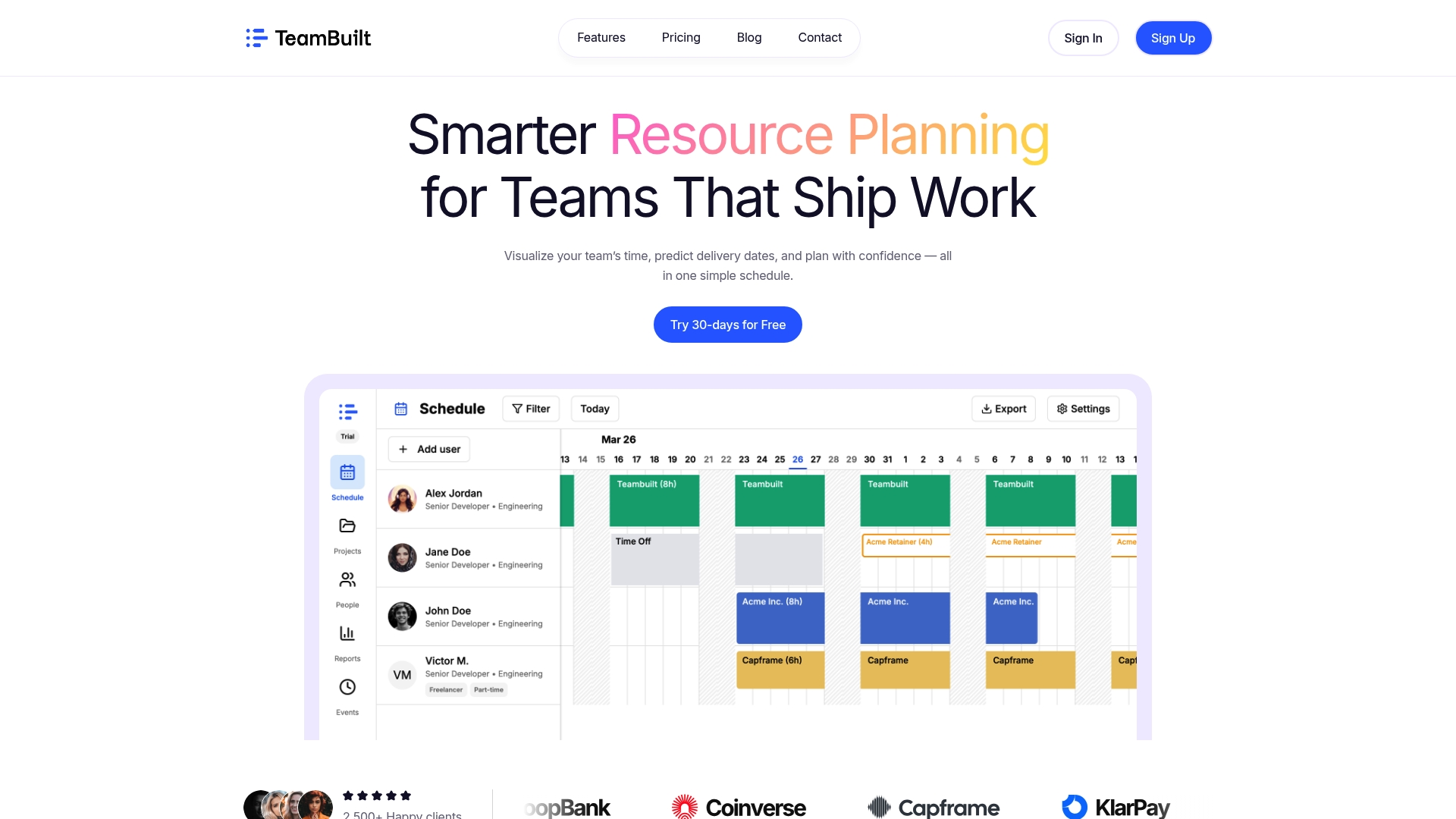
Teambuilt is built for exactly the planning environment this article describes: one where data quality, real-time visibility, and workflow clarity determine whether your team hits its delivery targets. The platform gives project managers, operations leads, and CFOs a centralized view of capacity, utilization, and project timelines without the spreadsheet bottlenecks that slow strategic decisions. You can explore the full range of planning and scheduling features that connect your team’s data to your planning workflow. If you are ready to replace scattered tools with a single source of truth, start with Teambuilt and see the difference integrated planning makes.
FAQ
What is the role of business intelligence in strategic planning?
Business intelligence converts raw organizational data into structured insights that improve the quality, speed, and confidence of strategic decisions. It functions as the analytical foundation for resource allocation, objective alignment, and scenario planning across management levels.
How does BI affect decision-making speed?
Combining Python-based pipelines with tools like Power BI has been shown to reduce decision-making time by over 36% and accelerate strategic planning speed by 40% compared to traditional spreadsheet methods. The gain comes from eliminating manual data assembly and enabling real-time scenario analysis.
What is the biggest risk when implementing BI for planning?
The most common failure is treating BI as a reporting upgrade rather than redesigning the workflows and roles around it. When BI outputs are not established as the shared planning baseline, version conflicts and accountability gaps undermine the investment.
Does BI work differently across industries?
Yes. In manufacturing and supply chain, data management resources predict planning success more than the BI tool itself. In professional services and retail, usability and real-time access drive adoption and planning effectiveness. The underlying data infrastructure requirement is consistent across all sectors.
How does BI connect to other planning systems?
BI operates as one layer in a broader decision-support architecture that includes business analytics, business process management, decision support systems, and big data infrastructure. Effective planning requires these layers to be integrated and governed, not deployed independently.
Recommended