
The Role of Integrations in SaaS: 2026 Guide



TL;DR:
- SaaS integrations are essential for automating workflows, reducing manual effort, and enhancing operational visibility. Treating integrations as a product rather than a project prevents debt, supports scale, and improves customer retention. Governance, proper model selection, and strategic planning are critical to maximizing SaaS value and AI readiness.
SaaS integrations are defined as connections between cloud-based applications that enable automated data sharing, synchronized workflows, and unified operational visibility across a tech stack. The role of integrations in SaaS has shifted from a nice-to-have feature to a core product requirement. Organizations that treat integrations as an afterthought pay for it in manual work, data silos, and slower delivery. Platforms like MuleSoft, Knit, and iPaaS providers have made it possible to connect dozens of tools without writing custom code for every handoff. The question is no longer whether to integrate, but how to do it without accumulating debt that slows you down later.
How do SaaS integrations improve operational efficiency?
SaaS integrations reduce manual entry, cut errors, and automate processes that would otherwise require human intervention at every step. That means fewer dropped handoffs between tools, faster data availability, and less time spent reconciling records across systems.
The most direct efficiency gain comes from automation. When your HRIS pushes new hire data directly into your provisioning system, IT doesn’t manually create accounts. When your project management tool syncs with your billing platform, finance doesn’t chase down hours at month-end. ITSM systems trigger automated provisioning via API integrations, removing entire categories of manual work from IT queues. Each automated handoff compounds: one integration saves hours per week, ten integrations can save entire roles.
Real-time data syncing changes how teams make decisions. Without integrations, data lives in snapshots. A project manager checks capacity in one tool, then manually cross-references another to confirm availability. With live syncing, the data is always current, and decisions based on it are more reliable. This is especially critical for resource planning, where a one-day lag in utilization data can cause overcommitment.
For B2B SaaS products specifically, integrations tie directly to onboarding speed and activation rates. A new customer who connects their existing tools on day one gets value faster and churns less. Manual data exports from an HRIS, by contrast, create friction that delays activation and signals to the customer that your product doesn’t fit their workflow.
- Automated HRIS onboarding workflows eliminate manual account provisioning
- Real-time project data syncing removes the need for status update meetings
- Bidirectional CRM and billing sync cuts revenue recognition errors
- Cross-tool alerting reduces response time on delivery blockers
Pro Tip: Map your top three customer workflows before building any integration. The integrations that touch onboarding, activation, or daily core tasks deliver the highest retention impact per engineering hour spent.
What are the common SaaS integration models and platforms?

Four distinct integration models exist in the market, and choosing the wrong one for your context creates maintenance overhead that compounds over time. Understanding the tradeoffs between native connectors, unified APIs, embedded iPaaS, and ETL tools is the foundation of any sound SaaS integration strategy.

Native integrations are built directly by the SaaS provider for a specific third-party tool. They offer the highest control over behavior and data mapping, but each one requires dedicated engineering effort to build and maintain. When the third-party API changes, you absorb the update cost entirely.
Unified APIs normalize connections across an entire category of providers. One engineer can ship 30 HRIS integrations in one sprint using a unified API layer instead of building native connectors one by one. The tradeoff is reduced customization at the individual provider level, but for most use cases the normalized data model is sufficient.
Embedded iPaaS platforms like Workato or Tray.io sit inside your product and let customers configure their own automation workflows. This shifts integration maintenance partly to the customer and enables use cases you didn’t anticipate. The complexity cost is real: you’re now supporting a workflow engine, not just a data connector.
iPaaS differs from ETL tools in a fundamental way. ETL (Extract, Transform, Load) tools like Fivetran or Airbyte are built for moving data into analytics warehouses. They’re batch-oriented and analytics-focused. iPaaS platforms handle real-time triggers, bidirectional syncs, and operational workflow automation. Using ETL where you need iPaaS is a common and costly mistake.
| Model | Best for | Key tradeoff |
|---|---|---|
| Native integrations | High-control, high-priority connectors | High build and maintenance cost per connector |
| Unified API | Scaling coverage across a category fast | Less customization per individual provider |
| Embedded iPaaS | Customer-configurable workflow automation | Adds product complexity and support surface |
| ETL tools | Analytics pipelines and data warehousing | Not suited for real-time operational workflows |
Pro Tip: Use a unified API layer for category coverage (HRIS, CRM, ticketing) and reserve native integrations for your top five most-requested tools where custom behavior is non-negotiable.
What is integration debt and why does it threaten SaaS growth?
Integration debt is the accumulating maintenance burden created when integrations are built without governance, standardization, or a coherent architecture. It’s the SaaS equivalent of technical debt, and it compounds faster because it spans multiple external systems you don’t control.
The scale of the problem is larger than most teams realize. Companies use roughly 976 applications on average, but only about 28% are fully integrated with a core framework. That connectivity gap means the majority of tools in a typical organization operate in partial or complete isolation. Every unconnected app is a potential source of manual work, data inconsistency, or missed automation.
The operational consequences are measurable. IT teams spend 36% of their time on integration work, and 26% of IT projects run late specifically because of integration issues. Those numbers reflect organizations where integration was treated as a project-by-project concern rather than a platform-level discipline.
“Integration debt can compound operational failures if connectivity and governance aren’t standardized early. The cost of retrofitting governance onto a fragmented integration estate is almost always higher than building it in from the start.”
The path to avoiding integration debt requires treating integrations as a product, not a project. That means:
- Establish an integration approval process before any new connector gets built or purchased
- Centralize ownership of integration architecture in a platform team or designated role
- Document every active integration with its owner, data flows, and maintenance schedule
- Audit integration health quarterly and retire connectors that no longer serve active workflows
- Choose platforms that support compliance and governance at the architecture level, including data caching policies and sub-processing controls
Organizations that skip this governance layer find themselves unable to move quickly when a third-party API changes or a new product requirement demands a new data flow. The integrations that were supposed to accelerate growth become the bottleneck.
How to develop an integration strategy that maximizes SaaS value
A good SaaS integration strategy starts with customer workflows and business impact, not connector count. The number of integrations you offer is irrelevant if none of them touch the workflows your customers use every day.
Start by categorizing integrations by business function: HRIS for people data, CRM for revenue data, ticketing for support workflows, and project management for delivery data. Within each category, rank connectors by customer request volume and churn correlation. The integrations that appear in both lists are your highest-priority builds.
Choosing the right model for each integration requires balancing three variables: control requirements, scale targets, and workflow complexity. A connector that needs custom field mapping and real-time bidirectional sync warrants a native build. A connector in a category where you need 20 providers covered warrants a unified API approach. A connector that customers want to configure themselves warrants embedded iPaaS.
- Prioritize integrations that reduce time-to-value during onboarding
- Use unified API layers to scale category coverage without proportional engineering cost
- Monitor integration health through error rates, sync latency, and customer-reported issues
- Collect integration usage data to identify which connectors drive retention and which are rarely used
- Retire low-usage integrations on a defined schedule to reduce maintenance surface
Integration readiness also directly affects AI adoption. 82% of IT leaders cite data integration as a top challenge when implementing AI capabilities. An organization with fragmented, ungoverned integrations cannot feed clean, consistent data to AI systems. Building a governed integration layer now is also an investment in AI readiness later.
The workflow automation examples that deliver the most measurable ROI share a common pattern: they eliminate a recurring manual handoff between two systems that both teams use daily. That’s the right frame for prioritization.
Key takeaways
SaaS integrations are the connective tissue of a modern tech stack, and organizations that govern them deliberately outperform those that treat them as one-off projects.
| Point | Details |
|---|---|
| Integrations drive activation and retention | B2B SaaS products with connected onboarding workflows see faster activation and lower churn than those relying on manual exports. |
| Integration debt compounds fast | With ~976 apps in use and only ~28% integrated, ungoverned connectivity gaps create mounting maintenance costs and delivery delays. |
| Model choice determines maintenance cost | Unified APIs scale category coverage efficiently; native integrations suit high-priority, high-control connectors; ETL tools belong in analytics pipelines, not operational workflows. |
| Governance prevents sprawl | An integration approval process, centralized ownership, and quarterly audits prevent fragmented architectures from slowing growth. |
| Integration readiness enables AI | 82% of IT leaders name data integration as their top AI challenge, making a governed integration layer a prerequisite for AI adoption. |
Why integrations are now a product discipline, not an IT task
I’ve watched the conversation around SaaS integrations shift dramatically over the past few years. When I started working with SaaS teams, integrations were treated as a checkbox on the sales sheet. “Yes, we integrate with Salesforce.” What that actually meant was a fragile, undocumented connector that one engineer built in a weekend and nobody owned.
The teams that are winning now treat integrations as a product surface with its own roadmap, ownership, and success metrics. They track integration adoption the same way they track feature adoption. They measure the correlation between integration usage and 90-day retention. They have a platform team that owns the integration layer the same way a product team owns the core application.
What I find most underappreciated is the governance piece. Most teams focus on building integrations and almost none focus on retiring them. Dead integrations are a real operational risk. They consume maintenance cycles, create security exposure, and confuse customers who see a connector listed that hasn’t worked reliably in months.
The rise of agentic AI makes this more urgent, not less. AI agents need clean, consistent, real-time data from multiple systems to function reliably. An organization with 30 poorly governed integrations feeding inconsistent data will get worse AI outcomes than one with 10 well-governed integrations feeding clean data. The quality of your integration architecture is becoming a direct input to the quality of your AI outputs.
My honest recommendation: before you add another connector to your catalog, audit what you already have. You’ll almost certainly find integrations that nobody uses, integrations that overlap in function, and integrations that are one API deprecation away from breaking. Fix the foundation before you build higher.
— Dima
See how Teambuilt connects your workflows
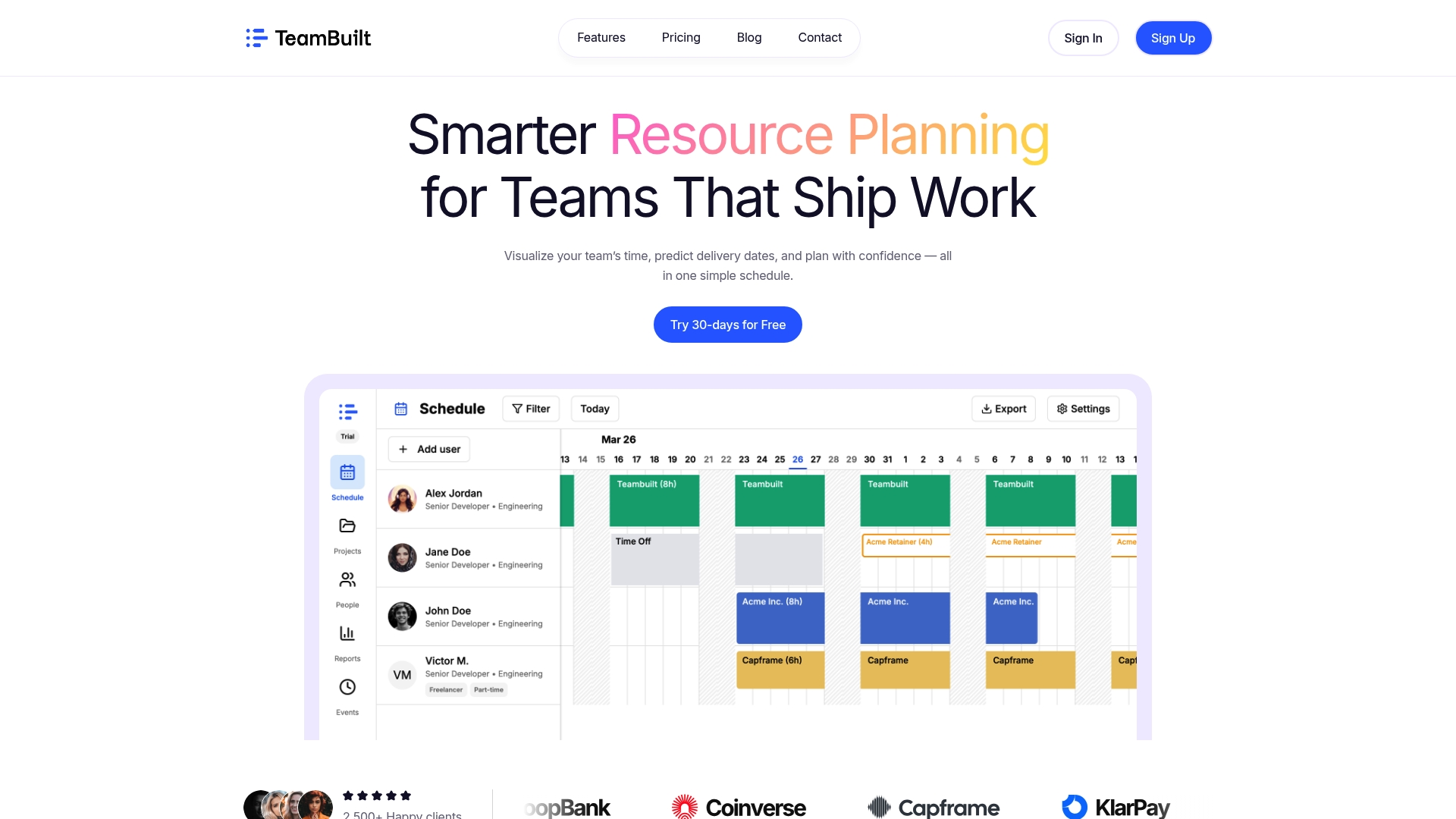
Teambuilt is built for organizations that need more than a project list. Its open API and pre-built integrations connect your resource planning, scheduling, and capacity data directly to the tools your teams already use. Whether you’re syncing headcount from your HRIS, pushing project milestones to your CRM, or pulling utilization data into your reporting stack, Teambuilt keeps your data consistent without manual exports. For project managers and operations leads who need real-time visibility across multiple teams, Teambuilt replaces the spreadsheet-and-email coordination layer with a centralized planning platform that integrates where it matters most.
FAQ
What is the role of integrations in SaaS?
SaaS integrations connect cloud-based applications to enable automated data sharing, synchronized workflows, and unified operational visibility. They reduce manual work, improve decision-making speed, and directly affect product activation rates and customer retention.
How do integrations affect SaaS product growth?
Integrations tied to onboarding and core customer workflows accelerate activation and reduce churn. B2B SaaS products that require manual data exports during onboarding create friction that delays time-to-value and increases early churn risk.
What is integration debt in SaaS?
Integration debt is the accumulated maintenance burden from uncoordinated, ungoverned integrations built without a standardized architecture. It manifests as increasing error rates, delayed projects, and an inability to adapt quickly when third-party APIs change.
What is the difference between iPaaS and ETL tools?
iPaaS platforms handle real-time triggers, bidirectional syncs, and operational workflow automation across applications. ETL tools are designed for batch data movement into analytics warehouses and are not suited for live operational workflows.
How many SaaS apps does the average organization use?
Organizations use roughly 976 applications on average, but only about 28% are fully integrated with a core framework. That connectivity gap is the primary driver of manual work, data inconsistency, and integration debt across the enterprise.
Recommended