
The Role of Real-Time Data in Business Decisions



TL;DR:
- Real-time data enables organizations to act immediately on current conditions, boosting operational efficiency and strategic growth.
- Achieving reliable real-time decision-making requires low-latency, ACID-compliant decision products and a cultural shift towards decentralized authority.
Real-time data is defined as business information processed and delivered within milliseconds of generation, enabling leaders to act on current conditions rather than historical snapshots. The role of real-time data in decisions has shifted from a technical advantage to a baseline operational requirement. Organizations with mature real-time processing report 12% average revenue growth and measurable reductions in operational costs. That number reflects a structural shift, not a marginal improvement. Platforms like Teambuilt, architectures built on Volt Active Data, and analytics engines from TDengine are redefining how fast organizations can move from data to action.
How real-time data integration transforms operational efficiency
The difference between real-time and batch processing is not just speed. It is the difference between responding to what is happening and reacting to what already happened. Batch cycles of 15 to 30 minutes create operational gaps that compound at scale, causing stockouts, missed pricing windows, and delayed fraud detection. For any organization running multiple workflows simultaneously, that lag is not a technical inconvenience. It is a revenue problem.
Real-time integration relies on three architectural components working together:
- Event-driven architecture: Systems emit data signals the moment a transaction, sensor reading, or user action occurs, rather than queuing records for scheduled export.
- Change Data Capture (CDC): CDC tracks row-level changes in source databases and propagates them instantly to downstream systems, eliminating the need for full-table refreshes.
- Streaming layers: Tools like Apache Kafka or cloud-native equivalents move data continuously between producers and consumers, maintaining low latency across distributed systems.
The business impact of getting this architecture right is concrete. AI-powered demand forecasting integrated with real-time data reduces inventory costs by 20 to 30% and improves retail margins by 5 to 7% per store. That is not a pilot result. That is what happens when pricing optimization and anomaly detection run on current data instead of yesterday’s.
Pro Tip: Apply real-time integration selectively. Businesses gain the most measurable value by targeting high-stakes, high-frequency use cases first, such as inventory replenishment, fraud detection, or dynamic pricing, rather than attempting to instrument every data source at once.

Why real-time data is critical for strategic decision-making
The impact of real-time data on strategic leadership goes beyond faster dashboards. Top companies with real-time operational capability achieve more than 50% higher revenue growth and net margins compared to peers. That performance premium is not explained by technology alone. It reflects a fundamentally different decision model.
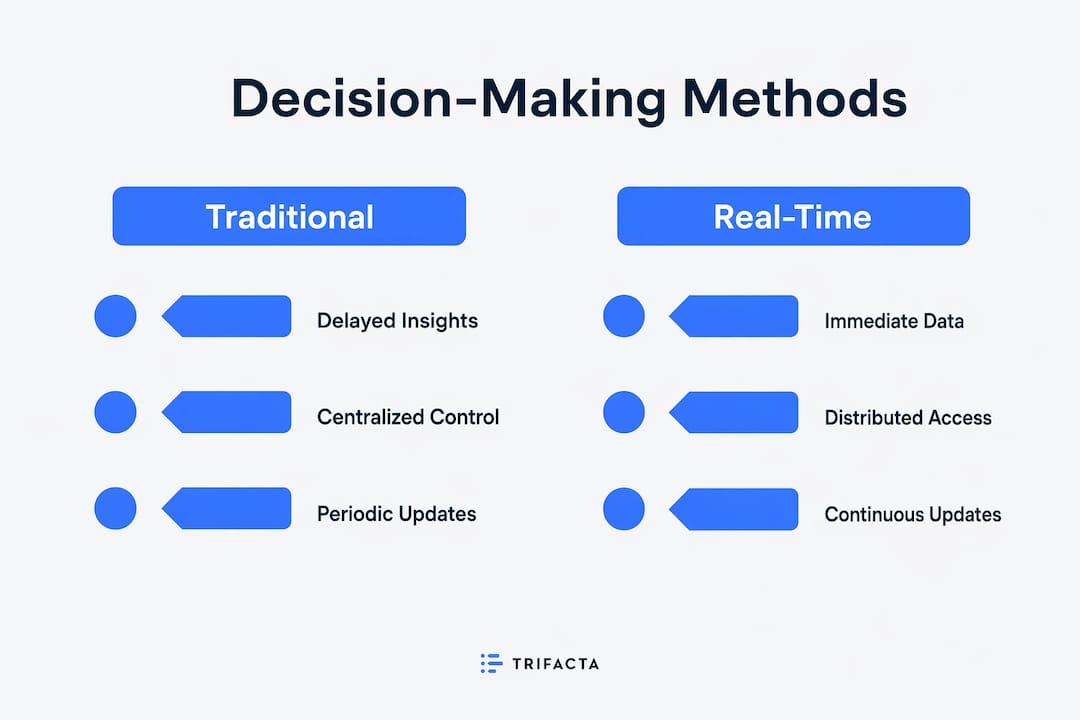
Traditional decision-making concentrates authority at the top of the org chart. Information travels up, gets analyzed, and directives travel back down. By the time a decision reaches execution, the market condition that triggered it may have already changed. Real-time data analytics breaks that cycle by shifting decision authority to empowered frontline teams operating under governance guardrails. Employees act immediately on current signals rather than waiting for approval chains to complete.
The table below shows how outcomes differ between organizations using real-time data versus those relying on traditional approaches.
| Decision area | Traditional approach | With real-time data |
|---|---|---|
| Inventory management | Weekly reorder cycles based on past sales | Continuous replenishment triggered by live stock levels |
| Pricing strategy | Monthly or quarterly price reviews | Dynamic pricing adjusted by demand signals in minutes |
| Risk and fraud detection | End-of-day batch review | Instant transaction scoring and automated alerts |
| Treasury and cash flow | Periodic reporting with manual reconciliation | Live visibility into cash positions and exposure |
| Workforce planning | Spreadsheet-based capacity reviews | Live utilization tracking with forward-looking forecasts |
Treasury departments illustrate this shift particularly well. Real-time data transforms treasury functions from backward-looking reporting units into strategic command centers that navigate volatility as it unfolds. For CFOs managing currency exposure or liquidity risk, the difference between a 30-minute-old position and a current one can be material.
What makes real-time decision execution harder than it looks
Capturing data in real time and executing decisions in real time are not the same problem. Most organizations solve the first and assume the second follows automatically. It does not. Only 11% of enterprises have deployed agentic AI in production, with 38% stuck in pilot phases. The primary barrier is not model quality or data volume. It is structural latency and transactional inconsistency in the systems that sit between the data and the decision.
A typical enterprise data stack layers streaming platforms, data lakes, feature stores, and application APIs on top of each other. Each layer adds latency. Each handoff introduces a potential failure mode. By the time a signal travels through that stack and triggers an action, the moment it was meant to address has passed. This is why the concept of a decision product matters.
A decision product is an authoritative, low-latency output that combines real-time data with business logic and transactional consistency, enabling AI agents and automated systems to act safely in production environments.
Streaming platforms solve signal delivery. Decision products solve execution. The architectural requirement is a single ACID-compliant in-memory system that collapses multiple layers into one, delivering sub-10ms latency without sacrificing consistency. In-memory processing replaces application-layer polling, which is the pattern responsible for most of the latency that makes real-time decisioning unreliable in practice.
Key failure modes to watch for in your current stack:
- Layer proliferation: Each added system between data source and decision point multiplies latency and failure risk.
- Polling architectures: Applications that query for updates on a schedule rather than receiving event-driven pushes introduce artificial delays.
- Eventual consistency: Systems that prioritize availability over transactional accuracy produce decisions based on stale or conflicting state.
Pro Tip: Do not conflate a fast data pipeline with true real-time decisioning. If your system cannot guarantee transactional consistency at sub-10ms latency, your AI agents are making decisions on data that may already be wrong.
Practical applications of real-time data analytics across industries
Real-time data analytics is not a single technology. It is a capability that manifests differently depending on the operational context. The examples below show how the same underlying architecture produces different outcomes across sectors.
Continuous SQL stream processing running inside the database core enables immediate anomaly detection and triggers automatic alerts without delay. In manufacturing, that means a sensor deviation triggers a maintenance alert before equipment fails. In IT operations, it means a latency spike in one service triggers an automated scaling response before users notice degradation.
| Industry | Real-time data application | Measurable benefit |
|---|---|---|
| Retail | Dynamic pricing and inventory replenishment | 20 to 30% inventory cost reduction |
| Manufacturing | Predictive maintenance via sensor stream analysis | Reduced unplanned downtime |
| Financial services | Transaction fraud scoring at point of authorization | Near-zero false-negative fraud rates |
| IT operations | Automated infrastructure scaling on live traffic signals | Maintained SLA during demand spikes |
| Professional services | Live resource utilization and project capacity tracking | Improved delivery predictability |
For professional services firms and agencies, the application is workforce-oriented. Real-time visibility into team capacity and project timelines allows operations leads to redistribute workload before a bottleneck becomes a missed deadline. This is where platforms like Teambuilt create direct operational value. Rather than running capacity reviews from last week’s spreadsheet, project managers see current utilization and can act on it the same day.
Workflow automation tied to real-time decision outputs is the next layer. When a decision product determines that a resource is over-allocated, it can trigger a reassignment workflow automatically, notify the relevant team lead, and update the project forecast without manual intervention. That is data-driven decision making operating at the speed the business actually moves.
Transitioning to real-time streaming requires cultural and operational change, not just technical upgrades. Teams that continue relying on batch processing while competitors operate on live signals face a compounding disadvantage that grows harder to close over time.
Key takeaways
Real-time data delivers its greatest strategic value when organizations combine fast data pipelines with ACID-compliant decision execution, empowered teams, and selective deployment across high-impact use cases.
| Point | Details |
|---|---|
| Real-time vs. batch processing | Batch cycles of 15 to 30 minutes create operational gaps that cost revenue at scale. |
| Strategic performance premium | Companies with real-time capability achieve 50%+ higher revenue growth and net margins than peers. |
| Decision products matter | Fast data pipelines alone are insufficient. ACID-compliant, sub-10ms decision products enable safe AI deployment. |
| Selective integration wins | Targeting high-stakes use cases first, such as fraud detection or inventory, delivers the clearest ROI. |
| Cultural shift required | Real-time adoption demands decentralized decision authority and governance guardrails, not just new technology. |
The uncomfortable truth about real-time data adoption
Most leaders I speak with believe their organization is further along on real-time data than it actually is. They have a live dashboard. They have a streaming pipeline. They assume the hard work is done. What they have missed is the gap between seeing data in real time and acting on it in real time with any reliability.
The organizations that get this right share one trait: they stopped treating real-time data as a reporting upgrade and started treating it as an infrastructure commitment. That means investing in governance before the use cases scale, not after. It means auditing your data stack for latency at every layer, not just at the ingestion point. And it means accepting that sticking with batch processing while your competitors move to streaming is not a neutral choice. It is a decision to fall behind on a compounding curve.
The cultural piece is the one most leaders underestimate. Empowering frontline teams to act on live signals requires trust, clear guardrails, and a willingness to let decisions happen without executive sign-off on every one. That is a harder shift than any technology implementation. But it is the shift that separates organizations that extract real value from real-time data from those that just have faster reports.
If you are a CTO or operations lead reading this, the question is not whether to invest in real-time capabilities. The question is whether your current mental model of “decision-making” is fast enough to use them. For SMBs driving growth through real-time coordination, that mental model shift is often the actual competitive advantage.
— Dima
See real-time decision-making in action with Teambuilt
Real-time data only creates value when it connects directly to the people and workflows that need it. Teambuilt is built on that principle. The platform gives project managers, operations leads, and CTOs live visibility into team capacity, workload distribution, and project delivery forecasts, all updated continuously rather than on a weekly reporting cycle.
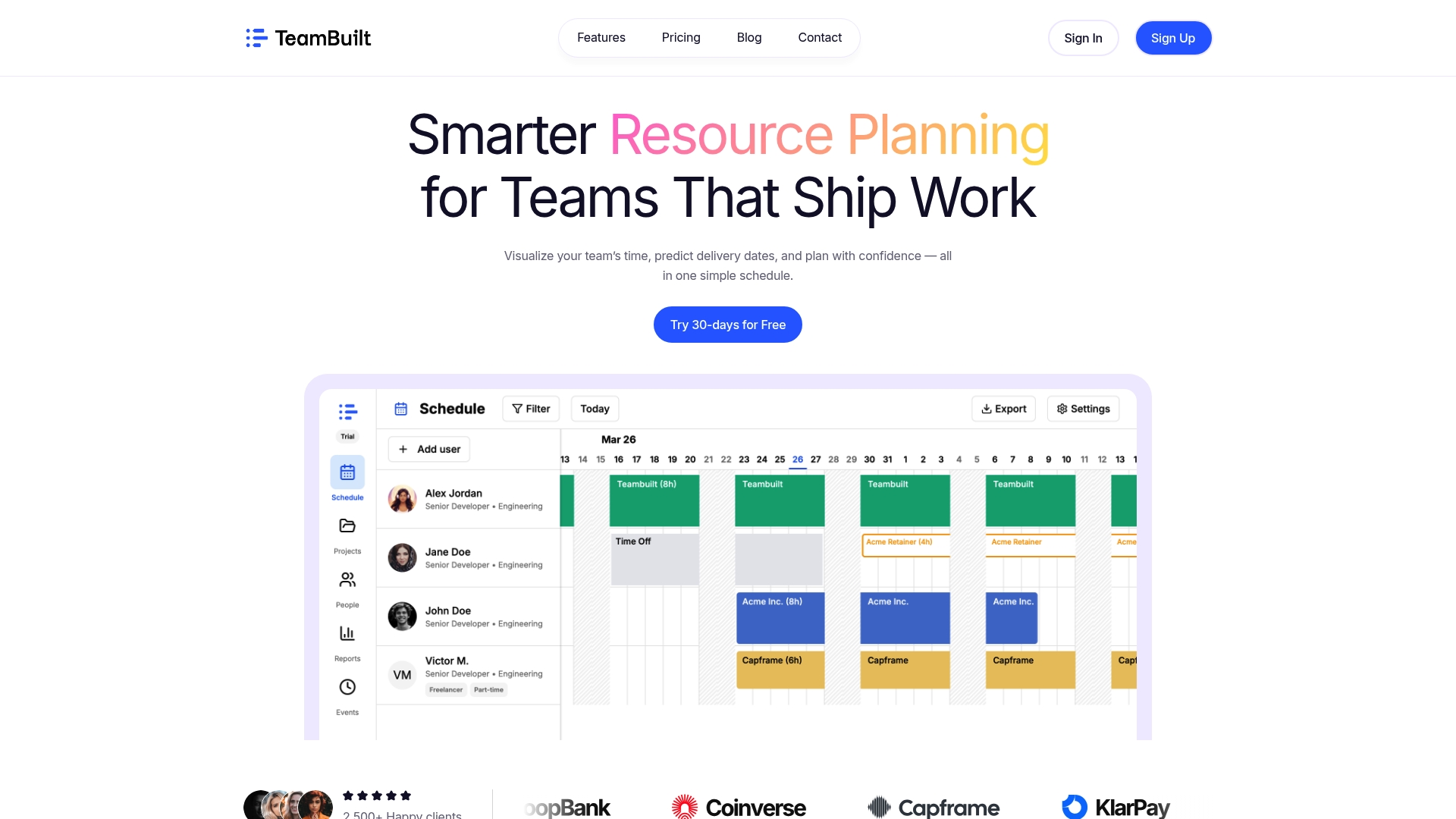
If your team is still making resource decisions from last week’s spreadsheet, Teambuilt replaces that with a centralized, real-time planning environment that integrates with your existing tools via open API. You can see who is over-allocated, which projects are at risk, and where capacity exists, before a problem becomes a missed deadline. Explore how Teambuilt supports real-time scheduling and resource planning, or go directly to teambuilt.app to see the platform in action.
FAQ
What is the role of real-time data in decisions?
Real-time data enables organizations to act on current conditions rather than historical reports, reducing the lag between an event occurring and a decision being made. Companies with mature real-time processing report 12% average revenue growth and measurable cost reductions compared to batch-dependent peers.
How does real-time data differ from batch processing?
Batch processing collects and analyzes data on a schedule, often with 15 to 30-minute cycles, while real-time data is processed and delivered within milliseconds of generation. That latency gap causes stockouts, missed pricing opportunities, and delayed fraud detection at scale.
What industries benefit most from real-time data analytics?
Retail, financial services, manufacturing, IT operations, and professional services all show measurable gains. Benefits range from 20 to 30% inventory cost reductions in retail to near-zero fraud false-negatives in financial services when transaction scoring runs at the point of authorization.
Why are so few companies using agentic AI in production?
Only 11% of enterprises have deployed agentic AI in production because most data stacks cannot deliver the sub-10ms latency and transactional consistency that safe AI agent execution requires. The gap is architectural, not a model quality problem.
How does real-time data change organizational decision-making culture?
Real-time data shifts authority from hierarchical approval chains to empowered frontline teams operating under governance guardrails. This decentralized model allows organizations to respond to market signals faster than competitors still waiting for executive sign-off on every decision.
Recommended