
Types of Project Reporting: A Practical Guide for PMs



TL;DR:
- Effective project reporting communicates status, risks, and progress to the right stakeholders at appropriate times.
- Routine, exception, and special analysis reports serve different audiences and purposes, helping improve decision-making.
Project reporting is the structured practice of communicating project status, performance, and risks to the right stakeholders at the right time. The types of project reporting you choose directly determine whether your team makes decisions faster or spends meetings catching up on information that should have been clear days earlier. Industry frameworks like PMI’s PMBOK and PRINCE2 both treat reporting as a core control mechanism, not an administrative task. Matching the report format to its audience and purpose is the single most important discipline in effective project reporting.
1. What are the main types of project reporting?
Project reporting methods fall into three broad categories: routine reports, exception reports, and special analysis reports. Each category serves a different purpose and targets a different audience. Routine reports keep everyone aligned on ongoing progress. Exception reports flag deviations that need immediate decisions. Special analysis reports answer one-off strategic questions. Understanding where each type fits prevents the most common reporting failure: sending the wrong information to the wrong person.

2. Routine reports: status, progress, and forecast
Routine reports are scheduled updates that answer three core questions: where are we now, what has been completed, and where are we headed. Each question maps to a specific report type.
Status reports give sponsors and senior stakeholders a high-level snapshot of overall project health. They typically cover schedule, budget, scope, and risk in a single page or dashboard view. The audience is executives who need to know if the project is on track, not the task-level details of how it got there.
Progress reports go one level deeper. They document completed tasks, work in progress, and near-term deliverables for the operational team. A weekly progress report for a software development team, for example, might list features completed in the sprint, blockers encountered, and what ships next week.
Forecast reports shift the lens forward. They predict the future state of the project based on current performance data, including revised completion dates and updated cost projections. A forecast report that shows a two-week schedule slip in month two gives the team time to recover before the slip becomes a missed deadline.
- Status reports: for sponsors and steering committees needing a health snapshot
- Progress reports: for team leads and delivery managers tracking operational detail
- Forecast reports: for project managers and finance leads planning ahead
Pro Tip: Structure your routine reports to answer past, present, and future in that order. Stakeholders read faster when the narrative flows from what happened, to where things stand, to what comes next.
3. How exception and issue reports manage risk
Exception reports are event-triggered documents, not scheduled ones. They go out when a project stage exceeds agreed tolerance limits on cost, schedule, or scope. That distinction matters. A routine status report might still show green while a specific workstream is quietly burning through its contingency budget. An exception report surfaces that problem before it contaminates the whole project.
The PRINCE2 framework defines exception reports as formal escalations to the project board. They must include the nature of the deviation, the cause, the impact, and a set of options with recommendations. That structure forces the project manager to think through solutions before escalating, not just report a problem and wait.
Risk and issue reports serve a related but distinct function. Risk and issue reports focus on actionable risks that have changed status, not a full catalog of every known risk. A risk register with 40 items is a reference document. A risk report highlights the three risks that moved from amber to red this week and tells the reader what action is required.
- Exception reports: triggered by tolerance breaches, require management decisions
- Risk reports: highlight status changes in active risks, not static risk lists
- Issue reports: document problems already affecting the project that need resolution
Pro Tip: Every risk or issue report should end with a named owner and a decision deadline. A report that lists problems without assigning accountability is just a worry list.
4. Financial and budget reports for cost control
Financial reporting is the area where project managers most often fall short. Financial reporting is often weak because project managers lack financial analysis skills, which means cost overruns get detected late. The fix is not more data. It is better structure.
Budget reports must link actual spending to the baseline budget, explain variances, and provide a revised forecast for project completion. A report that shows $180,000 spent against a $200,000 budget looks fine until you realize the project is only 60% complete and the remaining work requires $80,000 more.
| Element | What it shows | Why it matters |
|---|---|---|
| Actuals vs. baseline | Real spend against approved budget | Reveals whether the project is over or under budget |
| Variance | Difference between planned and actual | Quantifies the size of the cost problem |
| Earned value | Work completed relative to budget spent | Shows whether spend is producing proportional output |
| Revised forecast | Updated cost to complete | Predicts final project cost based on current burn rate |
The table above reflects the four elements every budget report needs to be useful. Without a revised forecast, stakeholders cannot tell if a current variance will self-correct or compound. Without earned value context, a budget underspend can actually signal that the project is behind schedule, not running efficiently.
5. How milestone and variance reports track schedule performance
Milestone reports give steering committees and clients a high-level view of schedule progress without operational detail. Milestone reports are ideal for audiences who need to know whether key deliverables are on track, not the granular task breakdown behind them. A client reviewing a construction project does not need to see every subcontractor’s daily log. They need to know whether the foundation pour, framing, and inspection milestones are hitting their dates.
Variance reports go further by quantifying the gap between planned and actual performance on both schedule and budget. Here is how to use them effectively:
- Compare planned milestone dates against actual or forecast completion dates for every major deliverable.
- Calculate schedule variance in days or weeks, not just percentage complete.
- Flag any milestone that has slipped more than once, since repeated slippages reveal systemic risk masked by a green status indicator.
- Pair schedule variance with budget variance to identify whether slippage is also driving cost increases.
- Include a corrective action statement for every variance above the agreed threshold.
The fifth step is the one most project managers skip. A variance report that shows a three-week slip but offers no corrective plan forces the steering committee to ask questions the project manager should have already answered.
6. Special analysis reports for one-off decisions
Special analysis reports address strategic questions that routine or exception reports cannot answer. They are one-off documents produced when a unique situation requires detailed investigation and a formal recommendation. Common examples include feasibility studies, impact analyses for scope changes, and post-implementation reviews.
The key difference from other report types is depth. A special analysis report does not summarize current status. It investigates a specific question, presents findings, and recommends a course of action. A project manager asked to evaluate whether a new regulatory requirement changes the project scope would produce a special analysis report, not a status update.
Structure matters here. The most effective special analysis reports open with an executive summary and recommendation, follow with the analysis and evidence, and close with implementation options. Decision-makers read the summary first. If the recommendation is buried on page eight, it often gets missed entirely.
Project reports should translate raw figures into insights that explain why variances occur and what corrective actions follow. That principle applies most forcefully to special analysis reports, where the entire value lies in the quality of the analysis, not the volume of data presented.
Key takeaways
Matching report type to audience and purpose is the foundation of effective project reporting across all formats and frequencies.
| Point | Details |
|---|---|
| Match report to audience | Status reports suit executives; progress reports suit delivery teams; forecast reports suit planners. |
| Exception reports require triggers | Send exception reports when tolerance limits are breached, not on a fixed schedule. |
| Financial reports need context | Always pair actual spend with variance explanation and a revised forecast to completion. |
| Milestone slippage signals deeper risk | Repeated milestone delays reveal systemic problems that green status reports often hide. |
| Special analysis reports need a clear recommendation | Open with the recommendation, then support it with evidence. |
The reporting habit that actually changes outcomes
Most project managers I have worked with treat status reports as a weekly obligation. They fill in the template, send it out, and move on. That habit produces reports that inform but never drive action.
The shift that actually changes outcomes is separating informational updates from decisions required in every report you send. When a stakeholder opens your report, they should immediately see two things: what they need to know, and what they need to decide. Mixing those two things together is why reports get read but nothing changes.
Financial reporting is where I see the most damage done. Project managers report numbers without context, and sponsors nod along until the cost overrun is too large to fix. Linking every variance to a cause and a corrective action is not extra work. It is the only way financial data becomes useful to someone who did not build the budget.
The team reporting frameworks that work best share one trait: they force the writer to answer “so what?” before sending. If you cannot explain what a reader should do differently after reading your report, the report is not finished yet.
— Dima
Teambuilt makes project reporting work for your whole team
Project managers who want their reports to drive real decisions need more than a good template. They need visibility into the data behind the report before it goes out.
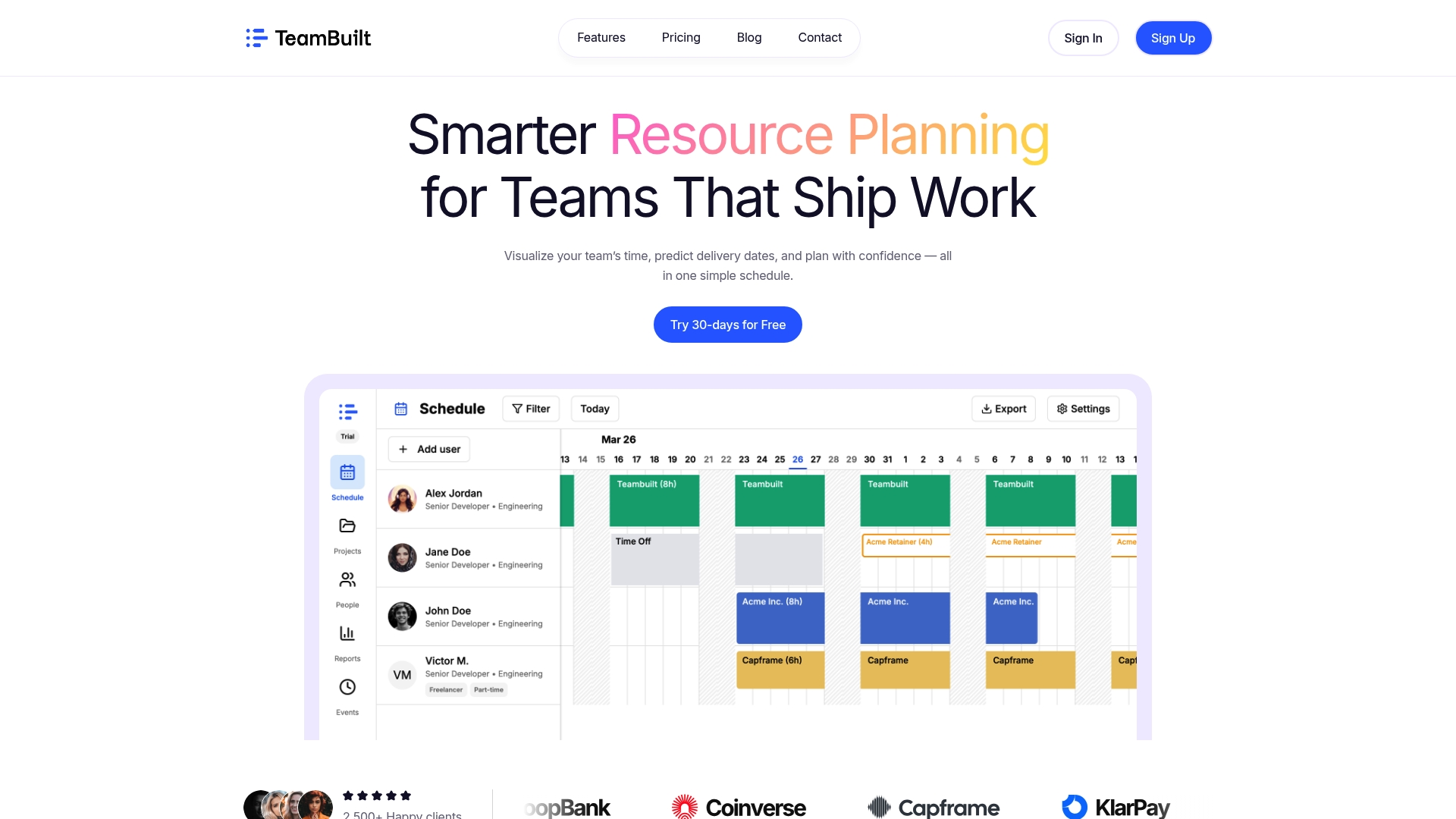
Teambuilt gives project managers and team leaders a centralized view of workload, capacity, and project timeline progress so that status reports, forecast reports, and milestone updates reflect what is actually happening across teams. Real-time scheduling data means your reports stop being a summary of the past and start being a reliable picture of where things stand right now. Teambuilt replaces scattered spreadsheets with a single source of truth that makes every report type faster to produce and easier to act on. Visit teambuilt.app to see how it works for your team.
FAQ
What are the main types of project reporting?
The three main categories are routine reports (status, progress, and forecast), exception reports (triggered by tolerance breaches), and special analysis reports (one-off deep dives for unique decisions). Each type serves a different audience and purpose.
How often should project status reports be sent?
Status reports are typically sent weekly or biweekly for active projects. The right frequency depends on project complexity, stakeholder needs, and how quickly conditions are changing.
What should a project budget report include?
A budget report should show actual spend against the baseline, explain variances, and provide a revised forecast for total project cost. Without all three elements, the report cannot alert stakeholders to emerging cost risks.
What is the difference between a progress report and a status report?
A status report gives a high-level health snapshot for executives and sponsors. A progress report provides task-level operational detail for delivery teams and team leads. Both are routine reports but serve different audiences.
When should a project manager send an exception report?
An exception report goes out when a project stage exceeds agreed tolerance limits on cost, schedule, or scope. It is event-triggered, not scheduled, and must include the cause, impact, and recommended options for the project board.
Recommended