
What Is Agency Team Structure: A 2026 Guide



TL;DR:
- Agency team structure is the organized framework that defines roles, responsibilities, and decision-making pathways within an agency to ensure efficient project delivery and consistent client satisfaction. It evolves with agency growth, requiring clear role distinctions, appropriate models, and ongoing refinement to enhance coordination and performance. Proper structuring, supported by tools like team charters and resource planning, transforms organizational design into predictable, scalable success.
Agency team structure is the organized framework that defines roles, responsibilities, and decision-making pathways within an agency to deliver projects efficiently and satisfy clients consistently. Without a deliberate structure, even talented teams lose work to miscommunication, duplicated effort, and unclear ownership. The three most common models — functional, pod, and hybrid — each suit different agency sizes and service complexities. Key roles like account managers, project managers, and producers form the backbone of any effective structure, and research from ResearchGate confirms that structured teams improve performance by enhancing coordination across the entire delivery chain.
What is agency team structure and why does it matter?
Agency team structure is the formal system that organizes people into roles, defines who reports to whom, and establishes how decisions get made across client work. It is not simply an org chart on a wall. It is the operating logic that determines whether a campaign brief reaches the right creative lead in two hours or two days.
The practical stakes are high. Ambiguous roles between account management and delivery directly cause lost work and client dissatisfaction. When no one owns a deliverable clearly, it either gets done twice or not at all. Structure eliminates that ambiguity by assigning explicit accountability at every stage of a project.
Agencies that treat structure as a bureaucratic formality miss its real value. The benefits of team organization show up in measurable outcomes: faster approvals, fewer revision cycles, and clients who renew because they trust the agency’s process. Structure is the infrastructure that makes talent predictable.
What are the main agency team structure models?
Functional, pod, and hybrid models represent the three dominant ways agencies organize their teams, and each carries distinct tradeoffs on communication speed, specialization depth, and client accountability.
Functional structure
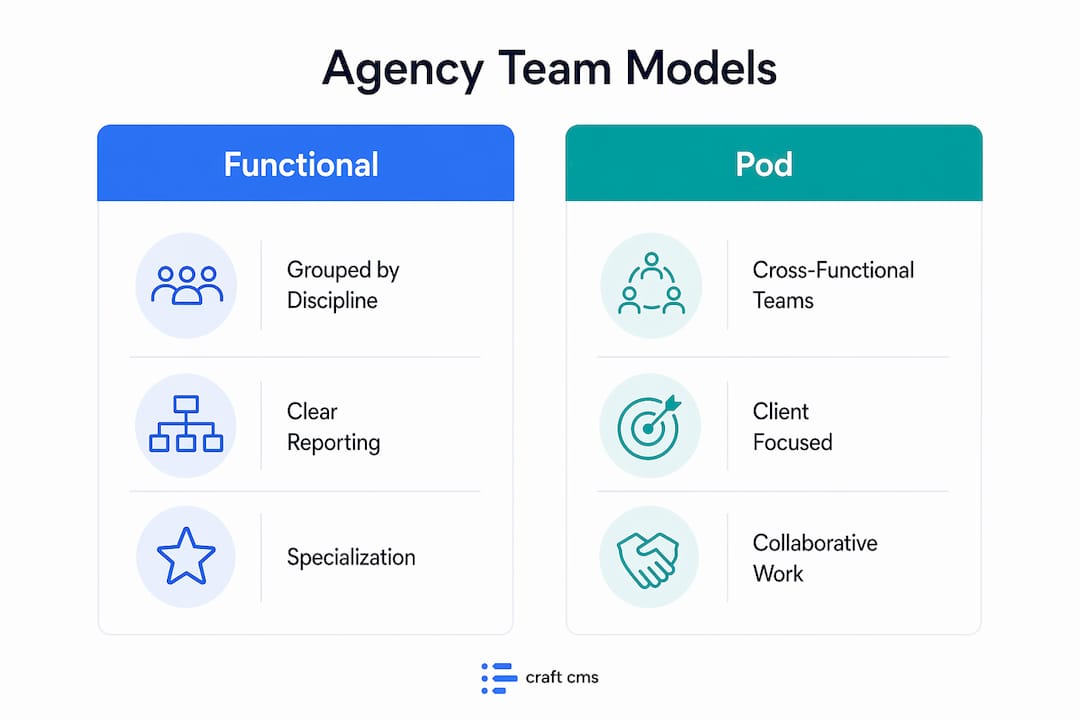
A functional structure groups people by discipline. Designers sit in a design department, copywriters in content, paid media specialists in performance. A department lead manages each group and allocates talent to projects as needed. This model maximizes specialization and makes it easy to develop deep expertise within a discipline. The weakness is coordination cost: getting a designer, a strategist, and a developer aligned on one client brief requires crossing multiple department boundaries, which slows delivery.
Pod structure
A pod structure assembles a cross-functional team around a client or client segment. One pod might contain a strategist, a designer, a developer, and an account manager who all work together exclusively on a set of accounts. Client intimacy is high, and communication loops are short. The tradeoff is that specialists can feel siloed from peers in their discipline, which limits knowledge sharing and career development. Pod models suit agencies with at least 10 people, where there is enough talent to staff complete pods without spreading anyone too thin.

Hybrid structure
A hybrid model combines functional leadership with pod-based client teams. Specialists belong to a discipline department for career development and standards, but they are assigned to client pods for day-to-day delivery. This is the most complex model to manage, but it scales well for mid-size and large agencies handling diverse client portfolios.
| Model | Communication | Specialization | Client accountability | Best fit |
|---|---|---|---|---|
| Functional | Slower across departments | High | Diffuse | Small agencies under 15 people |
| Pod | Fast within pods | Moderate | High | Agencies with 10 to 30 people |
| Hybrid | Moderate with clear interfaces | High | High | Agencies over 30 people |
Pro Tip: If you are unsure which model fits your agency, map your three most complex recent projects and count how many department handoffs each required. More than four handoffs per project is a signal that a pod or hybrid model would reduce friction.
How does agency team structure evolve as agencies grow?
Agency team structure is not a one-time decision. It changes as headcount grows, client complexity increases, and service lines expand. Agency structures typically evolve through three stages: a founding stage of one to five people, a growth stage of five to fifteen, and a scaling stage of fifteen to thirty or more.
At the founding stage, everyone does everything. The founder sells, delivers, and manages client relationships simultaneously. This works because communication is instant and context is shared. The moment a fifth or sixth person joins, informal coordination starts breaking down.
Between five and fifteen people, agencies need to introduce dedicated project managers, account managers, and department leads. These roles do not add overhead for its own sake. They free senior talent from administrative coordination so they can focus on the work that actually generates revenue. Capacity planning resources like team capacity guides for project managers become relevant at this stage because workload visibility starts to matter.
Beyond fifteen people, the structure requires department heads, an operations function, and often HR and finance support. Flat structures beyond ten people create founder bottlenecks, duplicated work, and delayed decisions that directly harm client service. The org chart at this stage needs explicit escalation paths, not just role titles.
The growth path looks like this in practice:
- 1 to 5 people: Founder plus generalist doers, no formal reporting lines
- 5 to 15 people: Add project managers, account managers, and one or two discipline leads
- 15 to 30+ people: Add department heads, an operations lead, and formal decision-rights documentation
Pro Tip: Hire doers before managers. Premature management layers add overhead without adding delivery capacity. Introduce formal management roles only when coordination complexity genuinely demands them, not when it feels like the professional thing to do.
What are the distinct roles within an agency team?
Role clarity is the single most underrated factor in agency performance. Account managers, project managers, and producers each own a distinct domain, and confusing these roles is one of the most common causes of delivery failure at growing agencies.
Here is how each role functions in practice:
-
Account manager (AM): The AM owns the client relationship and strategic alignment. They translate client goals into briefs, manage expectations, and protect the agency’s commercial relationship. The AM is not responsible for whether a task ships on Tuesday. They are responsible for whether the client believes the agency understands their business.
-
Project manager (PM): The PM owns delivery. They manage timelines, scope, task assignment, and risk. When a deadline is at risk, the PM is the person who identifies it first and escalates appropriately. The PM’s job is to make the delivery machine run, not to manage the client’s feelings about it.
-
Producer: The producer manages execution-heavy work that requires coordinating physical or logistical resources, most commonly in video production, events, or large content programs. Producers sit between the PM and the creative team, translating delivery plans into on-set or on-location reality.
These roles are complementary, not redundant. An AM without a PM becomes a bottleneck who is simultaneously managing client calls and chasing internal deadlines. A PM without an AM ends up in client conversations they are not equipped for. Separating these functions clearly is what allows each person to operate at full effectiveness. For a deeper look at how these roles interact within delivery workflows, agency project workflows provides a practical framework.
How does structure enhance agency performance through coordination?
The connection between structure and performance is not intuitive. Most agency leaders assume performance comes from hiring talented people. Research shows the mechanism is more specific: structured roles and hierarchy improve intra-team coordination, and coordination is what converts individual talent into collective output.
The research finding that matters most for agency leaders is that team longevity moderates this effect. Experienced teams with clear structures realize significantly more coordination gains than new teams with the same structure. This means investing in structural clarity pays compounding returns over time, not just immediate ones.
“The highest value of team structure lies in designing interfaces: how functions communicate, escalate, and resolve conflicts. An org chart that only lists roles without specifying these interfaces is decorative.” — James McCann, as cited by Project Management Formula
A team charter is the practical tool that converts an org chart into an operating system. It specifies who approves scope changes, who escalates and when, how conflicts between the AM and PM get resolved, and what communication cadence each role follows. Without a charter, the org chart is aspirational. With one, it becomes the actual way work gets done.
Matching structure to project complexity also matters. Projectized structures suit large programs where a single PM needs full authority over a dedicated team. Matrix structures fit multi-specialist projects where resources must be shared across accounts. Mismatching structure to complexity increases coordination cost without any corresponding benefit.
| Structure type | Authority model | Best for | Coordination cost |
|---|---|---|---|
| Functional | Department leads | Specialized, repeatable work | High across departments |
| Projectized | PM has full authority | Large, complex programs | Low within project |
| Matrix | Shared functional and PM | Multi-specialist client work | Moderate with clear rights |
For agencies building out their coordination practices, better team communication resources provide concrete methods for reducing handoff friction between roles.
Key takeaways
Agency team structure determines coordination quality, and coordination quality determines delivery performance across every client engagement.
| Point | Details |
|---|---|
| Structure drives coordination | Clear roles and reporting lines reduce handoff friction and improve delivery speed. |
| Model choice depends on size | Functional suits small agencies; pod fits 10 to 30 people; hybrid scales beyond 30. |
| Role clarity prevents failure | Separating AM, PM, and producer functions eliminates ownership gaps that cause missed deadlines. |
| Charters make structure real | A team charter with decision rights converts an org chart into an actual operating system. |
| Structure compounds over time | Teams with longer tenure realize greater coordination gains from the same structural clarity. |
Why most agencies get structure wrong at the 20-person mark
The structural mistakes I see most often do not happen at founding or at scale. They happen in the fifteen to forty person range, where agencies are too big for informal coordination but too small to feel justified in adding formal structure. Leaders at this stage often say they want to stay “flat and agile.” What they actually have is a founder who approves every client-facing decision and a team that has learned to wait rather than act.
The fix is not a reorganization. It is a decision-rights audit. Map the ten most common decisions made in a typical project week and identify who currently makes each one. If more than half trace back to one or two people, the structure is a bottleneck regardless of what the org chart says.
I have also seen agencies over-invest in the wrong direction, adding management layers before they have enough doers to manage. A team of twelve does not need three managers and nine producers. It needs eight producers, two senior leads who also produce, and two people handling client and project coordination. Structure should follow work volume, not organizational ambition.
The agencies that get this right treat their structure as a living document. They review it when a new service line launches, when headcount crosses a threshold, or when client feedback starts pointing to coordination failures. Structural discipline is not a one-time project. It is an ongoing practice that separates agencies that scale from those that plateau.
— Dima
See how Teambuilt supports your agency’s team structure
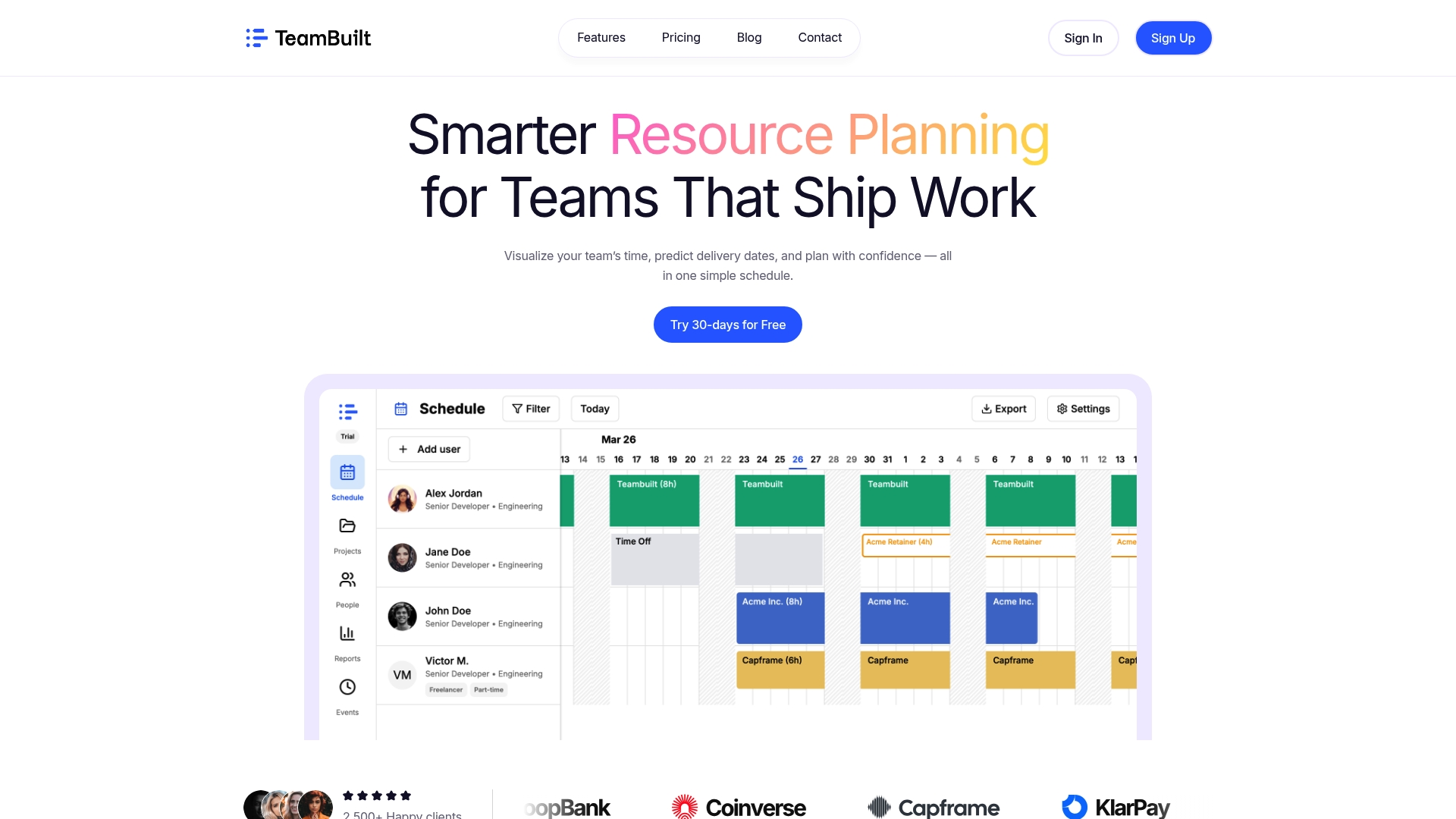
Teambuilt gives agency leaders real-time visibility into how their teams are organized, loaded, and performing across every active project. The platform’s workload visualization and capacity tracking tools make it straightforward to spot role gaps, identify overloaded team members, and forecast delivery dates based on actual resource availability. Whether you are formalizing roles for the first time or restructuring a growing team, Teambuilt’s resource planning tools replace scattered spreadsheets with a single source of truth. For agencies managing multiple clients and complex workflows, that visibility is what turns a well-designed structure into consistent, predictable delivery.
FAQ
What is agency team structure in simple terms?
Agency team structure is the system that defines who does what, who reports to whom, and how decisions get made inside an agency. It determines how efficiently client work moves from brief to delivery.
What are the three main agency team structure models?
The three main models are functional (grouped by discipline), pod (cross-functional teams per client), and hybrid (combining both). Each suits different agency sizes and client complexity levels.
When should an agency add formal management roles?
Formal management roles become necessary when an agency grows beyond five to ten people and informal coordination starts causing delays, duplicated work, or founder bottlenecks. Adding project managers and account managers at this stage frees senior talent for delivery.
What is the difference between an account manager and a project manager in an agency?
An account manager owns the client relationship and strategic alignment, while a project manager owns delivery timelines, scope, and task coordination. Confusing these roles creates ownership gaps that lead directly to missed deadlines and client dissatisfaction.
What is a team charter and why does an agency need one?
A team charter is a document that specifies decision rights, communication cadences, and escalation paths for a team. Without one, an org chart describes intended structure but does not govern how work actually gets done.
Recommended