
Hybrid Team Management Checklist for Leaders in 2026



TL;DR:
- A hybrid team management checklist promotes effective communication, accountability, and culture across remote and in-office workers. Leaders must define clear norms, measure outcomes, document decisions, and intentionally build relationships to prevent disconnection. Using the right tools and consistent practices ensures hybrid teams perform well and stay engaged.
A hybrid team management checklist is a structured set of practices that ensures leaders maintain consistent communication, accountability, and culture across both remote and in-office team members. Without one, teams default to proximity bias, communication gaps, and uneven performance standards. Organizations with mature hybrid leadership retain 67% more top talent and see 34% higher productivity than office-centric competitors. That gap is not accidental. It reflects the difference between leaders who manage hybrid work intentionally and those who treat it as a temporary arrangement. Tools like Slack, Asana, and Zoom are only as effective as the systems built around them.
What are the key elements of a hybrid team management checklist?
Every effective checklist for managing hybrid teams covers five core categories. Miss one, and the others start to break down.
- Communication standards: Define which channels handle urgent requests, which handle async updates, and what response times are expected. Without written norms, remote workers default to guessing.
- Regular 1:1 coaching check-ins: Weekly coaching check-ins with a simple framework improve outcomes and give managers early warning on blockers. A ten-minute structured conversation beats a thirty-minute status meeting.
- Outcome-oriented metrics: Measure what people deliver, not when they are online. This is the single most important shift in hybrid work strategy.
- Psychological safety: Psychological safety is the hidden engine of hybrid team performance. Build it through neutral responses to mistakes, early risk reporting, and modeling learning from failure.
- Documentation and decision logs: Every decision made in a meeting must be written down and shared. For remote team members, if it is not documented, it did not happen.
These five categories form the backbone of any team management guide for hybrid environments. The checklist items within each category are what leaders execute week over week.
How to manage communication effectively in hybrid teams
Effective hybrid team communication is a system with three layers: asynchronous messaging, synchronous meetings, and written documentation. Poor communication costs workers an average of 3.2 hours per week. Across a team of ten, that is 32 hours of lost productivity every single week.
The fix starts with an async-first mindset. Not every question needs a meeting. Not every update needs a call. Define clear norms so your team knows exactly how to route each type of communication:
- Urgent requests (response needed within two hours): direct message on Slack or Microsoft Teams
- Non-urgent updates (response within 24 hours): project thread in Asana or a dedicated Slack channel
- Decisions and announcements: written post in a shared documentation tool like Notion or Confluence
- Complex discussions: scheduled Zoom or Teams call with a written agenda sent 24 hours in advance
When synchronous meetings do happen, preparation is non-negotiable. Send an agenda. Assign a note-taker. Share a summary within one hour of the call ending. These habits are the difference between a meeting that moves work forward and one that creates more confusion.
Pro Tip: In hybrid meetings, have every participant join on their own device rather than clustering in-office attendees around a single screen. This levels the playing field and prevents remote participants from being excluded from side conversations.

For leaders looking to build a repeatable communication system, the team communication improvement workflow guide from Teambuilt covers how to structure these norms across departments.
Which performance management practices reduce proximity bias?
Proximity bias is the tendency to favor employees who are physically present. It is the most damaging pattern in hybrid work, and most managers do not realize they are doing it. The fix requires a deliberate shift from managing presence to managing outcomes.
Here is a numbered framework for building a bias-resistant performance system:
- Define outcome metrics for every role. Each team member should have two to four measurable deliverables per sprint or month. Vague goals create room for subjective judgment.
- Require documented progress updates from all team members. Standardized documented updates prevent managers from relying on hallway conversations as their primary performance signal.
- Use shared dashboards. Tools like Asana, Monday.com, and Trello give every team member equal visibility into project status. No one gets credit for invisible work.
- Hold milestone reviews on a fixed schedule. Monthly or bi-weekly reviews keep performance conversations structured and consistent across remote and in-office staff.
- Apply consequences consistently. If a remote employee misses a deadline, the response should be identical to what happens when an in-office employee misses one. Inconsistency destroys trust faster than any policy.
Managers who follow this framework build a culture where performance speaks louder than physical presence. That is the foundation of real virtual team productivity.
What technology tools support hybrid collaboration?
The right tools do not replace good management practices. They make those practices easier to execute consistently. Here is a comparison of the core platforms hybrid teams rely on:
| Category | Tool | Primary Use |
|---|---|---|
| Project management | Asana | Task tracking, milestone visibility, team workload |
| Project management | Trello | Visual kanban boards for smaller teams |
| Project management | Monday.com | Cross-team coordination and reporting |
| File sharing | Google Drive | Real-time document collaboration |
| File sharing | Dropbox | Secure file storage and sharing |
| Communication | Slack | Async messaging, channel-based norms |
| Communication | Microsoft Teams | Integrated chat, calls, and file sharing |
| Video meetings | Zoom | Synchronous calls with recording and transcription |
| Documentation | Notion | Decision logs, wikis, and process documentation |
Documentation functions as a scalable, persistent asset. The absence of documentation is the same as non-communication for remote team members. Tools like Notion and Confluence solve this directly by making documentation a default behavior rather than an afterthought.
Top hybrid leaders rely on clarity systems like RACI charts, meeting summaries, and decision logs rather than increasing meeting frequency. More meetings are rarely the answer.
Pro Tip: Equip hybrid meeting rooms with a dedicated camera, directional microphone, and second monitor for remote participants. Poor audio is the number one reason remote attendees disengage from in-room meetings.
For teams managing complex cross-functional work, Teambuilt’s collaborative project planning tips show how to connect these tools into a single planning workflow.
How to build culture and engagement in hybrid teams
Culture does not build itself in hybrid teams. Leaders have to schedule it. The informal connections that happen naturally in an office require deliberate planning when half the team is remote.
A practical culture checklist for hybrid leaders includes:
- Quarterly in-person gatherings: Even one or two days together per quarter significantly strengthens trust and informal relationships. These do not need to be elaborate offsites.
- Dedicated social time in meetings: Reserve the first five minutes of weekly team calls for non-work conversation. This is not wasted time. It is relationship capital.
- Recognition on shared channels: Public recognition in Slack or Teams ensures that remote employees receive the same visibility as in-office staff. Private praise does not build culture.
- Pulse surveys: Short monthly surveys using tools like Officevibe or Culture Amp give managers early signals on morale before problems escalate.
- Flexibility with accountability: Give team members control over when and where they work, but hold firm on output expectations and deadlines.
Hybrid leadership maturity progresses through defined levels that require policy development, manager training, and communication standards. Building culture is not a one-time initiative. It is a recurring item on every leader’s checklist.
Remote team collaboration does not fail because people are in different locations. It fails because leaders stop investing in the human layer of the work.
Key takeaways
A hybrid team management checklist works because it converts good intentions into repeatable systems that protect performance, fairness, and culture across every work location.
| Point | Details |
|---|---|
| Lead with outcomes | Measure deliverables, not hours online, to eliminate proximity bias. |
| Standardize communication | Define channels and response times in writing so every team member operates from the same norms. |
| Document every decision | Written decision logs give remote employees equal access to context and direction. |
| Schedule culture deliberately | Quarterly in-person time and regular recognition prevent remote workers from feeling invisible. |
| Use the right tools | Asana, Slack, Zoom, and Notion each solve a specific coordination problem. Use them together. |
What I have learned from managing hybrid teams
The most common mistake I see leaders make is treating hybrid management as a logistics problem. They buy the tools, set up the channels, and then wonder why the team still feels disconnected. The tools are not the problem. The intentionality is.
Hybrid management requires more deliberate communication than traditional management, but the underlying principles are the same. Clarity, consistency, and follow-through still drive performance. What changes is that you can no longer rely on physical proximity to fill in the gaps. Every assumption you would normally communicate through a hallway conversation now needs to be written down.
The leaders who get this right are not the ones with the most sophisticated tech stack. They are the ones who hold a weekly 1:1, send a meeting summary within an hour, and publicly recognize good work on a shared channel. These habits cost nothing and compound over time.
One thing I would push back on: the idea that async-first means fewer human connections. Meetings are the most expensive form of communication, and reducing them is the right call. But the meetings you do keep should be genuinely human. Use them for coaching, alignment, and celebration. Not status updates.
The leaders who build the best hybrid teams are the ones who treat the checklist as a living document. They review it quarterly, cut what is not working, and add what the team actually needs.
— Dima
Take your hybrid team coordination further with Teambuilt
Managing a hybrid team across multiple projects and time zones is hard enough without scattered spreadsheets and disconnected tools.
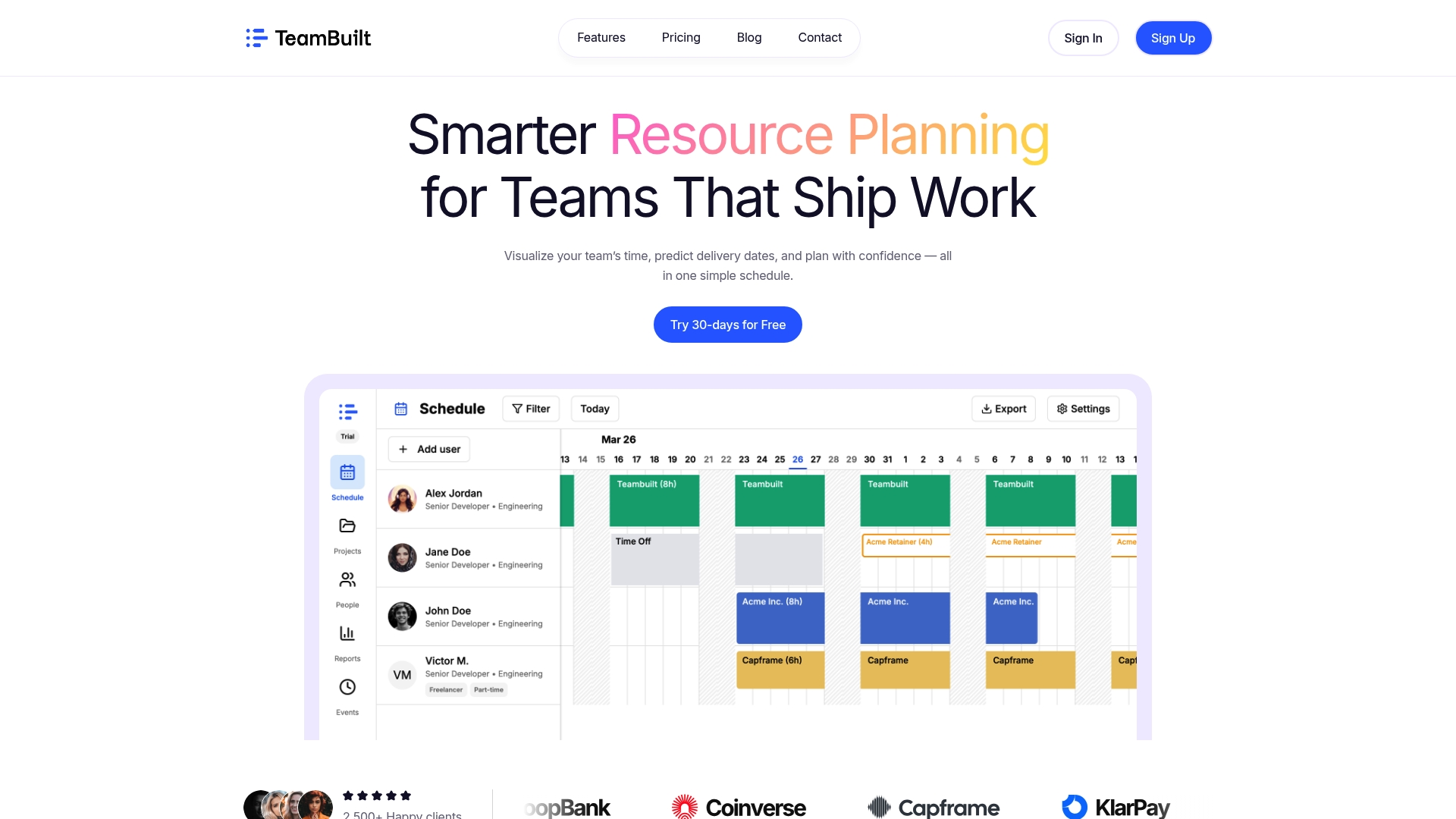
Teambuilt gives hybrid team leaders a single platform for real-time workload visibility, project scheduling, and cross-team coordination. You can see who is over capacity, forecast delivery dates based on actual availability, and keep every team member aligned without adding another meeting to the calendar. It replaces the guesswork that makes hybrid management feel harder than it needs to be. If you are ready to put your hybrid team planning on a system that scales, Teambuilt is built for exactly that.
FAQ
What is a hybrid team management checklist?
A hybrid team management checklist is a structured list of practices covering communication norms, performance tracking, documentation, and culture-building that leaders follow to manage both remote and in-office employees consistently.
How do you prevent proximity bias in hybrid teams?
Prevent proximity bias by measuring outcomes instead of presence, requiring documented progress updates from all team members, and using shared dashboards so performance is visible regardless of location.
What tools do hybrid teams need?
Hybrid teams need a project management tool like Asana or Monday.com, a communication platform like Slack or Microsoft Teams, a video tool like Zoom, and a documentation system like Notion or Confluence.
How often should hybrid managers hold 1:1 check-ins?
Weekly 1:1 check-ins are the standard for hybrid managers. A short, structured ten-minute conversation each week gives managers early visibility into blockers and keeps remote employees connected to their goals.
How do you build culture in a hybrid team?
Build culture through quarterly in-person gatherings, public recognition on shared channels, dedicated social time in team meetings, and regular pulse surveys to monitor engagement before problems grow.
Recommended