
Why Dev Teams Adopt SaaS Planning Tools in 2026



TL;DR:
- SaaS planning tools improve development workflows by enabling real-time collaboration and reducing planning cycles. Adoption rates strongly predict team productivity, with simpler, integrated platforms achieving higher engagement. Successful implementation requires process redesign and focus on live data to maximize efficiency and cost savings.
SaaS planning tools are cloud-based project management platforms that replace manual spreadsheets and disconnected workflows with automated, real-time coordination across development teams. The reason why dev teams adopt SaaS planning tools comes down to one measurable outcome: faster delivery with less operational drag. Organizations that make the switch report 30–50% shorter planning cycles, with some compressing 45-day planning cycles down to 3 days. Platforms like Jira, Asana, and Teambuilt have made this shift accessible to teams of every size, from early-stage startups to enterprise engineering departments managing dozens of concurrent projects.
Why dev teams adopt SaaS planning tools: efficiency and cost savings
The most direct reason development teams move to SaaS planning platforms is the measurable reduction in time spent on planning overhead. Manual spreadsheet workflows require constant reconciliation, version control, and status chasing. SaaS tools eliminate that friction by centralizing data and automating routine updates.
The financial case is equally strong. Companies adopting SaaS report 50% IT infrastructure savings by eliminating local servers and on-premise maintenance costs. That same shift produces 20–30% reductions in operational costs by removing manual data entry tasks. For a 20-person engineering team, that translates directly into budget that can fund product development instead of infrastructure upkeep.
Here is what the efficiency gains look like in practice:
- Planning cycle compression: Cycles that once took 45 days now complete in 3 days after migrating from spreadsheets to SaaS environments.
- Reduced status meeting load: Automated status updates replace manual check-ins, freeing engineers to focus on building.
- Eliminated version conflicts: A single shared workspace removes the “which spreadsheet is current?” problem entirely.
- Faster resource allocation: Real-time capacity data lets project managers assign work in minutes instead of days.
The shift from manual to cloud-based planning also removes the hidden cost of human error. Spreadsheet-based planning fails not because people are careless, but because the format was never designed for dynamic, multi-team coordination. SaaS tools are.
How does user adoption affect team productivity?
Adopting a tool and actually using it are two different things. Data from 247 companies shows that adoption rates predict productivity with a correlation of r=0.84. That is one of the strongest correlations in project management research. A tool sitting unused on a team’s tech stack produces zero benefit.

The adoption gap between tools is significant. Jira achieves 91% adoption in pure engineering teams but drops to only 34% in cross-functional teams. Asana reaches 82% adoption within 3 days across mixed-function groups. Those numbers tell a clear story: tool fit matters more than feature count.
Tool complexity is the primary adoption killer. High feature counts increase maintenance burden and reduce actual development throughput, with complexity correlating with task completion at r= -0.41. Every unnecessary configuration screen is a reason for a developer to abandon the tool and revert to Slack threads and sticky notes.
Pro Tip: Before committing to any SaaS planning platform, run a 2-week trial with your actual team, not just your project managers. Developer adoption in the first week predicts long-term usage more accurately than any feature checklist.
The most productive teams pick opinionated tools that simplify rather than complicate planning. An opinionated tool makes decisions for you about workflow structure, which reduces cognitive load and speeds onboarding. That is a feature, not a limitation.
Integration and real-time data: from static plans to live decisions
The biggest shift SaaS planning tools create is not speed. It is the move from static planning to continuous planning. Traditional project management produces a plan at the start of a sprint and then watches it become outdated within days. SaaS platforms connected to live operational data keep plans current automatically.

The primary value here is a single source of truth that pulls from CI/CD pipelines, CRM systems, and ERP data simultaneously. When a deployment fails in your CI/CD pipeline, a connected planning tool can flag the impact on delivery dates before a project manager even opens their laptop. That is proactive planning, not reactive firefighting.
AI accelerates this further. In 2026, AI automates roughly 70% of routine project management tasks including status updates, task routing, and anomaly detection across leading SaaS platforms. That automation frees senior engineers and project managers to focus on decisions that actually require human judgment.
The table below shows what changes when teams move from manual planning to integrated SaaS workflows:
| Planning activity | Manual workflow | Integrated SaaS workflow |
|---|---|---|
| Status updates | Weekly meetings, manual entry | Automated from connected tools |
| Resource allocation | Spreadsheet review, email threads | Real-time capacity dashboard |
| Delivery forecasting | Gut estimate or static Gantt chart | Data-driven, auto-updated projections |
| Risk detection | Discovered after delays occur | Flagged automatically by anomaly detection |
| Cross-team coordination | Separate tools, manual sync | Centralized, live visibility |
Pro Tip: Treat SaaS adoption as a process redesign project, not a software migration. Teams that simply replicate their old spreadsheet logic inside a new tool get none of the integration benefits. Rebuild your workflows around live data from day one.
The role of integrations in SaaS is what separates a planning tool from a planning system. A tool stores tasks. A system connects tasks to outcomes.
How to choose the right SaaS planning tool for your dev team
Tool selection comes down to one diagnostic question: who makes up 80% of your daily users? This is the “80% user rule,” and it determines which category of tool fits your team. Developer-first tools prioritize speed and keyboard-friendly workflows, integrating tightly with GitHub and Slack. General-purpose tools favor visibility and reporting for cross-functional stakeholders.
If your team is engineering-heavy, a developer-first platform reduces context switching and keeps engineers in flow. If your team includes product managers, designers, and client-facing roles, a general-purpose platform with strong visualization features serves the full group better.
Key criteria to evaluate in 2026:
- Ease of onboarding: Can a new team member contribute without a training session? If not, adoption will stall.
- Native integrations: Does the tool connect directly to GitHub, Slack, Google Workspace, or your CI/CD pipeline without custom development?
- Automation depth: Can it handle status updates, notifications, and task routing without manual triggers?
- Capacity visibility: Does it show workload distribution across team members in real time?
- Pricing transparency: Are there hidden costs for API access, additional seats, or advanced reporting?
Over-complexity is the most common selection mistake. Teams often choose the tool with the longest feature list, then spend the next quarter configuring it instead of shipping product. The hidden maintenance costs of complex tools divert engineering resources from actual development work. Simpler tools with strong integration support consistently outperform feature-heavy platforms in real-world adoption.
Overcoming common adoption challenges and maximizing ROI
The most common reason SaaS planning tool adoptions fail is treating the rollout as a cleanup exercise. Teams migrate their existing task lists, recreate their old spreadsheet columns, and call it done. That approach produces a more expensive version of the same broken workflow.
Successful adoption requires process redesign that connects the tool to live operational signals. That means defining which data sources feed the planning system, which workflows trigger automatic updates, and which decisions the tool should surface proactively.
Practical steps that improve adoption outcomes:
- Audit your current workflow first. Map every manual step before selecting a tool. You cannot automate a process you have not documented.
- Assign a tool owner. One person responsible for configuration and training drives adoption faster than a committee.
- Start with one team. Pilot the tool with your most engaged team, measure results, then expand.
- Automate the most painful tasks first. Status reporting and resource conflict detection deliver immediate visible value that builds buy-in.
- Track adoption metrics weekly. Daily active users and task completion rates tell you whether the tool is working before the next sprint review.
Pro Tip: The fastest path to ROI is automating the tasks your team hates most. If engineers dread weekly status updates, automate them first. Visible relief from painful work drives adoption faster than any onboarding presentation.
Explore workflow automation examples that show how project managers are cutting manual overhead in 2026 using SaaS platforms with built-in AI assistance.
Key takeaways
SaaS planning tools deliver their highest value when teams redesign workflows around live data integration rather than simply digitizing existing manual processes.
| Point | Details |
|---|---|
| Cycle time reduction | SaaS adoption compresses planning cycles by 30–50%, sometimes from 45 days to 3 days. |
| Cost savings are real | Teams report 50% IT infrastructure savings and 20–30% lower operational costs after switching. |
| Adoption predicts productivity | A correlation of r=0.84 between adoption rates and productivity makes tool fit a strategic decision. |
| Integration beats feature count | Tools connected to CI/CD, CRM, and ERP data outperform feature-heavy platforms with no live data. |
| Process redesign is non-negotiable | Migrating old workflows into new tools produces no efficiency gain without rebuilding around automation. |
What I have learned watching teams adopt SaaS planning tools
I have watched dozens of development teams go through SaaS planning tool adoptions, and the pattern is almost always the same. The teams that succeed are not the ones that chose the most powerful tool. They are the ones that chose the right-sized tool and then actually changed how they work.
The obsession with features is a trap. I have seen teams spend three months configuring a platform with hundreds of capabilities, only to use four of them. Meanwhile, a smaller team on a simpler tool shipped twice as much product in the same period. Simplicity is not a compromise. It is a competitive advantage.
The AI shift in 2026 is real and worth taking seriously. When 70% of routine project management tasks can be automated, the question is no longer whether to adopt SaaS. It is whether your team is capturing that automation or leaving it on the table. The teams that treat AI-assisted planning as a core workflow, not a nice-to-have feature, will outpace those that do not.
One thing I rarely see discussed is the cultural dimension. A SaaS tool does not fix a team that does not communicate. It amplifies whatever communication patterns already exist. If your team avoids accountability in standup, a new planning tool will not change that. The technology works best when the team culture is already oriented toward transparency and shared ownership of outcomes.
My honest recommendation: pick a tool your developers will actually open every morning, connect it to your existing systems, and redesign two or three of your most painful workflows around it. That narrow focus produces more ROI than a full-platform rollout with low adoption.
— Dima
See how Teambuilt handles this for dev teams
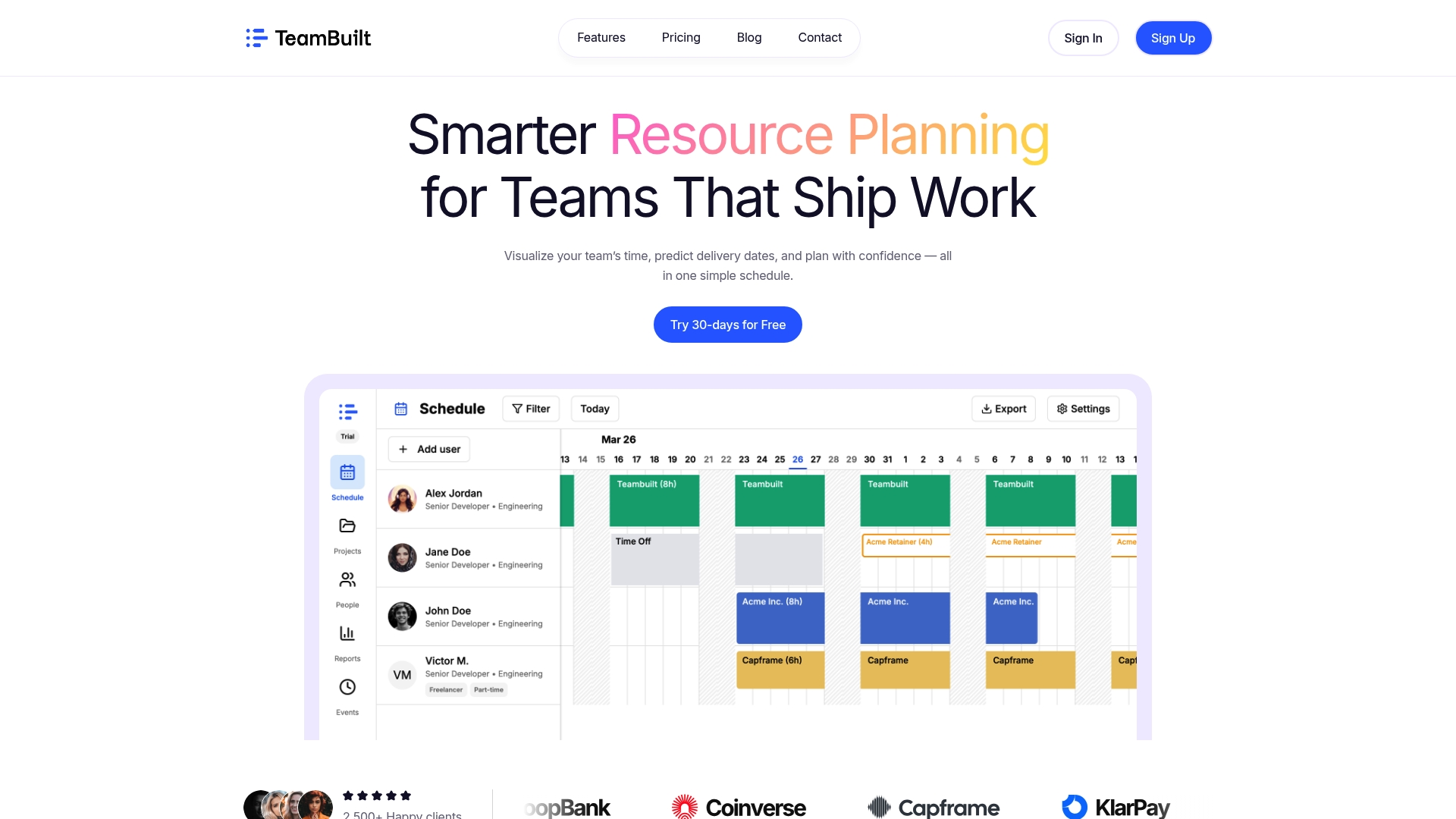
Teambuilt is built specifically for teams that need real-time visibility into capacity, workload, and delivery timelines without the configuration overhead of enterprise platforms. It connects directly to your existing tools via open API and pre-built integrations, giving project managers and CTOs a live view of who is working on what and when projects will actually ship. If your team is still reconciling resource availability in spreadsheets or losing time to manual status updates, explore Teambuilt’s resource planning platform to see how automated capacity tracking and workload visualization work in practice. You can also read more about why SMBs benefit from planning tools to understand the broader cost and growth case.
FAQ
Why do dev teams choose SaaS over on-premise planning tools?
SaaS planning tools eliminate local server costs, enable real-time collaboration across distributed teams, and receive continuous updates without IT intervention. Companies report 50% IT infrastructure savings after making the switch.
What is the biggest adoption challenge for SaaS planning tools?
The most common failure is migrating old manual workflows into a new tool without redesigning the underlying process. Successful adoption requires connecting the tool to live data sources and automating routine tasks from the start.
How does tool complexity affect developer productivity?
Tool complexity correlates with task completion at r= -0.41, meaning more features directly reduce throughput. Developer-first tools with focused, keyboard-friendly workflows consistently achieve higher adoption and better productivity outcomes.
What makes SaaS tools effective for agile teams specifically?
SaaS tools for agile teams provide real-time sprint tracking, automated status updates, and integration with CI/CD pipelines, which keeps planning aligned with actual development progress rather than lagging behind it.
How quickly can a dev team expect ROI from a SaaS planning tool?
Teams that redesign workflows around automation typically see measurable cycle time reductions within the first sprint cycle. Asana, for example, reaches 82% team adoption within 3 days, which accelerates the path to visible productivity gains.
Recommended