
Why Use Rolling Wave Planning for Better Projects



TL;DR:
- Rolling wave planning involves fully detailing near-term work while keeping future phases at a summary level until more information emerges. It reduces scope change requests, budget waste, and anchoring bias, improving forecast accuracy and stakeholder communication. The method works best for evolving, complex, or research projects and relies on fixed review cycles and disciplined wave boundaries.
Rolling wave planning is defined as the practice of detailing near-term project work fully while keeping future phases at a summary level until more information becomes available. Project managers use this technique, formally recognized by the Project Management Institute, to match planning depth with actual knowledge at each stage. The result is fewer wasted decisions, less rework, and a plan that stays accurate as reality shifts. If you have ever committed to a full Gantt chart in week one only to rebuild it in week four, rolling wave planning is the direct answer to that problem.
What are the key benefits of rolling wave planning?
Rolling wave planning delivers measurable improvements across cost, scope, and team performance. The benefits are not theoretical. They show up in project data and in the daily experience of teams that adopt the method.
Reduced scope change requests. Projects using rolling wave techniques experience 23% fewer scope-related change requests in later stages. Fewer change requests mean less rework, lower administrative overhead, and more predictable delivery timelines.
Lower budget waste. Organizations using adaptive planning report significantly lower budget waste than those locked into rigid upfront plans. Wasted spend shrinks because teams stop committing resources to work that is still poorly understood.

Mitigation of anchoring bias. Rolling wave planning reduces anchoring bias by keeping distant tasks at summary level until better information arrives. Anchoring bias is the cognitive trap where an early estimate becomes a fixed reference point even when evidence changes. Leaving future work vague on purpose removes that trap entirely.
Improved forecast accuracy. Rolling wave planning improves forecast accuracy and resource utilization by aligning planning granularity with what the team actually knows. A forecast built on real, near-term data beats one built on assumptions about work six months away.
Stronger stakeholder communication. When project managers present a detailed near-term plan alongside high-level future milestones, stakeholders get both clarity and honesty. That combination builds more trust than a false sense of certainty from a fully detailed upfront plan.

Pro Tip: Use your wave review meetings as a standing stakeholder update. Combining the planning cycle with the communication cycle cuts meeting overhead and keeps everyone aligned without extra effort.
How does rolling wave planning compare to traditional full upfront planning?
Traditional full upfront planning, sometimes called waterfall planning, requires teams to define every task, dependency, and resource before work begins. That approach works well when requirements are stable and the technology is well understood. Construction of a standard residential building fits this model. Writing a new software product for an emerging market does not.
The core drawback of full upfront planning is false precision. A 200-task Gantt chart built in week one looks authoritative. In practice, it is a document of assumptions. Planning without pretending is the honest alternative, and rolling wave planning is the formal structure that makes honesty possible.
| Factor | Full upfront planning | Rolling wave planning |
|---|---|---|
| Planning depth | All tasks detailed from day one | Near-term detailed, future at summary level |
| Flexibility | Low. Changes require full replanning. | High. Future phases absorb new information. |
| Anchoring bias risk | High. Early estimates become fixed. | Low. Future estimates stay provisional. |
| Best fit | Stable, well-understood requirements | Evolving requirements, complex projects |
| Stakeholder communication | Single detailed plan upfront | Detailed near-term plus milestone roadmap |
| Resource accuracy | Often overstated early | Calibrated as work approaches |
Rolling wave planning does not eliminate structure. It concentrates structure where it is most useful: the immediate work. Structured wave boundaries are what prevent the method from becoming an excuse for vague planning. Without clear wave boundaries, rolling wave planning degrades into reactive firefighting.
Pro Tip: When executives push for a full upfront Gantt chart, give them a detailed 4-week plan plus a milestone roadmap for the rest of the project. That combination satisfies the demand for visibility without forcing false precision on work that is still unknown.
What are rolling wave planning techniques and how are planning horizons defined?
Rolling wave planning operates through two distinct planning horizons. Understanding both is the foundation of any practical implementation.
The detailed horizon
The detailed horizon covers the work your team will execute in the immediate term. Industry standards define this as a 2–6 week window, with tasks broken down to the activity level, resources assigned, and dependencies mapped. Work inside this horizon is planned to the same depth you would use in any traditional project plan.
The summary horizon
The summary horizon covers everything beyond the detailed window. Work here is captured as milestones, phases, or work packages without task-level detail. The summary horizon is not a gap in the plan. It is a deliberate placeholder that will be elaborated as the project advances and more information becomes available.
How to implement rolling wave planning step by step
- Define your wave length. Set a fixed interval for your detailed horizon, typically 2–4 weeks for most projects. Longer waves work for construction or infrastructure. Shorter waves suit fast-moving software teams.
- Map the summary horizon. Identify major milestones and phases beyond the detailed window. Capture them as high-level work packages with rough effort estimates.
- Set fixed review cycles. Fixed review cycles every 4 weeks maintain planning structure and prevent chaos. At each review, elaborate the next wave and update the summary horizon with any new information.
- Assign resources only within the detailed horizon. Avoid committing specific team members to work that is still at summary level. Resource assignments made too early create false capacity constraints.
- Document assumptions for the summary horizon. Every summary-level phase should carry a list of the assumptions behind it. When those assumptions change, the team has a clear trigger to update the plan.
- Communicate the two-horizon structure to stakeholders. Make sure sponsors and clients understand that the summary horizon is intentionally high-level. Misunderstanding this point is the most common source of stakeholder friction with rolling wave planning.
The most common pitfall is irregular wave timing. Teams that elaborate new waves only when they feel ready, rather than on a fixed schedule, lose the predictability that makes the method work. Time-boxed planning intervals aligned with project cadence are what separate disciplined rolling wave planning from informal, ad hoc replanning.
When should project managers choose rolling wave planning?
Rolling wave planning is the right choice when the cost of being wrong early is high. The following situations consistently favor the method.
- Evolving requirements. Software products, marketing campaigns, and research projects all carry requirements that shift as the team learns more. Detailing all tasks upfront in these contexts guarantees rework.
- Complex, long-duration projects. Rolling wave planning is standard for complex long-duration projects including construction and infrastructure, not only software development. Any project where regulatory approvals, vendor decisions, or technical discoveries will shape later phases benefits from keeping those phases at summary level.
- Discovery and research phases. When a project begins with a discovery phase, the outputs of that phase define the work that follows. Planning the follow-on work before discovery ends is planning against unknowns.
- Projects with regulatory dependencies. Compliance requirements change. A project that must adapt to regulatory shifts mid-execution needs a planning structure that absorbs those changes without requiring a full replan.
- Teams prone to planning paralysis. Rolling wave planning reduces planning paralysis by focusing effort on immediate priorities. Teams that spend weeks debating task details for work six months away benefit immediately from the constraint of planning only what is knowable now.
The method is less suited to projects with fully fixed scope, fixed technology, and a well-understood execution path. A factory producing a known product on a known line does not need rolling wave planning. A team building a new product for a new market almost certainly does.
Key takeaways
Rolling wave planning is the most reliable method for managing projects where requirements, resources, or conditions will change before the work is complete.
| Point | Details |
|---|---|
| Plan near-term in detail | Limit detailed task planning to a 2–6 week horizon to maintain accuracy. |
| Keep future work at summary level | Leaving distant phases high-level prevents anchoring bias and false precision. |
| Use fixed review cycles | Review and elaborate the next wave on a set schedule, not on demand. |
| Fewer scope changes | Projects using rolling wave techniques see 23% fewer scope-related change requests. |
| Broad applicability | Rolling wave planning works across construction, software, research, and infrastructure projects. |
Rolling wave planning: what the theory misses
The textbook version of rolling wave planning makes it sound like a scheduling technique. After working with project teams across industries, I can tell you it is actually a communication technique first and a scheduling technique second.
The hardest part is never the planning mechanics. It is convincing executives that a summary-level future horizon is not a sign of poor preparation. I have sat in rooms where a sponsor demanded a fully detailed 12-month plan on day one of a software project. The honest answer is that the plan would be fiction. The practical answer, which I have used successfully, is to present a detailed 4-week plan with a milestone roadmap for the rest of the project. That framing satisfies the demand for visibility without forcing the team to defend estimates they cannot possibly stand behind.
The second thing the theory misses is the importance of wave discipline. Rolling wave planning fails when teams treat wave elaboration as optional or timing it loosely. The review cadence is not a suggestion. It is the mechanism that keeps the plan honest and the team predictable. Miss two wave reviews in a row and you are back to reactive planning with extra steps.
The third misconception is that rolling wave planning belongs only to agile software teams. Construction project managers have used progressive elaboration for decades. Any project with phases that depend on the outputs of earlier phases is a candidate. The label is newer than the practice.
— Dima
How Teambuilt supports adaptive project planning
Project managers who adopt rolling wave planning need tools that match the method’s flexibility. Rigid spreadsheets and static Gantt charts work against the approach.
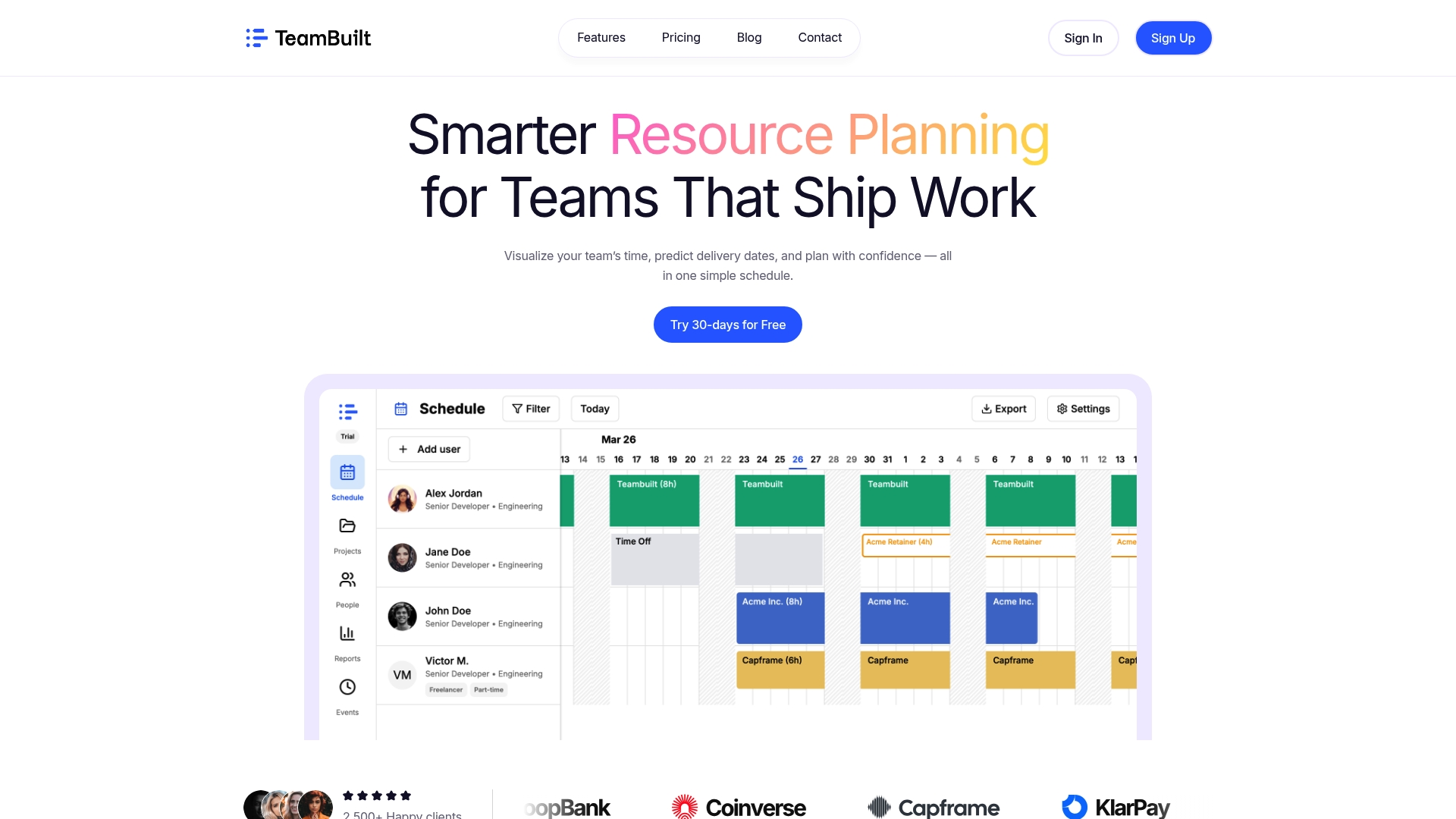
Teambuilt is built for exactly this kind of dynamic planning environment. Its real-time workload visualization lets you assign resources to the detailed horizon with confidence while keeping future capacity visible at a glance. When your wave review cycle arrives, Teambuilt’s delivery forecasting tools update automatically based on current resource availability, so your summary horizon stays grounded in real data rather than early assumptions. Teams managing multiple projects across departments use Teambuilt to coordinate wave reviews, track utilization, and keep cross-team dependencies visible without rebuilding their plan from scratch each cycle. You can explore Teambuilt at teambuilt.app.
FAQ
What is rolling wave planning in project management?
Rolling wave planning is a technique where near-term project work is planned in full detail and future work is kept at a summary level until more information is available. The Project Management Institute recognizes it as a standard practice for managing uncertainty in complex projects.
How does rolling wave planning reduce scope changes?
By delaying detailed planning of future work until requirements are better understood, teams avoid committing to tasks that will need to be changed later. Projects using rolling wave techniques experience 23% fewer scope-related change requests compared to fully upfront-planned projects.
What is the difference between rolling wave planning and progressive elaboration?
Progressive elaboration is the broader principle of refining a plan as more information becomes available. Rolling wave planning is the structured application of that principle, using fixed planning horizons and regular review cycles to control when and how elaboration happens.
How long should a rolling wave planning horizon be?
The detailed horizon is typically 2–6 weeks, depending on project complexity and pace. The summary horizon covers everything beyond that window and is elaborated at each fixed review cycle.
When is rolling wave planning not the right choice?
Rolling wave planning is less effective when project scope, technology, and execution path are fully known from the start. Fixed-scope projects with stable requirements and no external dependencies are better served by traditional full upfront planning.
Recommended