
Build a project management checklist for startup wins



TL;DR:
- Structured checklists based on proven domains significantly reduce startup project failures.
- Regular reviews and updates of checklists improve risk management and project predictability.
- Addressing critical edge cases pre-launch minimizes costly post-release fixes and support issues.
Running a growing startup without a solid project management checklist is like navigating a city with no map, no GPS, and a team that all think they’re the driver. Missed deadlines pile up. Scope expands without warning. And by the time someone raises a flag, the fire has already spread. Only 31% of projects are delivered fully on time, within budget, and on scope, with 19% failing outright. The good news: structured checklists consistently close the gap between chaotic execution and predictable delivery. This article walks you through every critical checklist domain, from planning and kickoff to edge case protection, with actionable frameworks your team can use starting today.
Table of Contents
- Identify core project management domains
- Checklist items for planning and kickoff
- Execution: Collaboration, tracking, and risk checks
- Edge cases and post-launch controls
- The uncomfortable truth: Checklists are a starting point, not the finish line
- Ready to streamline your project management?
- Frequently asked questions
Key Takeaways
| Point | Details |
|---|---|
| Checklist domains | Cover governance, scope, schedule, risk, quality, resources, and stakeholders for robust project management. |
| Early risk signals | Watch for changes in velocity, team sentiment, and dependencies to catch problems early. |
| Edge case coverage | Include exception handling and post-launch checks to prevent expensive failures. |
| Customization matters | Adapt checklists for startup speed with concise updates and flexible processes. |
| Actionable tools | Leverage automation platforms to make checklists easy for your team to follow. |
Identify core project management domains
With the need for structure established, let’s break down what domains every project checklist should cover.
Most project managers in startups and SMBs make the same mistake early on: they build checklists around their immediate problems rather than proven frameworks. The result is a patchwork list that misses entire categories of risk. Getting the domains right from the beginning is the single most valuable thing you can do before a single task is assigned.
The PMBOK 8th Edition organizes project management into 7 Performance Domains, each with its own Inputs, Tools and Techniques, and Outputs. These aren’t abstract academic concepts. They are practical checklists baked into a globally recognized standard. For any project manager working across multiple teams, this structure gives you a repeatable foundation that scales as your organization grows.
Here are the seven domains every checklist should be built around:
- Governance: Decision rights, escalation paths, approval workflows, and compliance requirements
- Scope: Feature definitions, acceptance criteria, change control, and out-of-scope documentation
- Schedule: Milestones, dependencies, sprint planning, and buffer allocation
- Risk: Risk register, probability and impact scoring, mitigation owners, and monitoring cadence
- Quality: Definition of done, testing standards, review cycles, and defect tracking
- Resources: Team availability, skill mapping, capacity limits, and cross-team dependencies
- Stakeholder management: Communication plans, feedback loops, escalation contacts, and alignment checkpoints
For startups that blend agile delivery with structured planning, these categories map well onto sprint-based workflows. Agencies running client projects, for example, often find that agency workflow checklists need to expand the stakeholder domain significantly because client sign-off becomes a critical path item.
Here’s how these domains compare in terms of risk exposure and checklist complexity for different team sizes:
| Domain | Risk level for startups | Checklist complexity | Most common failure point |
|---|---|---|---|
| Governance | High | Medium | No clear decision owner |
| Scope | Very high | High | Undocumented scope creep |
| Schedule | High | High | Ignored dependencies |
| Risk | Medium | Medium | Register not maintained |
| Quality | Medium | Medium | “Done” defined too loosely |
| Resources | Very high | High | Overallocation not visible |
| Stakeholder management | High | Medium | Feedback loop too slow |
“A checklist is only as powerful as the discipline behind it. The best teams treat their checklists as living documents, not static sign-off sheets.”
Starting your checklist architecture from these seven domains means you won’t wake up two weeks before launch realizing you never documented who approves scope changes. That’s a preventable failure. And in a fast-moving startup, preventable failures are the most expensive kind.
Checklist items for planning and kickoff
Now that the main domains are clear, let’s focus on what specific items go on your planning checklist as projects launch.
The planning and kickoff phase is where most projects either set themselves up for success or quietly plant the seeds of a future disaster. A rushed kickoff skips the conversations that would have caught the scope problem in week six. A poorly structured planning checklist leads to a team that’s busy but not aligned.
Here is a stepwise planning checklist built for startup speed:
- Define and document scope including what is explicitly out of scope. Get sign-off from at least one stakeholder before moving forward.
- Set a project timeline with major milestones, delivery dates, and review checkpoints. Build a timeline management checklist that accounts for team capacity, not just calendar days.
- Assign roles and responsibilities using a RACI matrix (Responsible, Accountable, Consulted, Informed) so every task has a clear owner and no one assumes someone else is handling it.
- Identify and map all dependencies, both internal (between teams) and external (vendors, APIs, client approvals). Dependencies that aren’t documented become blockers no one saw coming.
- Establish your communication cadence, whether that’s daily async standups via written updates, weekly syncs, or bi-weekly retrospectives. Define how decisions get made and where they get recorded.
- Set up your risk register with at least three potential risks identified before the first sprint begins. Assign a risk owner to each one.
- Confirm tooling and integrations so every team member knows where to log time, update status, and flag issues before day one.
- Conduct a kickoff meeting or async kickoff document that summarizes all of the above and gives every stakeholder a shared reference point.
Pro Tip: Startups don’t need to run two-hour kickoff ceremonies. A one-page kickoff doc shared async, with a 30-minute Q&A session, often gets better engagement than a long meeting. Pair it with your team scheduling steps to make sure the right people are available at the right time.
Here’s where business acumen pays a measurable dividend. Teams with strong business acumen, meaning they understand why a project matters financially and strategically, meet goals at 83%, deliver on schedule 63% of the time, and stay within budget 73% of the time, with a failure rate of just 8%. Compare that to teams that treat projects as purely technical exercises. The checklist items above aren’t just administrative steps. They are the moments where business context gets embedded into execution.
A well-built planning checklist removes ambiguity. When you know exactly who owns what, what’s in scope, and what success looks like before the first sprint starts, your team spends less time asking questions and more time shipping.

Execution: Collaboration, tracking, and risk checks
When planning gives way to execution, it’s time to leverage checklists for teamwork and early risk detection.
Execution is where checklists earn their reputation. During active delivery, teams generate a constant stream of status updates, blockers, risk signals, and decision points. Without a structured checklist to anchor your tracking, information falls through the cracks. The project manager ends up firefighting instead of steering.
Your execution checklist should cover the following on a weekly basis:
- Team update verification: Confirm every team member has updated their task status. Silence is not a green light.
- Velocity tracking: Compare actual progress against the plan. A 10% velocity drop over two consecutive weeks is a warning signal, not noise.
- Dependency review: Check whether any upcoming dependencies are at risk of compression. A dependency that was two weeks away last week and is now three days away is a red flag.
- Blocker escalation: Verify all logged blockers have an owner and a target resolution date.
- Stakeholder communication check: Confirm the most recent stakeholder update was sent on schedule and any open questions have been acknowledged.
- Resource utilization review: Flag anyone at over 90% capacity. Overloaded team members are a leading indicator of quality problems and burnout.
Tracking these items weekly gives you the real-time visibility that most project managers wish they had after the fact. For deeper guidance on keeping teams accountable during delivery, collaboration tips from real-world team environments can make a significant difference.
One of the most powerful additions to any execution checklist is a structured risk watchpoint system. Predictive risk management identifies three specific signals that provide one to three weeks of early warning before a project goes off the rails: velocity drops, sentiment shifts in team communication, and dependency compression.
Here’s how to act on each signal:
| Risk signal | Detection method | Early warning window | Recommended response |
|---|---|---|---|
| Velocity drop | Sprint burndown tracking | 1-2 weeks | Scope review, blocker audit |
| Sentiment shift | Tone in standups or async updates | 1-3 weeks | 1:1 check-in, workload review |
| Dependency compression | Timeline delta tracking | 1-2 weeks | Escalate to dependency owner, resequence if needed |
Pro Tip: Don’t wait for a formal risk review to act on these signals. Set a rule: if any two of these three signals appear in the same week, escalate immediately. Waiting another sprint cycle costs far more than an early conversation.
Pair your risk watchpoints with delivery best practices that your team can reference when signals appear. Having the response already defined in your checklist means the team acts faster and with less confusion.
Edge cases and post-launch controls
As execution wraps up, don’t skip the checklists that protect your project from edge-case failures.
Edge cases are the items that seem minor during planning but become catastrophic after launch. They are the scenarios your team didn’t test because no one thought to ask “what happens if the user does this?” A missing loading state, a broken error message, or an untested permission change can turn a successful launch into a support crisis within hours.
The most costly edge cases that project managers consistently miss include:
- Empty and loading states: What does the product show when there’s no data yet, or when data is loading slowly?
- Error states: What happens when an API call fails? Is the error message useful or just a generic alert?
- Network interruptions: Does the application handle offline or degraded network conditions gracefully?
- Permission changes mid-session: If a user’s role changes while they’re logged in, does the product behave correctly?
- Concurrent modifications: What happens when two users edit the same record at the same time?
- Boundary values: Does the system break at exactly 0 items, 1 item, or the maximum allowed count?
- Undo and interrupted flows: Can users recover from an accidental action? What happens if they close the browser mid-checkout?
- External dependency failures: If a third-party service goes down, does your product fail gracefully or completely break?
Fixing any of these after launch can cost 50-100 times more than addressing them during development. That’s not a rounding error. On a $100,000 project, a single missed edge case discovered post-launch can add $50,000 or more in remediation costs, not counting reputational damage.
“The edge cases you don’t test in staging become the support tickets that define your launch week.”
Your post-launch control checklist should include: confirming all error states display correctly in production, running a full permission audit for each user role, verifying all external integrations are live and monitored, and checking that rollback procedures are documented and tested. You should also confirm your monitoring and alerting tools are active and that the on-call owner is identified.
Workflow automation examples can help you systemize post-launch checks so they run automatically rather than relying on someone to remember. Automation turns your checklist from a manual task into a reliable safety net.
The uncomfortable truth: Checklists are a starting point, not the finish line
Here’s a perspective that most project management content won’t give you: the teams that treat checklists as sacred documents fail just as often as the teams that have no checklists at all.
A checklist built in January for a team of eight becomes dangerously misleading by April when the team has grown to fifteen and the product has pivoted twice. The domains are still valid. The specific items inside them may be completely wrong. Checklists that aren’t reviewed and revised after each major launch are artifacts, not tools.
The edge cases and risk signals covered in this article resolve the majority of costly project failures, but only if the team actually engages with them. A risk register no one reads is theater. A dependency map no one updates is a liability. The real discipline is in making checklist reviews a recurring, non-negotiable habit tied to your retrospectives.
The teams we’ve seen get the most value from structured checklists are the ones that treat every post-launch retrospective as a checklist audit. They ask: “What did we catch? What did we miss? What do we add?” Over three or four launch cycles, their checklists become genuinely predictive, reflecting the real failure patterns of their specific team, product, and customer base. Secure team planning processes give those teams the infrastructure to keep those insights organized and accessible for the next project.
Start with the frameworks in this article. But commit to making them yours.
Ready to streamline your project management?
If managing multiple checklists across growing teams feels like it requires its own project, you’re not wrong.
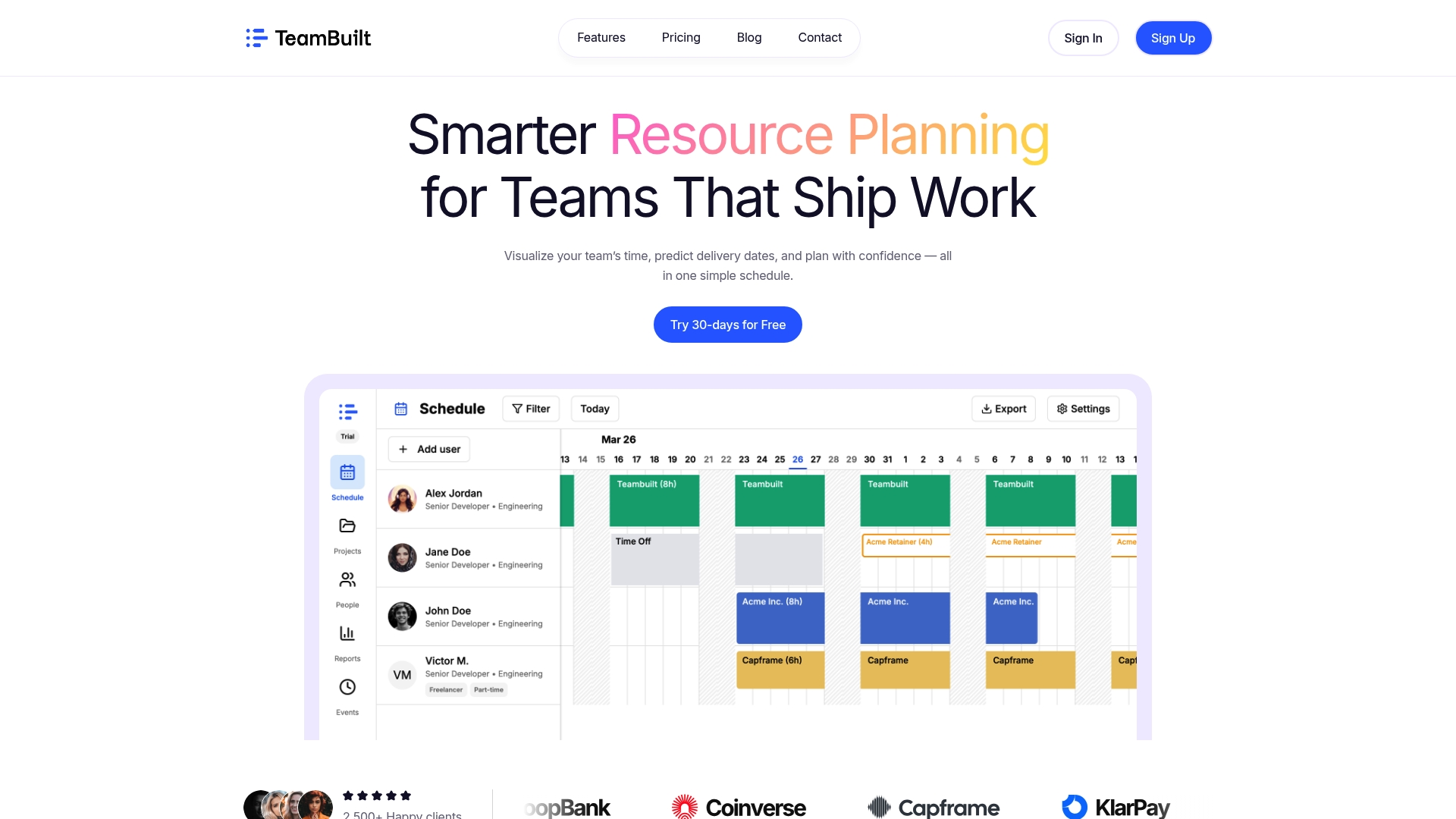
TeamBuilt is built for exactly this challenge. The platform gives project managers and operations leads real-time visibility into team capacity, workload distribution, and project timelines, all in one place. Instead of chasing updates across spreadsheets and Slack threads, you get a centralized planning environment where your checklist-driven processes actually connect to your team’s schedules and availability. Explore the project planning features to see how resource tracking and timeline forecasting work in practice, or visit TeamBuilt to learn how growing startups and SMBs use the platform to replace scattered workflows with structured, repeatable delivery.
Frequently asked questions
What domains should a project management checklist include for SMBs?
A robust checklist covers governance, scope, schedule, risk, quality, resources, and stakeholder management, aligned with the PMBOK 8th Edition 7 Performance Domains model for structured delivery.
How can early risk signals be tracked using checklists?
Monitor three key signals weekly: drops in team velocity, tone shifts in communication, and dependency compression, which give you one to three weeks of early warning before a project goes off track.
What is the impact of missing edge cases on project outcomes?
Missing edge cases after launch can increase fix costs by 50-100 times compared to finding them during development, making pre-launch edge case checklists one of the highest-value investments in your process.
How do you customize project checklists for startup teams?
Startups should tailor checklists around async standups, short one to two week sprints, and continuous deployment cycles instead of long planning ceremonies to maintain speed without sacrificing structure.
Recommended