
How to plan resources for SMB success: steps, tools, tips


TL;DR:
- Effective resource planning connects team efforts directly to business outcomes and KPIs.
- Ruthless prioritization of revenue and validation work maximizes impact within limited resources.
- Using purpose-built tools with automation improves scalability and visibility over spreadsheets.
You’re two weeks into a critical product sprint when your lead engineer flags a conflict: she’s double-booked across three projects, a key contractor just rolled off, and the backlog is growing faster than the team can clear it. Sound familiar? Poor resource planning is one of the most expensive and preventable problems facing project managers at startups and SMBs. Teams that get it right ship faster, burn less cash, and keep people from quitting out of frustration. This article walks you through a practical, step-by-step framework to define goals, assess what you have, prioritize ruthlessly, and pick tools that actually scale.
Table of Contents
- Clarify your resource planning goals
- Gather requirements and assess current resources
- Map and prioritize work for maximum impact
- Select and implement the right resource planning tools
- Why most resource planning playbooks miss the mark (and what to do instead)
- Smarter resource planning tools built for SMBs
- Frequently asked questions
Key Takeaways
| Point | Details |
|---|---|
| Tie plans to outcomes | Link resource allocation directly to core business goals like revenue, speed, and team health. |
| Inventory before allocating | List all resources and real demands before distributing people or budget to projects. |
| Prioritize ruthlessly | Assign most resources to high-impact revenue or validation projects, not just urgent requests. |
| Choose scalable tools | Move beyond spreadsheets to platforms that show team capacity and support automation. |
Clarify your resource planning goals
Before you open a spreadsheet or book a planning meeting, you need a clear definition of what resource planning actually means for your team. At its core, resource planning is the deliberate allocation of people, money, and tools toward specific business outcomes. It is not just scheduling. It is not just a capacity chart. It is a decision framework that connects your team’s daily work to the company’s top priorities.
The most common mistake managers make is treating resource planning as a logistics exercise instead of a strategic one. When you link resource decisions directly to business KPIs like profitability, project velocity, and customer satisfaction, the trade-offs become obvious and easier to defend to leadership.
Start by answering three questions:
- What are the top three outcomes the business needs in the next 90 days?
- Which projects directly generate revenue or validate your core product bets?
- What does organizational health look like, and how much capacity do you need to protect for it?
These questions force you to connect resource allocation to real business impact, not just workload management. Good project timeline management depends on this clarity first.
Here is why the stakes are so high for small teams: 78% of SMBs have less than 3 months cash runway, which means a misallocated sprint or a delayed revenue feature can genuinely threaten the business. This is not about being dramatic. It is about recognizing that resource decisions at your scale carry disproportionate consequences.
When setting goals, separate your planning into two buckets: external commitments (client deliverables, product launches, revenue targets) and internal health (team training, technical debt, process improvements). Effective startup resource allocation methods always anchor these buckets to measurable outcomes, not vague intentions. Define success criteria upfront so you can evaluate whether your allocation worked when the quarter ends.
Gather requirements and assess current resources
Once you have defined what successful resource planning looks like, the next step is to take inventory of your assets and constraints. This sounds straightforward, but most teams skip it or do it too loosely, and they pay for it later.

Build a resource inventory table that captures your actual capacity, not the theoretical maximum:
| Resource | Role | Weekly hours available | Key skills | Current project load |
|---|---|---|---|---|
| Person A | Backend engineer | 32 hrs | API, databases | Project X (80%) |
| Person B | Designer | 20 hrs | UX, prototyping | Project Y (50%) |
| Person C | PM | 40 hrs | Scrum, stakeholder mgmt | Projects X and Y |
Once you have this table, look at where time is actually going. This is where most managers get a rude awakening. Research shows actual allocation often breaks down as: new features 30%, bugs 25%, support 15%, infrastructure 12%, and meetings 18%. That means only about a third of your team’s time goes to the work you think is the priority.
The hidden culprits are worth naming explicitly:
- Untracked support requests that developers field informally
- Recurring meetings with no clear output
- Infrastructure maintenance that gets scheduled last-minute
- Context switching between projects that destroys deep work capacity
Reviewing team workflow examples from similar teams can reveal blind spots you have been normalizing. Most teams are surprised to find that 20 to 30 percent of their capacity disappears into work that was never planned for.
A practical way to surface this is to ask every team member to log what they actually did for one week, not what was assigned, but what they did. The gap between planned and actual is your hidden resource drain. Plug it before you allocate anything new.
Pro Tip: Use a shared intake channel or ticket queue to capture every ad hoc request in real time. This single habit transforms invisible work into visible, plannable tasks.
SMBs and startups often benefit from lightweight ERP and PM tools that formalize this tracking without requiring a full IT overhaul.
Map and prioritize work for maximum impact
Knowing your resources, you are ready to match them to work and stack-rank projects for impact. This is the step where discipline separates high-performing teams from chaotic ones.

The most effective approach for resource-constrained teams is a two-list system. List one contains all revenue-generating and validation projects. These are the things that either bring in money or prove a critical business hypothesis. List two contains everything else: infrastructure, internal tooling, process improvements, and meetings. Your job is to allocate resources to list one first, always.
Effective planning turns scarcity into strength through ruthless prioritization, targeting 85% of all available capacity toward revenue and validation projects. That leaves 15% for the operational work that keeps the lights on.
Here is a simple prioritization sequence to apply:
- Revenue features with a confirmed customer or pipeline impact
- Product validation work that tests your core bets before you scale investment
- Critical bug fixes that block revenue or break customer experience
- Infrastructure and security work with a clear risk consequence
- Process improvements and meetings with measurable efficiency gains
Anything that does not fit into these five categories should be deferred or dropped.
| Work type | Priority tier | Target allocation |
|---|---|---|
| Revenue features | Tier 1 | 50% |
| Validation projects | Tier 1 | 35% |
| Bug fixes | Tier 2 | 8% |
| Infrastructure | Tier 3 | 5% |
| Meetings/admin | Tier 4 | 2% |
Good team scheduling steps make this prioritization visible to everyone, not just the project manager. Visibility reduces politics and helps engineers and designers self-sort when new requests land.
Pro Tip: Run a weekly 15-minute priority check with your team. Ask one question: “Does what we’re working on this week map to Tier 1?” If the answer is no for more than one person, something has drifted.
For teams managing work across departments, understanding multi-team management methods is essential to keep competing priorities from colliding without warning.
Select and implement the right resource planning tools
With work prioritized, the right tools transform your plan from a static document into a live, scalable operation. But picking tools is where a lot of teams get tripped up.
Spreadsheets feel safe because they are flexible and familiar. They work fine for teams of five. Once you add more people, more projects, or more cross-team dependencies, spreadsheets become a liability. They do not update in real time. They do not flag overallocation automatically. They break when two people edit at the same time. Tools built for scale avoid these pitfalls by offering native capacity views and automation that spreadsheets simply cannot replicate.
When evaluating tools, look for these must-have features:
- Native capacity view that shows available hours per person per week
- Workload visualization so you can spot overallocation before it causes burnout
- Automated alerts when someone is over-assigned
- Easy task capture so nothing falls through the cracks
- Integration with tools you already use (Slack, GitHub, Jira, etc.)
The core features of strong PM platforms consistently include these elements, and skipping any one of them creates a gap you will eventually fill with manual effort.
Start your rollout with the single most complex, hardest-to-resource project you have. If the tool handles that, it will handle everything else.
Avoid rolling out a new tool to the entire team all at once. A phased pilot lets you work out kinks without disrupting every active project. Assign one project manager as the tool owner during the pilot. Gather feedback after two weeks and adjust before expanding.
Exploring project management tool picks designed for SMBs will help you shortlist options that match your team’s workflow without overcomplicating the transition. You can also review the resource planning features that purpose-built platforms offer to compare against your must-have checklist.
Why most resource planning playbooks miss the mark (and what to do instead)
Most resource planning guides spend 80% of their time on tools and templates. That is not where SMBs fail. Teams fail because they never make the brutal prioritization calls that the business actually needs.
Here is what we see over and over: a team adopts a shiny new PM platform, loads it with every project and task, and ends up with a perfectly organized picture of chaos. The tool did not solve the problem. The problem was a lack of will to say no to low-priority work.
The uncomfortable truth is that effective resource planning at a startup often means cutting something that a senior stakeholder cares about. That is a people and process problem, not a software problem.
Over-complex systems bog teams down just as badly as spreadsheets do. Simplicity and relentless focus on business outcomes beat elaborate frameworks almost every time. The best resource plans we have seen are the ones that fit on a single shared view, updated weekly, and reviewed by the whole team.
Start your planning practice where fire-fighting happens most: the edge cases. The specialist who is always overbooked. The timeline that always slips. The support queue that quietly devours engineering hours. Understanding the real-world pitfalls of multi-team coordination is where real improvement begins, not in the setup wizard of a new tool.
Smarter resource planning tools built for SMBs
Ready to put these resource planning strategies into action? The frameworks above are powerful, but they work best when backed by a platform built for the way growing teams actually operate.
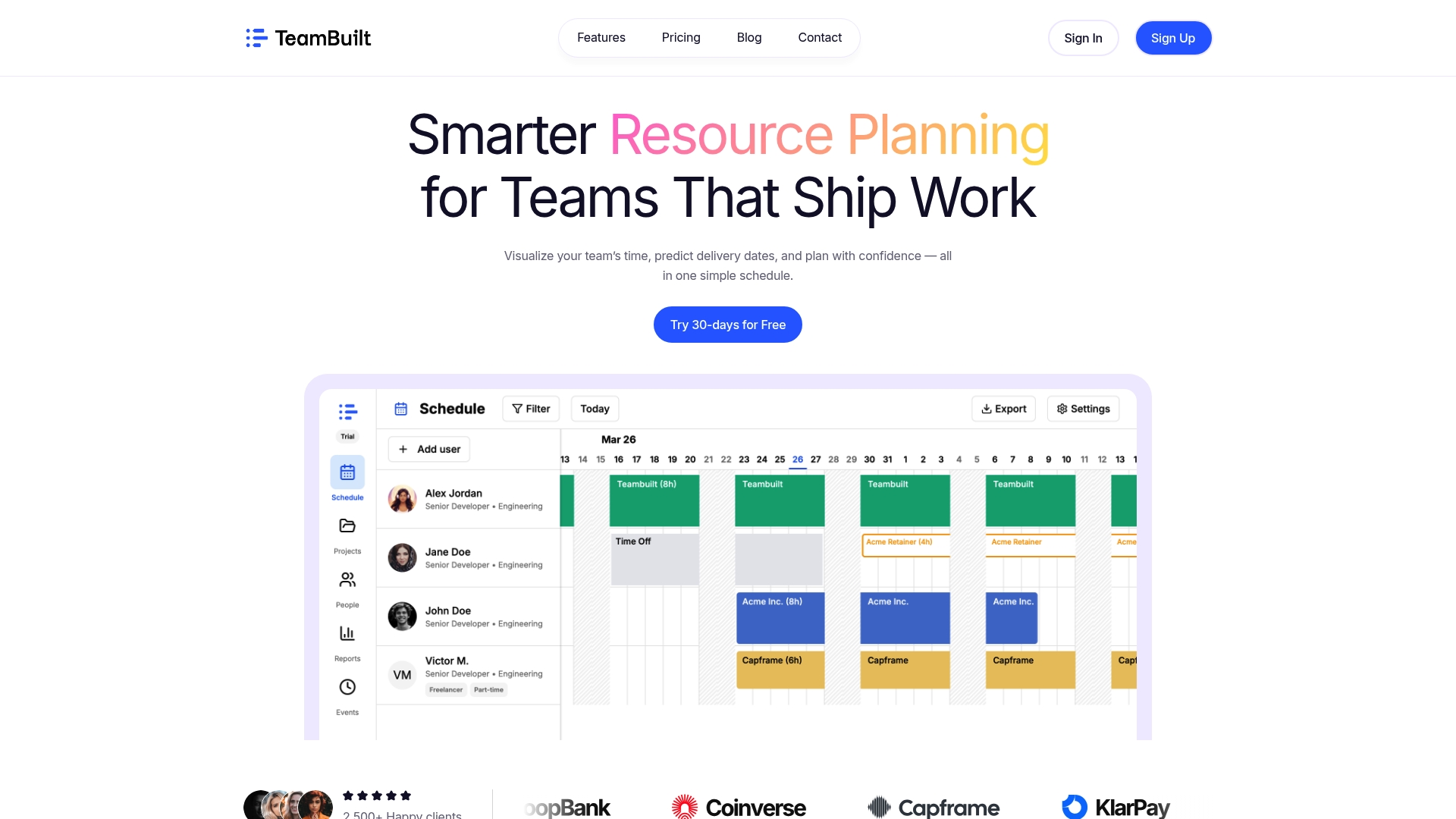
TeamBuilt gives project managers and operations leads real-time visibility into team capacity, workload distribution, and project timelines, all in one place. You can explore resource planning features designed specifically for SMBs, from automated overallocation alerts to cross-team scheduling views. Onboarding is fast, and the platform grows with your team without the sprawl of a traditional enterprise tool. If you are ready to replace scattered spreadsheets with a system that actually scales, learn more about Teambuilt and see how teams like yours use it to deliver more with less friction.
Frequently asked questions
What is resource planning in project management?
Resource planning is the process of allocating people, time, and tools strategically so your team can deliver projects on time and within budget. It connects daily work decisions to the business outcomes that matter most.
How do I decide which projects get the most resources?
Prioritize revenue or validation projects and target at least 85% allocation to these critical areas, using a visual ranking system to keep priorities transparent across your team.
Why shouldn’t I use spreadsheets for resource planning?
Spreadsheets do not scale for complex teams. Purpose-built tools with native capacity views and automations reduce manual errors and restore visibility as team size and project complexity grow.
What’s the most common mistake in startup resource planning?
The biggest mistake is underestimating hidden work. Bugs, support, and meetings alone can consume over 58% of your team’s time, leaving far less capacity for the strategic work that drives growth than most managers expect.
Recommended