
Optimize Team Capacity: A Practical Guide for Growing Teams



TL;DR:
- Actual team capacity is lower than nominal hours due to meetings, disruptions, and skill gaps.
- Regularly tracking and adjusting capacity ensures realistic workload planning and prevents burnout.
- Maintaining 70-80% utilization with buffer time optimizes responsiveness and long-term productivity.
Everyone on your team looks busy. Calendars are packed, Slack is pinging constantly, and people are working late. Yet somehow, deadlines keep slipping. This paradox is more common than most project managers want to admit, and it almost always comes down to one thing: a flawed understanding of true team capacity. Busy does not equal productive, and fully scheduled does not equal fully available. This guide walks you through a concrete, step-by-step process to accurately calculate your team’s real capacity, allocate work without burning people out, and adjust your approach as conditions change.
Table of Contents
- Understanding team capacity: Core concepts and pitfalls
- Step 1: Map your team’s real workload and availability
- Step 2: Calculate, allocate, and adjust for real capacity
- Step 3: Monitor, troubleshoot, and optimize over time
- Why chasing full utilization breaks teams—and how to do better
- Streamline your team capacity planning with Teambuilt
- Frequently asked questions
Key Takeaways
| Point | Details |
|---|---|
| True capacity isn’t 100% | Practical capacity is always less than theoretical; real-world factors quickly reduce the number. |
| Smaller teams work better | Teams with fewer than nine people deliver more value per person than larger groups. |
| Buffers prevent burnout | Building in a 10-20% buffer for interruptions and ad hoc work is essential for sustainability. |
| Regular review is vital | Team capacity should be checked and adjusted monthly to reflect shifting demands and team changes. |
Understanding team capacity: Core concepts and pitfalls
Team capacity, in a business context, is the total amount of productive work your team can realistically complete in a given time period. Notice the word realistically. Most managers calculate capacity by counting heads and multiplying by working hours. That number is your nominal capacity, and it almost never reflects reality.
The most persistent myth in resource planning is that 100% utilization equals optimal output. It does not. When every hour is committed, there is no room for the unexpected: a client escalation, a sick day, a shifted priority. Teams operating at full theoretical capacity are one surprise away from failure. The capacity tracking benefits become clear the moment you realize that slack in the system is not waste. It is resilience.
Several real-world factors quietly erode your nominal capacity:
- Time zone differences can reduce effective collaboration by 10-25% depending on overlap: a 1-4 hour gap costs around 10%, while a 9+ hour gap can cost 25%
- Context switching between tasks costs approximately 7% of productive time per switch
- Skill mismatches force team members to work outside their strengths, slowing everything down
- New hires operate at significantly reduced capacity during ramp-up, sometimes for months
- Ad hoc work (unplanned requests, urgent fixes, internal admin) consumes a larger slice of the week than anyone wants to admit
Here is a simple comparison to illustrate the gap:
| Capacity type | Calculation | Example (1 person, 40-hr week) |
|---|---|---|
| Nominal capacity | Contracted hours | 40 hours |
| Effective capacity | Nominal minus all reductions | 26-30 hours |
The difference between those two numbers is where projects go wrong. Team capacity planning strategies built around nominal figures will consistently overcommit your team.
Size also matters more than most managers expect. Teams larger than 9 people tend to produce less output per person, largely due to coordination costs, communication overhead, and decision friction. Bigger is not always better.
Pro Tip: Always factor in a buffer of at least 10-20% of total available hours for ad hoc work and unexpected interruptions. This single habit prevents most overcommitment problems before they start.
Step 1: Map your team’s real workload and availability
With the big-picture risks in mind, it’s time to move into actionable steps, starting with documenting the reality of how your team spends time.
You cannot manage what you have not measured. Before you calculate anything, you need a clear picture of each person’s actual working situation. This means going beyond job titles and contracted hours.
Here is an example of a basic team availability matrix:
| Team member | Role | Time zone | Contracted hours | Recurring meetings | Est. available hours |
|---|---|---|---|---|---|
| Alex | Dev | EST | 40 hrs | 6 hrs | 34 hrs |
| Maria | Design | CET | 40 hrs | 4 hrs | 36 hrs |
| Sam | PM | PST | 40 hrs | 10 hrs | 30 hrs |
| Jordan | QA | AEST | 40 hrs | 5 hrs | 35 hrs |
Even this simple table reveals something useful: Sam has 10 hours of recurring meetings. That is 25% of the week gone before any project work begins. Factors like time zone gaps of 5-8 hours between team members reduce effective overlap by around 20%, which hits collaborative tasks the hardest.
Here is a numbered process to build your team’s capacity profile:
- List every team member and their contracted working hours per week
- Identify recurring meetings for each person, including standups, reviews, and one-on-ones
- Note time zone offsets and calculate the actual overlap window for collaboration
- Document planned absences for the planning period, including vacations and public holidays
- Estimate ad hoc interruptions based on historical patterns or manager input
- Subtract all of the above from contracted hours to get a working availability figure
Looking at workflow examples for teams can help you identify what categories of work you might be forgetting to account for. Once this profile is documented, you have a real foundation to plan from. Without it, every estimate is a guess dressed up as a plan.
Pro Tip: Revisit your team availability matrix at least once a month. People’s meeting loads change, projects shift, and new commitments appear. A snapshot from six weeks ago is already outdated. You can also explore resource allocation tips for more structured approaches to keeping this data current.
Step 2: Calculate, allocate, and adjust for real capacity
Once you’ve mapped out availability and demand, you’ll need to turn those numbers into a practical, actionable capacity figure.

Here is the core formula to work with:
Adjusted Capacity = Available hours (recurring meetings + expected interruptions + context switching cost + ad hoc buffer)
That ad hoc buffer alone should account for 10-20% of available hours. When you run the numbers honestly, the results can be surprising. For roles that involve heavy communication, coordination, or support work, effective capacity often lands at only 40-50% of theoretical hours. A project manager contracted for 40 hours may have only 18-22 hours of actual project-focused time.
Here is a step-by-step process to calculate each team member’s true capacity:
- Start with contracted hours for the period
- Subtract recurring meeting time (use your matrix from Step 1)
- Subtract an estimate for unplanned interruptions (start with 10% if you have no data)
- Subtract a context switching cost of approximately 7% of remaining hours
- Apply an ad hoc work buffer of 10-20%
- The result is your adjusted capacity for that person
Once you have adjusted capacity figures for the whole team, allocate work based on those numbers, not on raw availability. Someone showing 40 hours of open calendar time is not the same as someone with 40 hours of productive capacity.
Distributing work correctly also means matching tasks to skill sets. Assigning a task to whoever has open hours, regardless of fit, is one of the most common and costly planning mistakes. Use your skill matrix from Step 1 to guide assignment decisions. Scheduling for efficiency means aligning the right person with the right task at the right time, not just filling slots.
Pro Tip: Whenever you hire a new team member or launch a new project type, recalculate capacity from scratch. Both events change the inputs significantly, and planning off stale figures creates immediate problems.
Step 3: Monitor, troubleshoot, and optimize over time
After your initial calculation, maintaining and evolving your approach is essential for real-world success.

Capacity planning is not a one-time exercise. Teams change. Clients add scope. People leave or join. A plan built in January will not reflect reality in March without consistent monitoring.
Track these signals every month:
- Utilization rates: Is anyone consistently above 85%? That is a warning sign, not a badge of honor
- Overtime frequency: Regular overtime points to a structural capacity gap, not a workload spike
- Missed deadlines: Which projects? Which roles? Look for patterns
- Team feedback: Are people flagging that they are overwhelmed? Listen before it becomes a retention problem
- Unplanned work volume: How much of each week is being consumed by requests that were not in the plan?
Bottlenecks often hide in plain sight. A single overloaded role (a QA engineer, a senior developer, a project lead) can block the entire team’s output while everyone else technically has capacity. This is a common source of missed deadlines that has nothing to do with the broader team being overloaded.
Empirical research shows that teams exceeding 9 members tend to produce less per person, with coordination overhead and communication costs eating into effective output.
When you spot a problem, resist the urge to make sweeping changes immediately. Incremental adjustments work better and allow you to measure the effect of each change. Share your findings with the team too. When people understand why workloads are being adjusted, they respond better and contribute more useful feedback.
Real-time team coordination tools make this monitoring loop much easier to sustain. Pair them with project delivery best practices to keep your reviews structured and focused.
Pro Tip: Make capacity reviews a standing monthly agenda item, not something that only happens when things break. Prevention is faster and cheaper than recovery.
Why chasing full utilization breaks teams—and how to do better
Here is an uncomfortable truth most planning guides skip: the obsession with maximizing utilization is one of the most reliable ways to destroy team performance.
When utilization becomes a KPI, managers start filling every available hour. It looks efficient on a spreadsheet. In practice, it eliminates any capacity for thinking, learning, recovering, or handling anything unexpected. Teams become reactive instead of proactive, and quality quietly erodes while everyone stays technically busy.
Empirical findings on team productivity consistently show that sustainable pacing, not maximum loading, produces better long-term output. The managers who get this right shift their focus from hours filled to value delivered. They protect buffer time deliberately. They treat slack capacity as an investment, not waste.
The practical alternative is to manage toward a target utilization of 70-80%. That range keeps teams responsive, maintains quality, and creates enough breathing room for the team to do their best work. Capacity tracking for sustainable teams gives you the visibility to maintain that target without flying blind.
Stop measuring busy. Start measuring impact.
Streamline your team capacity planning with Teambuilt
If you have worked through these steps manually, you already know how much time accurate capacity planning takes. Spreadsheets drift, data gets stale, and keeping everyone aligned requires constant effort.
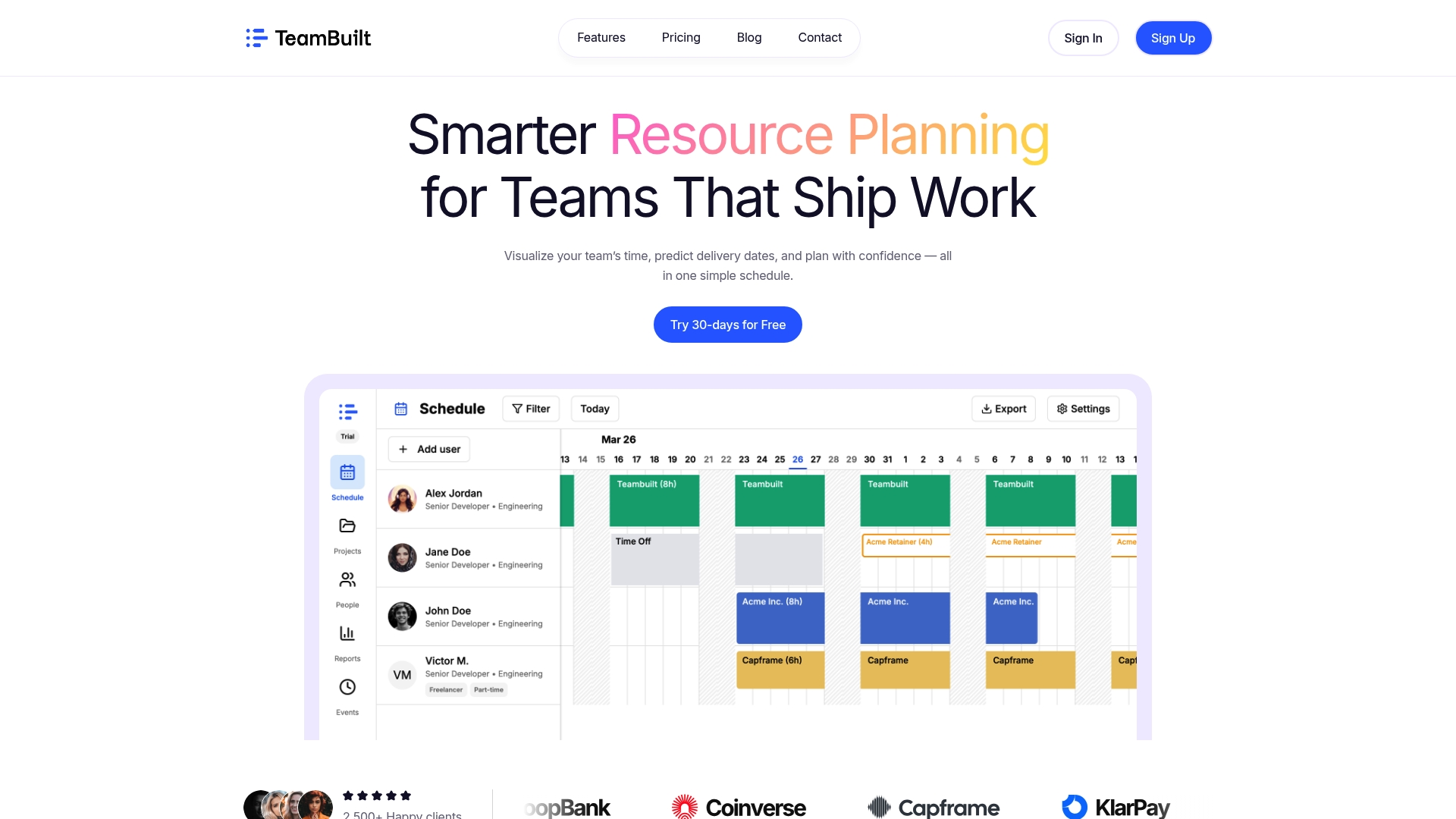
TeamBuilt’s features are built specifically for this problem. You get real-time visibility into team availability, workload distribution, and utilization across every project and role. Scheduling conflicts surface before they become delivery failures. Capacity data updates automatically as assignments change. If you are ready to move from reactive firefighting to proactive planning, get started with TeamBuilt and see how much simpler capacity management can be when the right infrastructure is in place.
Frequently asked questions
What is team capacity in project management?
Team capacity is the total amount of productive work your team can handle in a given period, factoring in skill sets, availability, recurring meetings, and routine interruptions. It is always lower than the sum of contracted hours.
How do remote teams affect overall capacity?
Remote and distributed teams can see a 10-25% capacity reduction due to time zone differences, missed collaboration windows, and increased context switching between async and sync communication.
What is the ideal team size for maximum productivity?
Empirical studies show teams larger than nine tend to be less productive per person, so keeping teams smaller improves both output and communication quality.
How much buffer time should I include in my team’s capacity?
Building in a 10-20% buffer for ad hoc work and interruptions is the most practical safeguard for keeping projects on schedule when the unexpected happens.
Recommended
- Team capacity planning: 40% more story points delivered | Teambuilt Blog
- Dynamic Team Environments: Optimize Collaboration & Resources | Teambuilt Blog
- Dynamic Team Environments: Optimize Collaboration & Resources | Teambuilt Blog
- Team performance metrics explained: unlock growth with data | Teambuilt Blog