
Project Delivery Forecasting Guide: Proven Strategies



TL;DR:
- Most mega-projects overrun budgets and schedules, damaging trust and profitability.
- Using structured methodologies like Earned Value Management and Reference-Class Forecasting improves accuracy and reduces risks.
- Embedding forecasting habits into team culture and tools leads to more reliable project delivery.
Most project teams believe their forecasting is solid until a deadline slips or a budget explodes. The reality is far harsher: 91.5% of mega-projects overrun both budget and schedule, and the consequences hit your client relationships, revenue, and team morale all at once. Accurate project delivery forecasting is no longer a nice-to-have. It is the operational foundation that separates teams that scale from teams that scramble. This guide walks you through the methodologies, resource frameworks, and behavioral habits that drive real forecasting accuracy, so you can stop guessing and start delivering with confidence.
Table of Contents
- Why accurate project delivery forecasting matters
- Core methodologies: EVM, RCF, and beyond
- Resource forecasting: Multi-layered approaches for every horizon
- Managing uncertainty: Edge cases, risk, and hybrid strategies
- From forecasting to action: Integrating tools and behaviors
- A fresh perspective: Why most forecasting advice falls short
- Start forecasting with confidence using Teambuilt
- Frequently asked questions
Key Takeaways
| Point | Details |
|---|---|
| Forecasting is mission-critical | Accurate project delivery forecasting prevents costly overruns and builds trust with stakeholders. |
| Use proven methodologies | Earned Value Management and Reference-Class Forecasting boost accuracy, especially when supported by consistent benchmarking. |
| Integrate layered approaches | Short-, medium-, and long-term resource forecasting improves planning precision and adapts to changing needs. |
| Update and adapt frequently | Regularly revise forecasts and embrace hybrid strategies and AI tools for managing uncertainty. |
| Culture enables success | Embedding honest, disciplined forecasting habits outperforms any single tool or method for growing teams. |
Why accurate project delivery forecasting matters
Project complexity is rising. Client expectations are higher. And the margin for error keeps shrinking. When your delivery forecast is off, the damage does not stop at a missed date. It triggers budget overruns, erodes client trust, disrupts downstream teams, and forces costly rework. Understanding what is actually at stake is the first step toward fixing it.
“Over 91% of massive projects miss their delivery targets, costing firms billions in rework, penalties, and lost business.”
That number is not an outlier. It is a pattern driven by optimism bias, poor data, and forecasting methods that were never updated to match modern project complexity. The good news is that teams using structured approaches like reference-class forecasting (RCF) and regular benchmarking consistently outperform those relying on gut feel or outdated templates.
Here is what poor forecasting actually costs:
- Budget blowouts: Underestimating scope leads to unplanned spending that squeezes margins
- Reputation damage: Clients who experience missed deadlines are unlikely to return or refer
- Team burnout: Constant firefighting from inaccurate plans exhausts your best people
- Operational bottlenecks: Downstream teams cannot plan when upstream delivery is unpredictable
- Lost competitive advantage: Competitors with tighter forecasts win bids and scale faster
Reference-class forecasting, which anchors your estimates to what similar projects actually delivered rather than what your team hopes to achieve, is one of the most underused tools in project management. Pair that with scenario planning that accounts for edge cases and you build a forecasting model that is stress-tested before the project even starts. Reviewing project delivery best practices for SMB teams is a strong starting point for building that foundation.
Core methodologies: EVM, RCF, and beyond
Knowing that forecasting matters is not enough. You need a method. The three most battle-tested approaches are Earned Value Management, Reference-Class Forecasting, and a growing field of hybrid and AI-assisted models.
Earned Value Management (EVM) is the gold standard for tracking project performance against a baseline. It integrates scope, schedule, and cost into a single performance picture. EVM integrates scope, schedule, and cost for accurate performance measurement using metrics like Planned Value (PV), Earned Value (EV), Actual Cost (AC), Schedule Variance (SV), and Cost Variance (CV). Forecasting formulas like Estimate at Completion (EAC), Estimate to Complete (ETC), and To Complete Performance Index (TCPI) give you a forward view of where the project is heading. Critically, EVM forecasting can achieve ±10% accuracy once a project is 20% complete, provided your baseline data is clean.

Reference-Class Forecasting (RCF) corrects for human optimism by grounding your estimate in historical benchmarks. Instead of asking “how long do we think this will take,” you ask “how long did similar projects actually take?”
Emerging methods like Earned Schedule (ES), Earned Duration (ED), and machine learning models now offer even sharper forecasting, especially for complex or fast-moving projects.

| Method | Best for | Accuracy | Key benefit |
|---|---|---|---|
| EVM | Mid-to-large fixed scope | High after 20% progress | Schedule and cost integration |
| RCF | New or uncertain projects | Moderate to high | Removes optimism bias |
| Hybrid EVM + RCF | Most SMB/agency projects | High | Combines data and benchmarks |
| AI/ML models | Complex, data-rich projects | Very high | Pattern recognition at scale |
For project timeline management, combining EVM with at least one benchmarking method is the most practical move for growing teams.
Pro Tip: Start EVM tracking from day one, even if you only use three metrics: EV, AC, and CPI. You can build complexity later. Clean early data is what makes late-stage forecasts reliable.
Resource forecasting: Multi-layered approaches for every horizon
Delivery forecasting and resource forecasting are not the same thing, but they are inseparable. A timeline forecast that ignores resource availability is just a wish list. You need both.
Resource forecasting mixes historical data, parametric models, and expert judgment to produce estimates that actually hold up under real project conditions. Here is how to structure it across three time horizons:
- Short-term (1 to 4 weeks): Use live project data and daily task breakdowns to forecast with precision. At this level, you are tracking individual capacity, current utilization, and any immediate blockers that will shift delivery.
- Medium-term (1 to 3 months): Shift to category-based allocation. Group resources by role or team and plan against upcoming sprints or deliverable milestones. You are optimizing the mix, not micro-managing tasks.
- Long-term (3+ months): Focus on strategic projections for annual planning, hiring pipelines, and capacity gaps. Precision drops here, but directional accuracy is what matters for leadership decisions.
| Forecast type | Horizon | Accuracy level | Primary input |
|---|---|---|---|
| Task-level detail | 1 to 4 weeks | High | Live project data |
| Category-based | 1 to 3 months | Moderate | Sprint and milestone plans |
| Strategic capacity | 3+ months | Directional | Historical trends and hiring plans |
Integrating these layers into your delivery forecast requires good tooling and consistent data entry. Platforms that support visualization for project planning make it dramatically easier to spot utilization gaps before they become delivery risks. For teams building their first structured approach, a step-by-step team scheduling process is the fastest way to close the gap between planned and actual resource use.
Pro Tip: Run a weekly resource check that compares planned hours to actual hours logged. A gap of more than 15% over two consecutive weeks is an early warning sign that your delivery forecast needs to be revised.
Managing uncertainty: Edge cases, risk, and hybrid strategies
Every forecast is a bet. The question is how well you have calculated the odds. Uncertainty is not a problem to eliminate. It is a variable to model.
Hybrid methodologies are now used by over 31% of projects, and AI-driven models are outperforming traditional methods in complex, fast-moving environments. This shift reflects a real insight: no single method handles all risk profiles equally well.
Statistic callout: Over 31% of project teams now use hybrid methodologies, and AI/ML models are outperforming traditional forecasting in adaptive environments.
Here is how different approaches map to risk:
- Predictive (Waterfall-style): Works well when scope is locked and dependencies are clear. Breaks down fast when requirements change
- Adaptive (Agile/Scrum): Absorbs change well but makes long-range delivery forecasting harder without additional frameworks
- Hybrid: Combines fixed planning phases with adaptive execution, which fits most SMB and agency projects
- AI-assisted: Best for teams with rich historical data who want automated anomaly detection and pattern-based forecasting
Early-stage forecasting inaccuracy and fat-tailed IT risks are among the most common edge cases that blow up project timelines. Black Swan events (low probability, high impact surprises) are nearly impossible to predict but can be partially mitigated by keeping project scopes smaller, running regular risk reviews, and building buffer reserves into your resource plan.
For teams evaluating project management tool features, look specifically for built-in scenario planning, not just task tracking.
Pro Tip: Run at least three forecast scenarios at project kickoff: optimistic, realistic, and pessimistic. Share all three with stakeholders so expectations are set before the first milestone.
From forecasting to action: Integrating tools and behaviors
Methods are useless without consistent execution. The most common failure mode is not the wrong methodology. It is sporadic use of the right one. Here is how to turn forecasting from a one-time exercise into a continuous team habit.
- Implement EVM from project day one using integrated tools that pull real-time data. Manual tracking kills adoption fast
- Run weekly forecast reviews that compare current EV and CPI against baseline. Update EVM and scenario forecasts weekly to stay ahead of surprises rather than reacting to them
- Train your team on the basics: PMs should understand EVM metrics even if software handles the calculations. Literacy matters for honest reporting
- Standardize your data inputs: Garbage in, garbage out. Define what counts as a completed task and enforce it
- Embed scenario planning into every project kickoff: Make the three-scenario model a standard template, not an optional exercise
“The biggest forecasting failures we see are not technical. They are cultural. Teams avoid updating forecasts when the news is bad because it feels like admitting failure. But a delayed update always costs more than an honest one.”
Building scalable project workflows requires encoding these behaviors into your process, not just your tools. Software makes forecasting faster. Culture makes it accurate.
A fresh perspective: Why most forecasting advice falls short
Here is the uncomfortable truth most forecasting guides skip: the method is rarely the problem. Teams that switch from spreadsheets to EVM software without changing how they report, review, and respond to data see almost no improvement in delivery accuracy. The tool did not fail. The culture did.
Growing companies tend to over-invest in software and under-invest in training. A PM who deeply understands two or three core metrics and updates them honestly will outperform a team running complex AI-assisted dashboards they barely trust or understand.
The discipline of regular course correction, even when the numbers are uncomfortable, is what separates teams that forecast well from those that forecast optimistically. Honest, real-world forecasting advice will always emphasize behavior change alongside tooling. Forecasting culture, where everyone from the PM to the sponsor expects and acts on updated projections, is the real competitive edge. Build the habit before you scale the tech.
Start forecasting with confidence using Teambuilt
Applying these frameworks is much easier when your tools and your workflows live in the same place. TeamBuilt is built specifically for project managers and operations leads who need real-time resource visibility, workload forecasting, and delivery tracking without juggling five separate platforms.
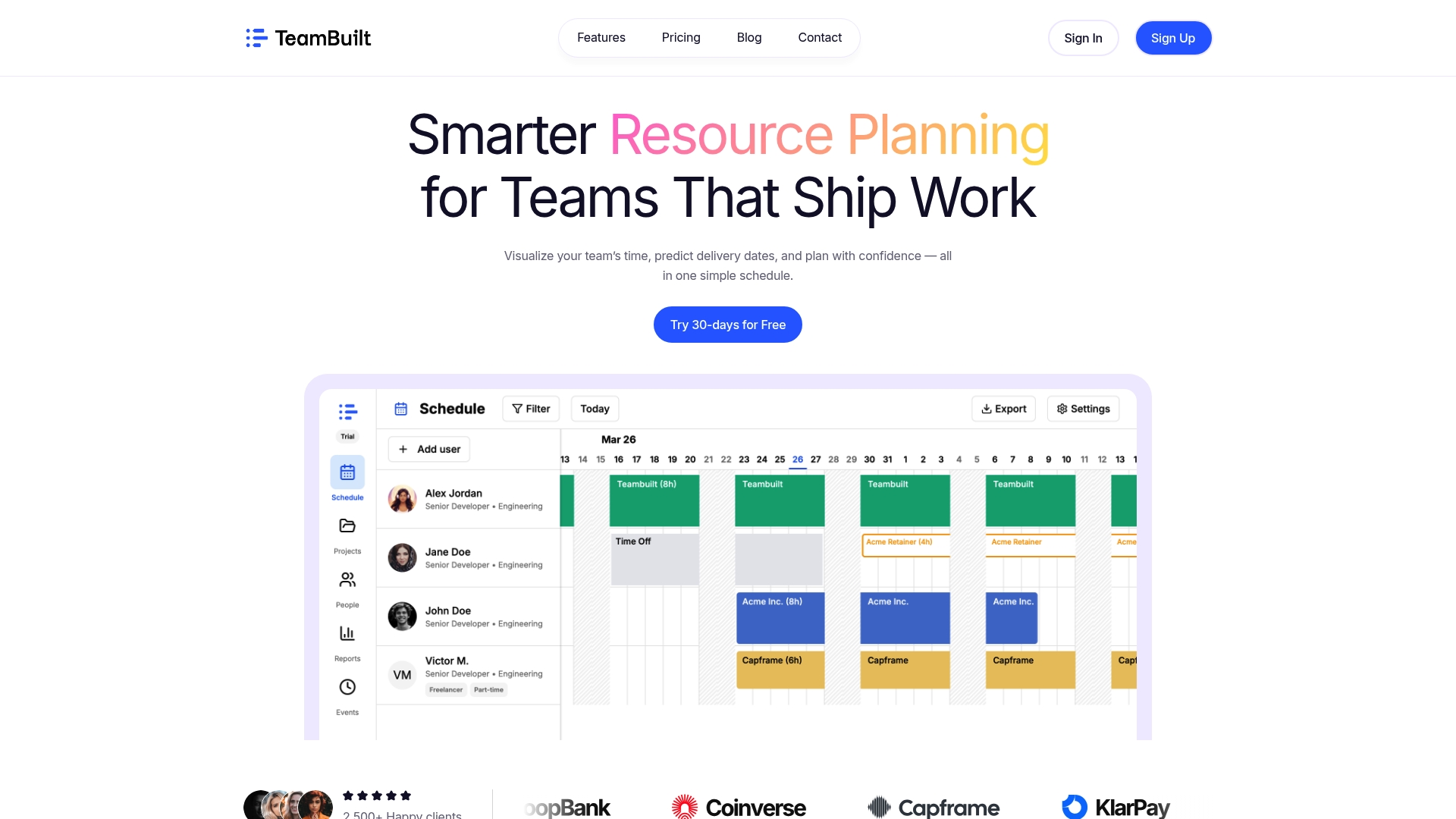
From capacity planning to resource scheduling features that surface utilization gaps before they become deadline risks, TeamBuilt connects your resource data to your delivery forecast in one view. Whether you are running a growing agency or a multi-team SMB, the project delivery tools inside TeamBuilt are designed to replace spreadsheets and scattered workflows with a single source of planning truth. Start a free trial and see how much clearer your next project forecast can be.
Frequently asked questions
What is project delivery forecasting in simple terms?
EVM integrates scope, schedule, and cost to forecast performance and outcomes. Project delivery forecasting estimates how long a project will take, what it will cost, and whether it will finish on time and within budget based on current progress and real data.
How accurate are project delivery forecasts using EVM?
Once a project reaches 20% completion, EVM forecasting formulas can predict outcomes within about ±10% accuracy, provided your underlying data is clean and consistently tracked.
What’s the best method for forecasting delivery in fast-changing projects?
Hybrid and AI/ML models outperform traditional forecasting in adaptive environments. Hybrid approaches that blend predictive planning with agile execution give you the structure of a baseline with the flexibility to absorb change.
How often should delivery forecasts be updated?
Update EVM and scenario forecasts weekly or whenever a significant project change occurs. Waiting until a milestone is missed means the damage is already done.
How do you manage unpredictable risks in project forecasting?
Mitigate Black Swans and fat-tailed risks by breaking large projects into smaller scopes, running regular scenario analysis, and building buffer capacity into your resource plan from the start.
Recommended