
Why integrated planning tools transform team performance


TL;DR:
- Only 8% of organizations have fully integrated end-to-end planning, leading to inefficiencies.
- Integrated planning tools unify scheduling, resources, and reporting, reducing silos and tool sprawl.
- Benefits include faster delivery, better resource allocation, lower costs, and improved decision-making.
Most teams believe they are well-coordinated until delivery slips, budgets bloat, or a critical resource gets double-booked across three projects at once. The uncomfortable reality is that only 8% of organizations have fully integrated end-to-end planning, while 70% still rely on siloed processes and 47% depend on spreadsheets. For project managers and operations leads at growing startups, SMBs, and agencies, this gap creates a real competitive disadvantage. This guide explains what integrated planning tools actually do, why they matter specifically for organizations in growth mode, and how to adopt them without falling into the most common traps.
Table of Contents
- Understanding integrated planning tools
- Why startups, SMBs, and agencies need integration
- Key benefits of integrated planning tools
- ROI, efficiency, and process nuances
- A fresh perspective: Integration without the tech-first trap
- Next steps: Explore integrated planning for your team
- Frequently asked questions
Key Takeaways
| Point | Details |
|---|---|
| Break down silos | Integrated tools unify processes, replacing spreadsheets and siloed workflows for seamless cross-team collaboration. |
| Boost efficiency and ROI | Teams report up to 187% ROI and dramatic reductions in SaaS costs by consolidating planning solutions. |
| Scale smart | Integrated tools support growth by reducing rigidity and tool sprawl, improving async collaboration as operations scale. |
| Focus on process first | Success depends more on process alignment and talent upskilling than choosing the right software. |
Understanding integrated planning tools
The phrase “integrated planning tools” gets used loosely, so let’s define it precisely. An integrated planning tool is a platform that unifies scheduling, resource management, workload visibility, and cross-team coordination into a single, connected system. Instead of pulling data from a Gantt chart in one app, headcount in a spreadsheet, and capacity estimates from a Slack thread, everyone works from one shared source of truth.
That distinction matters more than it sounds. Traditional project management solutions, like basic task boards or standalone Gantt tools, manage work but not resources. They tell you what needs to happen, not whether you actually have the people and capacity to do it. Integrated planning tools enable unified processes across projects and teams, breaking down the silos that cause resource conflicts, missed handoffs, and planning surprises.
The key capabilities that separate integrated tools from conventional software include:
- Real-time visibility into who is working on what, at what capacity, and when they are available
- Cross-team coordination that surfaces dependencies between teams before they become blockers
- Resource forecasting that predicts delivery dates based on actual availability, not optimistic estimates
- Workload balancing that prevents burnout by distributing tasks according to real capacity data
- Centralized reporting so stakeholders see one version of project status, not five conflicting updates
These capabilities compound. When your scheduling data connects directly to your capacity data, and your capacity data feeds your delivery forecasting, the whole system becomes predictive rather than reactive. You stop managing by firefighting and start managing by design.
The use of centralized planning tools is especially powerful when teams span multiple departments or work across several client accounts simultaneously, which is the normal operating condition for agencies and scaling SMBs.
Pro Tip: Before selecting or implementing any integrated planning tool, document your existing workflows and identify where handoffs break down. The technology can only connect processes that are already understood. Trying to automate broken or undefined processes will just make the chaos faster.
Why startups, SMBs, and agencies need integration
Growing organizations face a specific and painful problem: complexity grows faster than headcount. When a startup goes from 10 to 40 people, or an agency takes on five new client accounts, the volume of coordination required does not scale linearly. It explodes. Most teams respond by adding more tools, which creates what the industry calls tool sprawl.
Tool sprawl is the condition where teams use so many disconnected apps that the work of managing the tools becomes a job in itself. A marketing agency might use one tool for task management, another for time tracking, a separate spreadsheet for resource planning, a different platform for client reporting, and Slack to fill the gaps between all of them. Every new tool requires onboarding, maintenance, and context-switching.

For growing startups and SMBs, integrated tools reduce tool sprawl, improve asynchronous collaboration, and scale with operational complexity without adding rigidity. That last part is important. Many consolidation tools solve sprawl by locking teams into rigid workflows that do not adapt to how real project work actually evolves.
The benefits of moving from sprawl to integration are measurable:
| Challenge | Siloed approach | Integrated approach |
|---|---|---|
| Resource conflicts | Discovered late, resolved reactively | Surfaced early, resolved proactively |
| Cross-team coordination | Manual follow-ups and meetings | Automated dependency tracking |
| Reporting | Multiple versions of truth | Single, real-time dashboard |
| Tool costs | Paying for 10+ platforms | 3 to 5 consolidated tools |
| Onboarding new staff | High friction across many tools | Faster ramp-up in one platform |
For agencies specifically, consolidation has delivered concrete financial returns. A boutique agency that reduced its tool stack from 12 products to 3 not only simplified its operations but generated measurable cost savings. That shift also changes how quickly new team members get productive, because they learn one system instead of navigating a patchwork of disconnected apps.
A useful way to think about this for your own organization: map every tool your team uses in a typical project week and note which ones exchange data with each other. If most of them require manual copy-paste to share information, you are paying a coordination tax on every project you deliver.
Your real-time collaboration guide for efficient project teams can show you what this looks like in practice, with specific patterns for how teams structure cross-functional communication without adding meeting overhead.
Pro Tip: When evaluating platforms for consolidation, prioritize tools that support bidirectional integrations with your existing stack. A tool that can only push data out, but not receive updates back, will create a new set of sync problems even as it solves old ones.
Key benefits of integrated planning tools
Having established why growing organizations need integration, now let’s break down the tangible benefits these tools deliver.
The primary benefits of integrated project management include portfolio visibility, optimized resource allocation, risk mitigation, accelerated delivery, and strategic alignment with business goals. Each of those is worth examining individually, because they compound in ways that most teams do not anticipate.

Portfolio visibility means decision-makers can see all active projects, their status, and their resource consumption in a single view. This is critical when a CTO or operations lead needs to evaluate whether the team can take on a new client or project without creating delivery risk on existing commitments.
Optimized resource allocation means people are assigned to work that matches their availability and skills, rather than defaulting to whoever speaks up first in a Slack channel. This directly reduces overallocation, which is one of the most common causes of delivery delays and team burnout.
Here is a side-by-side look at how the approaches compare:
| Metric | Siloed tools | Integrated tools |
|---|---|---|
| Resource utilization accuracy | Low (manual, often outdated) | High (real-time, automated) |
| Delivery predictability | Reactive and estimate-driven | Data-driven forecasting |
| Strategic alignment | Inconsistent across teams | Tied to portfolio-level goals |
| Risk identification | After the fact | Proactive via dependency mapping |
The project visualization approach that integrated tools enable is central to delivery speed. When teams can see workload heatmaps alongside project timelines, they identify bottlenecks before they stall delivery, not after.
Here are the top five benefits ranked by operational impact:
- Reduced resource conflicts through real-time availability tracking that prevents double-booking before it happens
- Faster delivery cycles because teams spend less time coordinating and more time executing
- Lower SaaS costs through tool consolidation, with agencies cutting costs 30% by going from 12 to 3 tools, alongside a 22% productivity gain and 40% faster onboarding
- Stronger stakeholder confidence through consistent, real-time reporting that replaces scattered status updates
- Strategic agility when leadership can quickly model the resource impact of new opportunities before committing
“Integrated planning is not just about tools. It is about giving every team member and every decision-maker a shared, accurate picture of reality so that choices are made on facts, not assumptions.” This is the shift that moves operations from reactive to strategic.
Understanding how to redesign agency workflows around integrated planning principles can accelerate this shift significantly for client-facing teams.
ROI, efficiency, and process nuances
After seeing the general benefits, let’s get into the concrete numbers on ROI and efficiency, and examine important nuances that most discussions leave out entirely.
The financial case for integrated planning tools is strong. A Forrester Total Economic Impact study found that Cora PPM delivered 187% ROI over three years, with $25 million in efficiency gains and a nine-month payback period for a composite enterprise. For a mid-sized organization, those are not abstract figures. They represent real hours saved, projects delivered on time, and headcount not needed because existing staff works more efficiently.
AI-augmented planning tools push these numbers further. AI PM tools save 800 to 1,200 hours per year for a 10-person team, representing $60,000 or more in value at $75 per hour, with breakeven in under 30 days. However, this is where a critical nuance appears.
AI-driven automation is powerful, but it crowds out human judgment when teams rely on it uncritically. Automated scheduling recommendations are only as good as the data and assumptions behind them. An AI that optimizes resource allocation based on historical patterns will miss the contextual knowledge that an experienced project manager holds: the client relationship dynamic, the team member going through a rough personal period, the technical dependency that is not yet captured in the system.
Here is a breakdown of ROI benchmarks worth knowing before you make a business case:
| Scenario | Metric | Result |
|---|---|---|
| Enterprise PPM rollout | 3-year ROI | 187% |
| AI PM tools, 10-person team | Annual hours saved | 800 to 1,200 |
| Agency tool consolidation | Cost reduction | 30% |
| Agency tool consolidation | Onboarding speed | 40% faster |
| AI PM tools, 10-person team | Breakeven timeline | Under 30 days |
Common adoption pitfalls to watch for include:
- Skipping the proof of concept (PoC): Off-the-shelf tools frequently fail when applied to complex or nonstandard workflows without prior testing in a controlled environment
- Underestimating process redesign: Most adoption challenges require cross-functional redesign that goes well beyond configuring software, including changing how decisions get made across teams
- Weak PMO support: Project Management Office involvement significantly moderates whether a planning information system actually changes behavior or just adds another platform nobody trusts
- Over-reliance on automation: When teams stop questioning AI recommendations, they lose the institutional knowledge that makes forecasts meaningful and trustworthy
- Ignoring change management: The technical rollout is often the easy part. Getting people to actually use a new system requires deliberate communication, training, and visible leadership support
The workflow automation examples most relevant to project managers show how automation works best when it handles routine, low-judgment tasks like status updates and scheduling reminders, freeing human attention for the decisions that actually require it.
Pro Tip: Before committing to a full rollout, run a 30-day PoC with one team on one project type. Define clear success metrics upfront, such as scheduling conflict rate, time spent in status meetings, or resource utilization accuracy. Use those results to build internal buy-in and shape the broader implementation.
A fresh perspective: Integration without the tech-first trap
Here is the pattern we see repeatedly across organizations that struggle with integrated planning: they buy the tool before they redesign the process. They assume that the software will fix the coordination problem, when in reality the software can only make an already-understood process more efficient.
This is the tech-first trap. It shows up as a sophisticated platform that nobody trusts, a beautiful dashboard that no one opens, and a rollout that quietly gets abandoned six months in. The technology was fine. The adoption strategy was not.
Integrated tools shift teams from siloed, manual planning to dynamic, data-driven processes ideal for volatile environments in startups and SMBs, but success demands upfront process alignment, talent upskilling, and a clear-eyed awareness of tech-first pitfalls.
The most effective operations leads we have observed treat integration as a cultural shift first and a software implementation second. They invest in helping team members understand why centralized planning matters, not just how to use the new tool. They redesign the handoff points between teams before they automate them. They build trust in the data before they ask leadership to make decisions based on it.
The tech can support all of this. But it cannot create it.
Next steps: Explore integrated planning for your team
The challenges this article covers, from resource conflicts and tool sprawl to unpredictable delivery and siloed reporting, are exactly what TeamBuilt is designed to address.
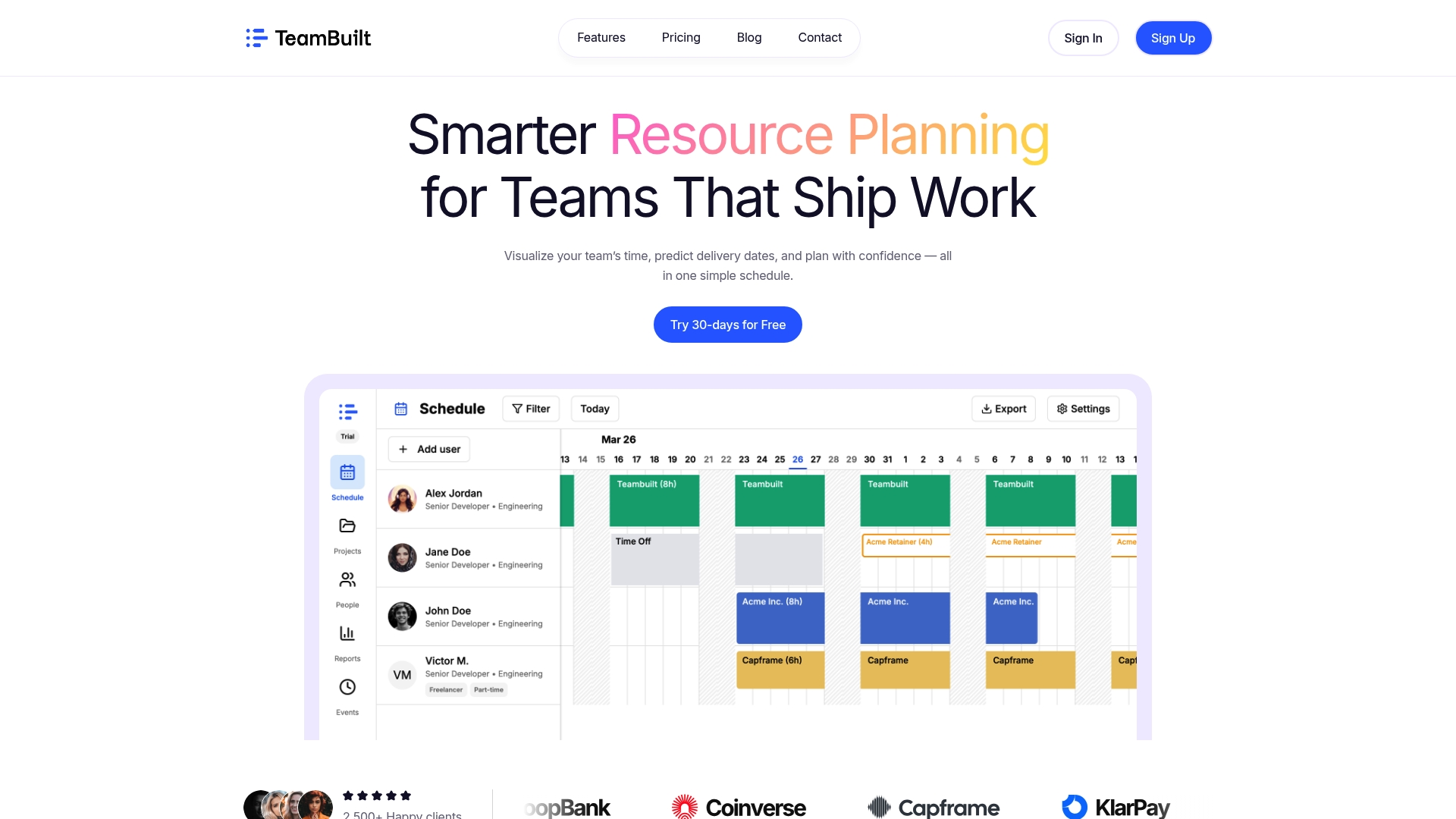
TeamBuilt gives project managers and operations leads real-time workload visibility, capacity tracking, and delivery forecasting built specifically for organizations with multiple teams and complex workflows. You can replace your scattered scheduling spreadsheets with a live, collaborative view of who is available, what is at risk, and where your next bottleneck is forming before it costs you a deadline.
Explore TeamBuilt’s resource planning features to see how the platform maps to the integration journey this article describes. Whether you are consolidating tools, scaling a team, or trying to build better forecasting into your delivery process, there is a practical starting point here for your specific workflow.
Frequently asked questions
What are the most important features in an integrated planning tool?
Unified processes, real-time visibility, bidirectional integrations, and workload views are the capabilities that most directly improve resource management and cross-team collaboration for growing teams.
How does ROI compare between integrated tools and siloed software?
Integrated tools deliver up to 187% ROI over three years and help agencies cut SaaS costs 30% through consolidation, significantly outperforming the fragmented cost and productivity profile of siloed software stacks.
What are typical challenges when adopting integrated planning tools?
Most teams underestimate the need for cross-functional process redesign, talent upskilling, and proof of concept testing before committing to a full platform rollout across the organization.
How quickly can startups and agencies see benefits from integration?
Most organizations see meaningful efficiency gains within 30 to 90 days, especially with AI-augmented tools where breakeven arrives in under 30 days when process alignment is established from the start.
Recommended