
6 major benefits of capacity tracking for team efficiency



TL;DR:
- Capacity tracking enhances team productivity by automating workload forecasting, task allocation, and reporting.
- It enables proactive project management by forecasting demand spikes and identifying bottlenecks early.
- Proper use of capacity data optimizes resource allocation and supports dynamic strategies like the match methodology.
Managing resources across a growing team feels like spinning plates. One project runs hot while another stalls for lack of the right people, and somewhere in between, your best engineers are drowning while junior staff sit idle. For startups and SMBs, this isn’t just frustrating, it’s expensive. Poor resource visibility is one of the leading reasons projects miss deadlines and budgets spiral out of control. This article breaks down six concrete, evidence-backed benefits of capacity tracking so you can move from guessing to planning, and from firefighting to building.
Table of Contents
- Boost productivity and eliminate manual tasks
- Enable proactive project delivery and avoid last-minute firefighting
- Optimize resource allocation across team roles
- Adapt to changing project needs with capacity methodologies
- What most startups miss about capacity tracking
- Get started with smarter resource planning
- Frequently asked questions
Key Takeaways
| Point | Details |
|---|---|
| Productivity boost | Capacity tracking drives up to 40% greater productivity for SMB teams. |
| Proactive delivery | Teams avoid last-minute crises and deliver projects on time by predicting resource needs. |
| Better resource allocation | Capacity tracking ensures balanced workloads and optimal use of team strengths. |
| Dynamic adaptation | Using proven methodologies lets teams adjust to change and scale efficiently. |
| Reduced manual work | Automation features cut administrative burdens by over 70% in busy environments. |
Boost productivity and eliminate manual tasks
The first thing most project managers notice after adopting capacity tracking software is how much time they get back. Manually chasing updates, building spreadsheets from scratch, and reconciling who’s available this week eats hours that should go toward actual work. Capacity tools centralize all of that in one place, removing the back-and-forth that slows teams down.
The numbers back this up. Small businesses that adopted capacity tracking tools saw a 40% productivity boost, with some reporting a 73% reduction in manual administrative tasks after switching from spreadsheet-based tracking to purpose-built software. That’s not a marginal improvement, it’s a structural change in how work gets done.
Here’s what capacity tracking software typically automates or streamlines:
- Workload forecasting: See who’s available and when, weeks in advance, without manually building timelines.
- Task allocation: Assign work based on real availability, not assumptions or gut feel.
- Status updates: Replace daily check-ins with live dashboards that reflect actual progress.
- Conflict detection: Get alerts when someone is double-booked or approaching burnout before it becomes a problem.
- Reporting: Generate utilization and capacity reports automatically instead of compiling data by hand.
Improved team workflow productivity doesn’t come from working harder, it comes from removing the friction that buries teams in low-value tasks. When your team spends less time managing logistics and more time executing, output quality rises alongside volume.
For agencies and teams running multiple concurrent projects, building scalable agency workflows becomes far more achievable once capacity is visible and tracked in real time.
Pro Tip: Schedule a weekly 15-minute capacity review meeting using your tool’s dashboard. This small habit prevents workload blind spots from compounding into project crises.
Enable proactive project delivery and avoid last-minute firefighting
Most project delays don’t appear out of nowhere. They build slowly, invisible until the deadline is close enough to cause panic. A developer gets pulled into support. A designer takes sick leave. A client expands scope mid-sprint. Without capacity visibility, each of these events triggers reactive scrambling rather than a calm adjustment.

Capacity tracking shifts teams from reactive firefighting to proactive optimization, directly reducing project failure risk and improving delivery predictability. That shift is harder than it sounds, but the mechanism is simple: when you can see demand against available hours weeks ahead, you can make decisions before pressure builds.
Here’s how proactive delivery plays out in practice:
- Demand spike alerts: When an upcoming project phase requires more hours than your team currently has available, your capacity tool flags it in advance, not the day it becomes a crisis.
- Buffer planning: Leaders can intentionally hold back capacity for high-priority or unexpected work, instead of discovering they have no slack when an urgent request lands.
- Bottleneck identification: Capacity data reveals which roles or individuals are chronically overloaded, allowing you to rebalance or hire before a bottleneck stalls delivery.
- Realistic commitments: When sales or leadership can see actual availability, they make promises to clients that the team can actually keep.
“The best project managers we’ve seen aren’t better at putting out fires. They’ve built systems that prevent the fires from starting.”
Building strong capacity planning strategies takes practice, but the payoff is compounding. Teams that plan ahead spend less energy on damage control and more on strategic work that actually moves the business forward. Pairing this with clear project timeline steps gives managers the full picture from resources to delivery milestones.
Optimize resource allocation across team roles
One of the most common and costly problems in growing teams is invisible imbalance. Your senior developer handles everything critical because nobody else can. Your operations lead is pulled into every cross-functional meeting. Meanwhile, mid-level staff with the right skills sit underutilized because no one thought to assign them. Capacity tracking surfaces these gaps before they become retention or delivery problems.
Only 50% of projects succeed fully according to recent PMI research, with poor execution and resource mismanagement cited as key barriers. The fix isn’t necessarily more people, it’s better visibility into the people you already have.
Capacity tracking improves allocation by giving you a clear view of:
- Skills mapping: Who has which skills, and is that person being used where they’re strongest?
- Utilization rates: Is anyone running at 120% capacity while others sit at 60%?
- Role-specific bottlenecks: Which roles become chokepoints as project load increases?
- Bench strength: Who has available hours that could absorb urgent or high-value work?
The difference between ad hoc allocation and capacity-tracked allocation is stark:
| Factor | Ad hoc allocation | Capacity-tracked allocation |
|---|---|---|
| Visibility | Low, based on memory | High, data-driven |
| Workload balance | Uneven, reactive | Even, proactive |
| Overload risk | High | Low |
| Staff burnout | Common | Rare |
| Decision speed | Slow | Fast |
Learning from multi-team management tips reinforces how critical cross-team visibility is, especially when resources are shared between departments. Pairing that visibility with centralized planning tools ensures everyone works from a single source of truth rather than competing spreadsheets.
Adapt to changing project needs with capacity methodologies
Capacity tracking isn’t a single approach. Three core methodologies define how teams respond to fluctuating demand, and choosing the right one for your context can mean the difference between a smooth quarter and a chaotic one.
Here’s a quick breakdown:
- Lead strategy: You add capacity ahead of forecasted demand. This works well when you have predictable growth and can afford to hire or expand before you’re at full load. The risk is carrying excess cost if demand doesn’t materialize.
- Lag strategy: You wait until demand exceeds current capacity before responding. This minimizes wasted spend but often leaves teams overloaded in the short term and risks burning out staff during peak periods.
- Match strategy: You adjust capacity incrementally and continuously as demand signals change. This is the most operationally complex but provides the best balance between cost and responsiveness.
The Match methodology is ideal for startups and SMBs that are balancing growth ambitions against tight budgets. It requires real-time data to work well, which is exactly what capacity tracking software provides.
| Methodology | Best for | Risk | Cost efficiency |
|---|---|---|---|
| Lead | Predictable, high-growth teams | Overcapacity | Low |
| Lag | Cost-sensitive teams | Burnout, delays | High |
| Match | Dynamic SMBs and startups | Complexity | Medium-High |
Exploring the right project management tools helps you implement whichever methodology fits your team’s growth stage. For distributed or cross-functional teams, leaning into real-time collaboration tips ensures your chosen approach actually takes hold across departments.
Pro Tip: If you’re unsure which methodology to start with, default to Match. Review your capacity data bi-weekly and adjust incrementally. You’ll learn your team’s real rhythms faster than any framework can predict.
What most startups miss about capacity tracking
Here’s an uncomfortable truth: most startups treat capacity tracking as a reporting task rather than a management discipline. Teams log hours at the end of the week, generate a utilization chart, and file it away. Nothing changes. The tracking becomes a chore instead of a decision-making tool.
The real value of capacity tracking isn’t the data itself, it’s what you do with it. Teams that see lasting capacity planning results integrate their data into weekly planning conversations, use it to challenge scope creep, and hold leaders accountable to realistic commitments. They close the feedback loop.
The most common mistakes we see are infrequent tracking, siloed data that doesn’t reach the people who need it, and no structured process for acting on what the data shows. The fix is less about the software and more about the habit. Bake capacity reviews into your existing rituals, your sprint planning, your weekly ops call, your one-on-ones. When tracking informs decisions consistently, it becomes genuinely strategic rather than just administrative. That’s where the morale improvements, the scalable delivery, and the sustained efficiency gains actually come from.
Get started with smarter resource planning
The insights in this article are only useful if you can act on them. Spreadsheets and manual tracking will only take you so far before the cracks start showing in delivery timelines and team morale.
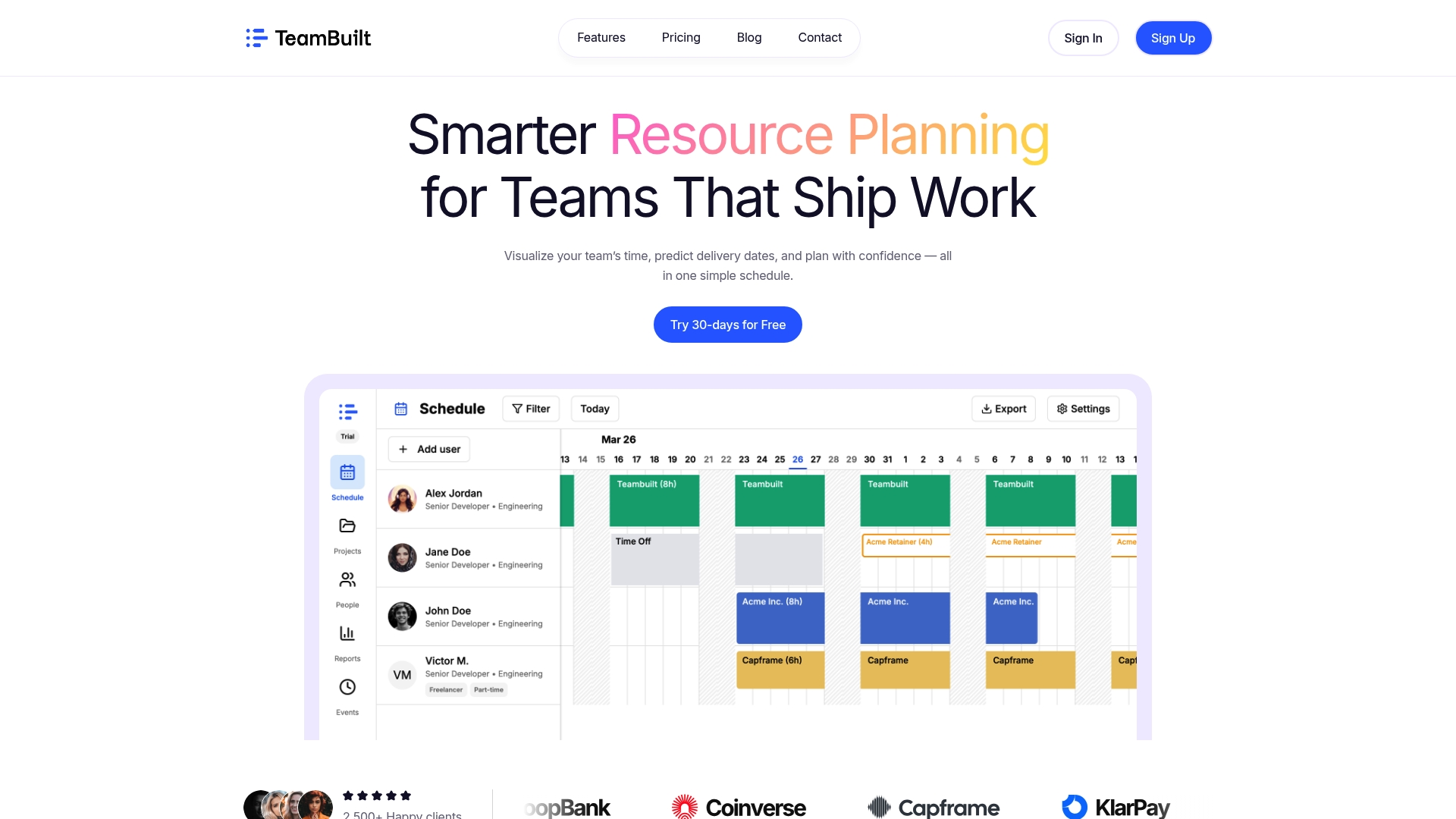
TeamBuilt gives project managers and operations leads a single platform to track capacity, visualize workload, and forecast delivery dates based on real resource availability. With automation built in, you spend less time on admin and more time making decisions that matter. Explore the full set of resource planning features and see how teams are using them to eliminate guesswork from their planning. Visit the Teambuilt platform to start your trial and take control of how your team’s capacity is planned and protected.
Frequently asked questions
How does capacity tracking improve project outcomes for startups?
Capacity tracking gives leaders real-time visibility into available resources, enabling proactive adjustments that reduce delays. Only half of projects fully succeed, and poor resource execution is a primary reason.
What is the most effective capacity tracking methodology for SMBs?
The Match method is the most effective for SMBs because it adjusts capacity dynamically as demand changes, balancing growth ambition with cost control.
Can capacity tracking software help reduce manual admin work?
Yes. Teams that adopt capacity tools can cut manual tasks by 73%, freeing up significant time for higher-value project work.
How does capacity tracking impact resource allocation?
It reveals skills gaps and utilization imbalances, helping managers distribute workloads evenly and prevent overloading key staff who are critical to delivery.
Recommended