
Boost project success with delivery predictability



TL;DR:
- Delivery predictability measures a team’s ability to reliably meet committed dates over time.
- Reducing system instability like technical debt and rework improves delivery consistency.
- Using dashboards and stable inputs helps teams build trust and improve forecasting accuracy.
Bettering your estimates feels like progress, but it rarely stops the late deliveries that erode client trust and strain your team. Delivery predictability is the degree to which a team can forecast and reliably meet committed delivery dates over a defined planning horizon, and it depends on far more than sharper math. For project managers and operations leads at growing startups and SMBs, closing the gap between what you promise and what you ship is the single most powerful lever for building organizational credibility, reducing firefighting, and scaling confidently.
Table of Contents
- Defining delivery predictability: Beyond guesses and estimates
- How do you measure delivery predictability? Operational frameworks and key metrics
- What actually harms predictability? The hidden forces behind delivery surprises
- How to actually improve delivery predictability: Practical steps for modern teams
- Why predictability is trust, not pressure: A new lens for modern teams
- Achieve delivery predictability with advanced planning tools
- Frequently asked questions
Key Takeaways
| Point | Details |
|---|---|
| Predictability defined | It means reliably meeting your delivery promises, not just making better estimates. |
| Measure with milestones | Track actual vs planned milestone completion to gauge predictability. |
| Reduce variance first | Focus on addressing rework, technical debt, and unstable priorities before pushing for tighter forecasts. |
| Tools empower insight | Dashboards and analytics support early warning and smarter adjustments, not just accountability. |
Defining delivery predictability: Beyond guesses and estimates
With the term introduced, it’s crucial to clarify what delivery predictability is and what it isn’t. Many teams treat “predictable delivery” as a synonym for “accurate forecasting,” but these are meaningfully different. Forecasting is about producing a number. Predictability is about consistently hitting what you commit to, sprint after sprint, quarter after quarter.
Think of it this way: a weather model that always predicts 72°F when the actual high is anywhere between 60°F and 85°F is technically generating a forecast. It is not predictable. Your project calendar can generate delivery dates all day, but if your actual shipments scatter around those dates with no discernible pattern, you don’t have a predictable system.
There’s also an important distinction between predictability and reliability. Predictability means your outcomes land close to your forecasted range with consistency. Reliability means you meet your commitments repeatedly over time. The two work together, but you can be reliable without being predictable if you always add buffer to every estimate. True operational health requires both.
According to Agile Seekers, “delivery predictability is the degree to which an organization/team can forecast and reliably meet committed delivery dates (and often outcomes/scope) over a defined planning horizon.” That scope element matters. Missing a feature while hitting a date still hurts predictability if stakeholders expected the full deliverable.
Most project managers focus their energy on improving estimate accuracy because it feels controllable. The deeper problem is usually system stability: how much variance exists in how work flows from start to finish. Learning more about project management terms like throughput, cycle time, and work-in-progress limits helps you see this more clearly. Reviewing project delivery best practices can also expose gaps between your current process and what high-performing teams actually do.
Signs your team is struggling with predictability:
- Milestones are consistently moved out by one to two weeks
- Sprint or release velocity varies widely with no clear reason
- Stakeholders routinely ask “when will this actually be done?”
- Scope creep enters late in cycles without renegotiation
- Post-mortems keep surfacing the same root causes
- You rely on heroic effort to hit dates rather than steady workflow
“Predictability isn’t a guarantee you get from better estimation. It’s a property you build into your system by reducing the forces that cause variance.” This is the shift that separates teams who constantly firefight from those who consistently deliver.
How do you measure delivery predictability? Operational frameworks and key metrics
Now that you understand what delivery predictability is, let’s uncover how to systematically measure it. Without measurement, improvement is guesswork. The good news is that a handful of practical metrics cut through the noise and give you real data to act on.
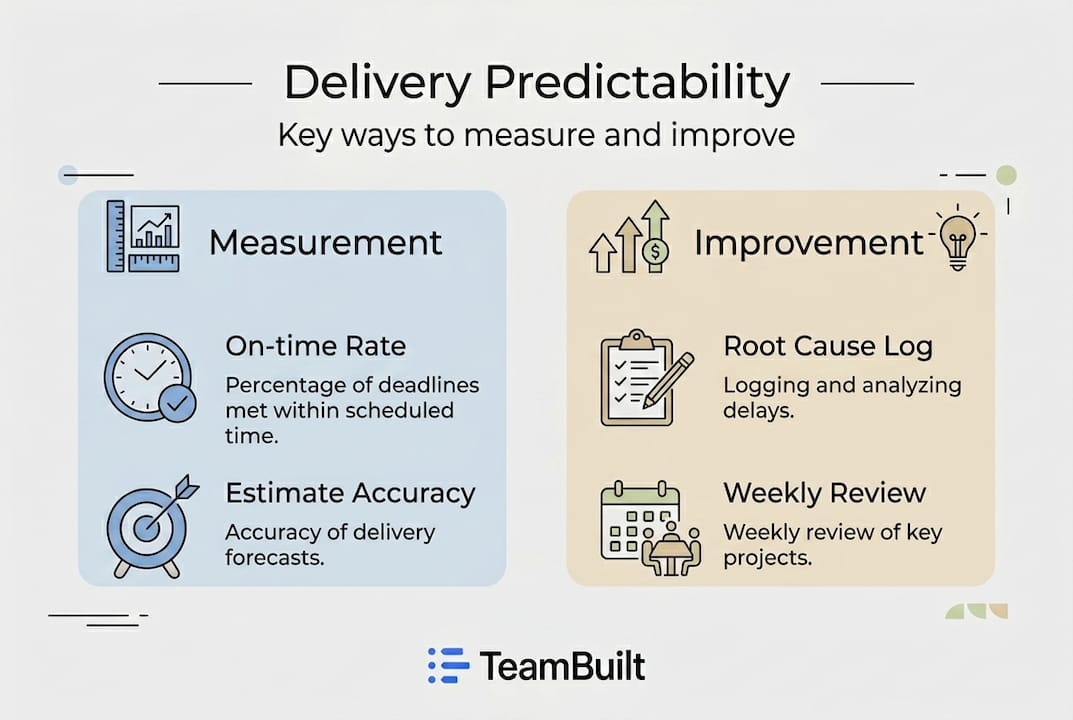
Milestone delivery predictability is the most accessible starting point. As noted by Count.co, a practical way teams quantify delivery predictability is by comparing planned versus actual delivery outcomes over repeated milestones, expressed as a percentage of milestones delivered on or before committed dates. If you hit 8 of your last 10 committed milestones on time, your milestone delivery predictability is 80%. Tracking this month over month reveals whether you are trending up, down, or flat.
DORA metrics (DevOps Research and Assessment) offer a complementary view, particularly for software and product teams. According to the DORA Metrics Guide, common operational approaches treat predictability as a function of how reliably work flows from commitment to delivery, rather than as a guarantee from estimation alone. Key DORA indicators include lead time for changes, deployment frequency, and change failure rate. These tell you whether your system is stable enough to support predictable output.
Here’s a direct comparison of estimation-centered metrics versus flow-centered operational metrics:
| Metric type | Example metrics | What it tells you | Risk if used alone |
|---|---|---|---|
| Estimation accuracy | Story point variance, deadline offset | How close your forecasts are | Can mask systemic instability |
| Flow and throughput | Cycle time, lead time, WIP limits | How work moves through the system | Less intuitive for non-technical leads |
| Milestone delivery | % milestones on time, delivery rate | Commitment reliability over time | Needs a long-enough data set |
| Outcome tracking | Features delivered vs. planned | Scope reliability | Requires clear upfront scope definition |
For project delivery forecasting to be meaningful, you need at least two to three months of milestone data before the numbers tell a trustworthy story.
How to calculate your milestone delivery predictability step by step:
- Define what “on time” means for your team. Is it the original committed date, or the most recently revised date? Choose one and stick to it.
- List every milestone you committed to over the past quarter, including internal deadlines, not just client-facing ones.
- Mark each milestone as delivered on time or late.
- Divide on-time milestones by total milestones and multiply by 100.
- Track this percentage monthly and look for the trend, not just the number.
Using visual project planning tools makes step two and three dramatically faster because your data already exists in a centralized format rather than scattered across email threads and spreadsheets.
“In high-performing teams, predictability is less about the precision of forecasts and more about the stability of the system generating those forecasts. Fix the system first, then refine the forecast.”
What actually harms predictability? The hidden forces behind delivery surprises
Measurement only works if you address the underlying causes. Let’s uncover what those are. The most common mistake teams make is treating a missed deadline as an estimation problem when it’s almost always a systems problem.
Research published on Medium makes this clear: delivery predictability is not just statistical probability or better math. It improves when variance-inducing forces are reduced, including rework, technical debt, unbounded experimentation, and unstable direction or capacity. These are the real culprits, and most of them are invisible until they cause a miss.
Technical debt slows everything down in ways that resist estimation. A task estimated at three days balloons to seven because the codebase requires workarounds nobody documented. You can’t estimate your way out of that. You have to pay down the debt.

Rework is often the biggest hidden cost. When requirements shift after work begins, the team isn’t just adding new work. They’re also discarding completed work, which is doubly expensive. Stable, well-defined requirements at the start of a cycle are one of the highest-leverage predictability investments you can make.
Inconsistent team capacity is another major driver of variance. If your team’s actual availability fluctuates weekly due to unplanned meetings, PTO, context-switching between projects, or sudden priority shifts from leadership, your forecasts will always drift from reality. Learning solid team capacity planning practices closes this gap significantly. The benefits of capacity tracking become most obvious precisely when your team is under pressure and capacity is tightest.
Hidden signals that your system is unstable:
- Work that was “done” regularly gets reopened for fixes
- Team members are pulled across multiple projects simultaneously
- Priority changes arrive mid-sprint or mid-cycle with no renegotiation
- Handoffs between teams or functions create unpredictable delays
- You can’t confidently say how much capacity your team actually has next week
- Dependencies on external teams or vendors are tracked informally
Handling project timeline management without visibility into these instability signals is like driving with a fogged windshield. You can still drive, but every turn is a gamble.
Pro Tip: Before adjusting your forecasting method, audit your variance sources for one month. Keep a simple log of every time a task takes more than 50% longer than estimated, and note the reason. After 30 days, you’ll see a pattern. That pattern is your highest-leverage starting point for improvement.
How to actually improve delivery predictability: Practical steps for modern teams
Armed with root causes and measurement, here’s how to drive real improvement. Moving from chronic delivery surprises to consistent, trustworthy commitments is not a one-sprint fix. It’s a series of deliberate changes to how your team operates week to week.
The most impactful insight from Craig Risi’s research on planning metrics is that predictability dashboards and commitment-reliability metrics are most valuable for moving from hope to evidence-based planning. They provide early warning and support trust rather than pressure teams into unrealistic commitments. That framing matters enormously for how you implement these steps.
Five actionable steps to boost delivery predictability:
- Stabilize your inputs first. Lock requirements before work begins on each cycle. Create a lightweight “definition of ready” so your team only picks up work that is well-scoped. Reduce mid-cycle priority changes by batching stakeholder feedback into structured checkpoints.
- Make capacity visible and consistent. Track actual availability, not assumed availability. Account for recurring meetings, planned PTO, onboarding responsibilities, and cross-team commitments before assigning work.
- Replace deadline-focused tracking with milestone delivery metrics. Stop measuring whether your estimates were accurate after the fact. Start measuring whether you hit committed milestones. These are different questions with very different implications.
- Use dashboards for early warning, not post-mortem. A good predictability dashboard tells you right now whether a milestone is at risk, not after it misses. Set up weekly check-ins against your milestone plan rather than waiting for end-of-cycle reviews.
- Build a learning loop. After each delivery cycle, spend 20 minutes reviewing what your milestone delivery predictability score was, what drove variance, and what one change you’ll make next cycle. Compounding small improvements over six months produces remarkable results.
The tools your team uses have a direct impact on how achievable these steps are. Here’s how key platform features map to specific predictability goals:
| Platform feature | Predictability benefit | Problem it solves |
|---|---|---|
| Real-time capacity dashboard | Accurate workload visibility | Overcommitment and hidden conflicts |
| Milestone tracking and analytics | Reliable commitment metrics | Missing early warning signals |
| Forecasting engine | Evidence-based delivery dates | Hope-based planning |
| Cross-team scheduling | Dependency visibility | Untracked inter-team blockers |
| Integrated workload view | Single source of planning truth | Scattered spreadsheets and siloed data |
Using centralized planning tools brings all of these capabilities together in one place, which is especially valuable when your organization spans multiple teams with overlapping dependencies.
Pro Tip: Don’t wait until a milestone misses to review your predictability data. Set a standing 15-minute weekly review where you look at milestone status, capacity changes, and any new blockers. The earlier you spot a risk, the more options you have to respond without blowing the timeline.
Why predictability is trust, not pressure: A new lens for modern teams
Before wrapping up, let’s re-examine how predictability metrics should truly serve modern teams. This is where most organizations go wrong, and getting it right changes everything.
The conventional use of delivery predictability metrics in many organizations looks like this: leadership tracks the numbers, and when the team misses, the data becomes evidence for a performance conversation. Predictability becomes a stick. Teams feel surveilled rather than supported. And ironically, when teams feel that kind of pressure, predictability gets worse, not better, because people start gaming estimates to protect themselves rather than giving honest forecasts.
The more effective lens, and the one Craig Risi’s framework explicitly supports, is that predictability metrics exist to provide early warning and support trust. They are diagnostic tools, not scorecards. When a team’s milestone delivery predictability drops from 85% to 65%, the right response is curiosity: What changed? What destabilized the system? Where does the team need support or relief?
We’ve seen this play out repeatedly. Organizations that use predictability data to understand and improve their system consistently outperform those that use it to evaluate and pressure their teams. The difference isn’t just cultural. It’s operational. When teams feel safe giving honest input about capacity and risks, the data is accurate. When they feel pressured, the data is optimistic, and optimistic data is worse than no data because it hides the real problem.
Predictability is ultimately about trust: trust that your team’s commitments mean something, trust that leadership will respond constructively when things shift, and trust that the system you’re all working inside is designed to succeed. Measurement supports that trust when used with the right intent.
Achieve delivery predictability with advanced planning tools
To put everything above into practice, it helps to have the right tools working with you rather than against you.
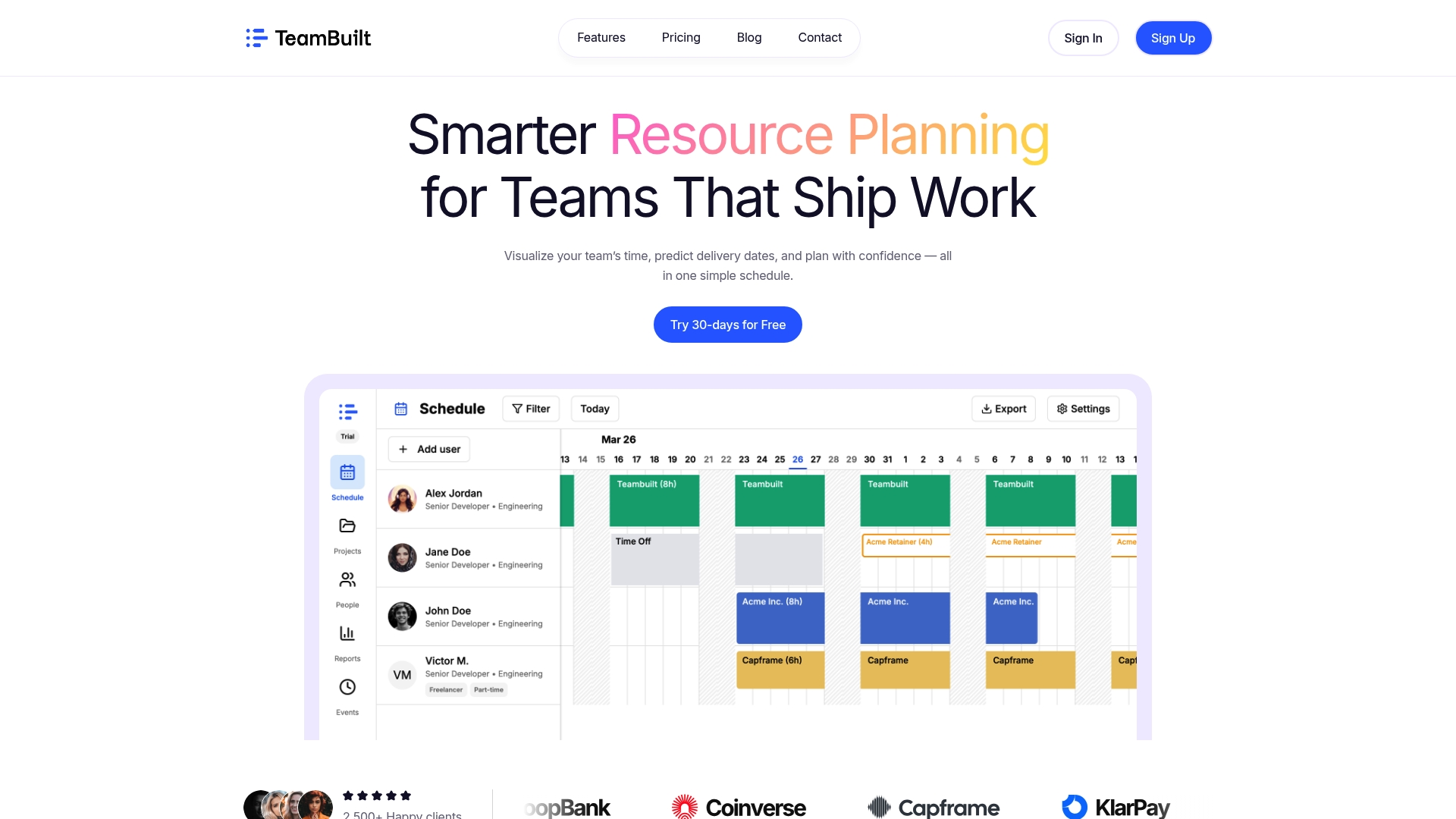
TeamBuilt is built specifically for the operational challenges that project managers and ops leads at growing startups and SMBs face every day. The platform brings together real-time team scheduling, capacity tracking, milestone analytics, and delivery forecasting in a single workspace, so your planning lives in one place instead of six spreadsheets and three different apps. Whether you need to spot an overloaded team member before they become a bottleneck or generate a forecasted delivery date based on actual resource availability, the resource planning features give you the visibility to act early and the data to back your commitments. Explore how TeamBuilt can help your team move from reactive firefighting to genuinely predictable delivery.
Frequently asked questions
What is delivery predictability in project management?
Delivery predictability is a team or organization’s ability to reliably forecast and meet committed deadlines and outcomes over a set timeframe, not just produce accurate estimates.
How do you calculate delivery predictability?
A common method is dividing the number of milestones delivered on time by the total number of milestones committed, then multiplying by 100 to get a percentage.
What are the main causes of poor delivery predictability?
Unstable requirements, technical debt, frequent rework, and inconsistent team capacity are the leading variance-inducing forces behind unpredictable delivery outcomes.
How can teams improve project delivery predictability?
Teams can stabilize requirements, reduce technical debt, track actual versus planned outcomes, and use early-warning dashboards to catch risks before they become missed milestones.
Recommended