
Top collaborative planning templates for better teamwork



TL;DR:
- Effective collaborative templates feature real-time editing, explicit commitments, and phased planning support.
- Tracking commitments through PPC or RFV metrics enhances team accountability and delivery predictability.
- Combining multiple templates tailored to project scope improves workflow and reduces bottlenecks in SMB teams.
Running a growing startup or SMB means you’re constantly juggling more projects, more people, and more moving parts than last quarter. When coordination breaks down, the cost is immediate: missed deadlines, duplicated work, and team members blocked on tasks they can’t even start. Collaborative planning templates give project managers and team leads a shared framework that turns scattered to-do lists into synchronized execution. This article walks you through how to pick the right template, which options deliver the most value, and how to match each one to your specific project context.
Table of Contents
- Essential criteria for selecting collaborative planning templates
- Top collaborative planning templates for teams
- Comparing collaborative planning template features
- Situational recommendations: choosing the right template for your project
- Why most SMBs overlook the true power of collaborative planning templates
- Collaborative planning tools to drive your team forward
- Frequently asked questions
Key Takeaways
| Point | Details |
|---|---|
| Selection criteria | Choose templates with real collaboration support, phased planning, and reliability measurement. |
| Template options | Top templates include Gantt, Kanban, make-ready planners, and commitment trackers. |
| Comparative insights | Feature-rich templates tailored for layered cadences outperform basic planning boards. |
| Real-world fit | Match your template choice with your project size, workflow complexity, and team style. |
| Measurable reliability | Tracking team commitments and reliability metrics drives continuous improvement. |
Essential criteria for selecting collaborative planning templates
Not every template labeled “collaborative” actually supports genuine teamwork. Many are just shared spreadsheets with a fresh coat of paint. Before you invest time customizing anything, evaluate templates against a set of criteria that reflect how your team actually works.
Collaborative features that matter from day one
The baseline requirement is real-time editing so multiple team members can update the plan simultaneously without version conflicts. Beyond that, look for commenting at the task level, clear task ownership fields, and notification systems that alert the right people when status changes. If you’re unfamiliar with some of these project management terms, brushing up beforehand will help you evaluate templates more accurately.
Workflow support for phased planning
Good templates mirror how projects actually unfold over time. The Last Planner System (LPS) is a commitment-based collaborative planning methodology that emphasizes explicit commitments, readiness screening, and reliability measurements. Templates inspired by LPS support look-ahead planning windows (typically 3 to 12 weeks out), make-ready checklists to confirm tasks are truly ready before they’re assigned, and commitment tracking to log whether each task was completed as promised.
Flexibility and scalability
Your template needs to grow with your team. Custom fields let you add context specific to your industry or workflow. Phase markers help break large projects into manageable chunks. And scalability means the template doesn’t collapse under the weight of 50 tasks when you started with 10.
Visualization tools
Different stakeholders need different views. A developer wants a task list; a CFO wants a timeline; a department head wants a Kanban board showing what’s in progress. Templates that support Gantt charts, kanban views, and calendar overlays serve a wider audience without requiring separate tools.

Integration with your existing stack
A template is only useful if it connects to the tools your team already uses, whether that’s Slack, Google Workspace, Jira, or your CRM. API access and pre-built integrations reduce manual data entry and keep your plan current without extra effort.
Here’s a quick checklist of what to look for:
- Real-time collaborative editing with role-based permissions
- Task-level comments and notifications
- Explicit commitment tracking fields
- Look-ahead planning horizons (3 to 12 weeks)
- Make-ready checklists to confirm task prerequisites
- Reliability measurement fields (PPC or similar)
- Custom fields and phase markers
- Multiple views (Gantt, Kanban, list, calendar)
- Integration with project and communication tools
Pro Tip: Prioritize templates that include commitment tracking and phased planning cycles from the start. Teams that skip these features often rediscover the same resource bottlenecks sprint after sprint, because there’s no structured way to learn from what didn’t get done.
Top collaborative planning templates for teams
With clear criteria in mind, here are the most effective collaborative planning templates you can implement today. Each one serves a different purpose, and understanding where each shines helps you avoid using the wrong tool for the job.
-
Gantt chart planner. The Gantt chart remains one of the most universally understood project planning formats. It maps tasks against a timeline, shows dependencies between work items, and gives every stakeholder a bird’s-eye view of the project schedule. For startups managing product launches or SMBs coordinating client deliverables, a Gantt template with shared editing rights transforms a static schedule into a living document. Review the team scheduling steps for guidance on building effective Gantt schedules.
-
Kanban board template. Kanban boards organize work by status columns, typically “To Do,” “In Progress,” and “Done.” They’re ideal for ongoing workflows like content production, customer support ticket management, or software sprint cycles. The visual simplicity makes bottlenecks obvious at a glance. When one column gets overloaded, you know immediately where to intervene.
-
Make-ready planner. This template is less common but highly effective for teams dealing with complex dependency chains. It lists upcoming tasks for the next 3 to 12 weeks and tracks whether the prerequisites for each task are actually in place before assigning them to someone. This prevents the common scenario where a team member starts work only to discover they’re waiting on approvals, assets, or information that was never confirmed ready.
-
Commitment tracker. Borrowed directly from LPS methodology, a commitment tracker logs what each team member promises to complete in a given week, then records whether that commitment was fulfilled. Over time, this builds a Percent Plan Complete (PPC) score that reveals execution reliability. High PPC scores mean your plans are realistic. Low scores signal systemic problems in how work is being assigned or resources allocated. See workflow examples from real SMBs to understand how commitment tracking plays out in practice.
-
Phase and project roadmap template. For longer-horizon planning, a roadmap template shows major project phases across months or quarters. It gives executives and investors a clear view of where the project is headed, while still connecting to the tactical detail in your Gantt or Kanban layers.
The LPS’s layered planning approach demonstrates how templates should accommodate both long and short-term planning cycles, stacking a roadmap at the top, Gantt in the middle, and make-ready plus commitment tracking at the execution layer.
“Teams that operate without explicit commitments are essentially running on optimism. The moment you start measuring what gets done versus what was promised, you gain a feedback loop that actually improves over time.” This is the core insight that separates high-performing SMB teams from those that keep repeating the same delivery failures.
Pro Tip: Use make-ready planners for your 3 to 12 week look-ahead horizon. Most last-minute task discovery and resource scrambles happen because teams assume a task is ready when it isn’t. The make-ready review forces an honest conversation before work is assigned.
Comparing collaborative planning template features
Since not all templates provide the same value, a head-to-head comparison helps clarify which is right for your team.
Reliability measurement in the form of PPC (Percent Plan Complete) or RFV (Reasons for Variance) is a core feature of advanced collaborative planning frameworks, and it’s often the feature that separates good templates from truly transformative ones.
The table below compares five template types across the dimensions that matter most for growing teams. For deeper context on how visualization for project planning connects to resource allocation decisions, it’s worth exploring how each view type informs staffing choices.
| Template type | Real-time collaboration | Phased planning | Make-ready support | Commitment tracking | Reliability measurement | Flexibility |
|---|---|---|---|---|---|---|
| Gantt chart planner | High | Moderate | Low | Low | None | Moderate |
| Kanban board | High | Low | Low | Low | None | High |
| Make-ready planner | Moderate | High | High | Moderate | Low | Moderate |
| Commitment tracker | Moderate | Moderate | Moderate | High | High | Low |
| Phase roadmap | Moderate | High | Low | Low | None | High |
A few patterns worth highlighting. Kanban boards win on flexibility and real-time collaboration but offer no built-in reliability measurement. That’s fine if your workflow is repetitive and stable, but it becomes a problem when you’re managing complex, multi-team projects with dependencies. Commitment trackers score highest on accountability features but are the least flexible, meaning they work best as a layer on top of another template rather than as a standalone solution. The make-ready planner sits in a useful middle ground for teams managing 3 to 12 week horizons where prerequisite checking is critical.
The insight here is that no single template type covers all dimensions. The most effective teams use a combination, matching each template to the planning horizon and complexity level it’s best suited for.
Situational recommendations: choosing the right template for your project
Once you’ve compared templates, use these recommendations to choose the right one for your current and future projects.
Matching planning cadences and reliability metrics to the specifics of your workflow directly improves predictability and outcomes. Here’s how to apply that practically across common startup and SMB scenarios.
Use the right template for your situation:
-
Product development teams should layer a phase roadmap for quarterly planning with a Gantt chart for sprint-level detail and a commitment tracker for weekly standup accountability. This combination connects high-level goals to daily execution without losing visibility at any level.
-
Client services and agency teams benefit most from Kanban for managing concurrent client workflows, paired with a make-ready planner to confirm deliverable prerequisites before assigning tasks to creatives or strategists. This prevents the constant context-switching that kills productivity in agency environments.
-
Internal operations teams running recurring processes (HR onboarding, quarterly reporting, compliance reviews) should use Kanban for ongoing tasks and commitment trackers for project-specific work. The commitment tracker creates accountability even when work doesn’t have a hard deadline stamped on it.
-
Cross-functional projects involving multiple departments need a phase roadmap as the shared reference point, with department-specific Gantt or Kanban boards feeding into it. Without a shared top-level view, each team optimizes for its own priorities and coordination breaks down.
-
If you’re running your first structured planning cycle, start with a Gantt chart and a basic commitment tracker. Master those two before adding make-ready reviews. Complexity added too fast leads to process abandonment.
-
If you’re scaling from 5 to 20 people, this is the inflection point where Kanban alone stops working. Add a make-ready planner and structured commitment tracking before you hit the coordination wall.
For teams thinking ahead to delivery forecasting, project delivery forecasting becomes significantly more reliable when commitment tracking data builds up over several planning cycles, because your historical PPC score gives you a realistic buffer to apply to future estimates.
Why most SMBs overlook the true power of collaborative planning templates
Most advice on this topic stops at feature comparisons and template recommendations. But in our experience working with growing teams, the real problem isn’t template selection. It’s process alignment.
Teams pick templates based on what looks good in a demo or what their project management tool happens to offer by default. A well-designed visual template feels productive. It creates the impression of organization. But if it doesn’t capture explicit commitments and measure whether those commitments are fulfilled, it’s just a more attractive version of the scattered workflows it replaced.
The missing piece is almost always explicit commitments and reliability measurement like PPC or RFV. These aren’t bureaucratic overhead. They’re feedback loops. Without them, teams repeat the same capacity planning mistakes because they have no data on why tasks slipped. With them, patterns emerge quickly: certain team members are chronically over-allocated, certain task types always take longer than estimated, certain dependencies are never confirmed in advance.
The counter-intuitive reality is that small SMBs benefit more from commitment-based planning than large enterprises, not less. Enterprise teams have dedicated project managers, PMO offices, and tooling budgets to absorb planning failures. A 12-person startup has none of those buffers. One missed dependency can delay a client delivery, strain a relationship, and consume a week of engineering time in rework.
Reviewing team workflow lessons from comparable SMBs makes this concrete. The teams that report the clearest improvement in delivery predictability are almost always the ones that committed to tracking PPC, not the ones that switched to a prettier interface.
The practical shift is smaller than most teams expect. Add a commitment column to your existing template. Run a weekly 15-minute review of what was promised versus what was delivered. Track the PPC score over four weeks. You’ll have enough data to identify your top three process friction points, and fixing those three things will do more for your delivery reliability than any template redesign.
Collaborative planning tools to drive your team forward
When you’re ready to put these principles into action, advanced collaborative planning tools can take your workflow to the next level.
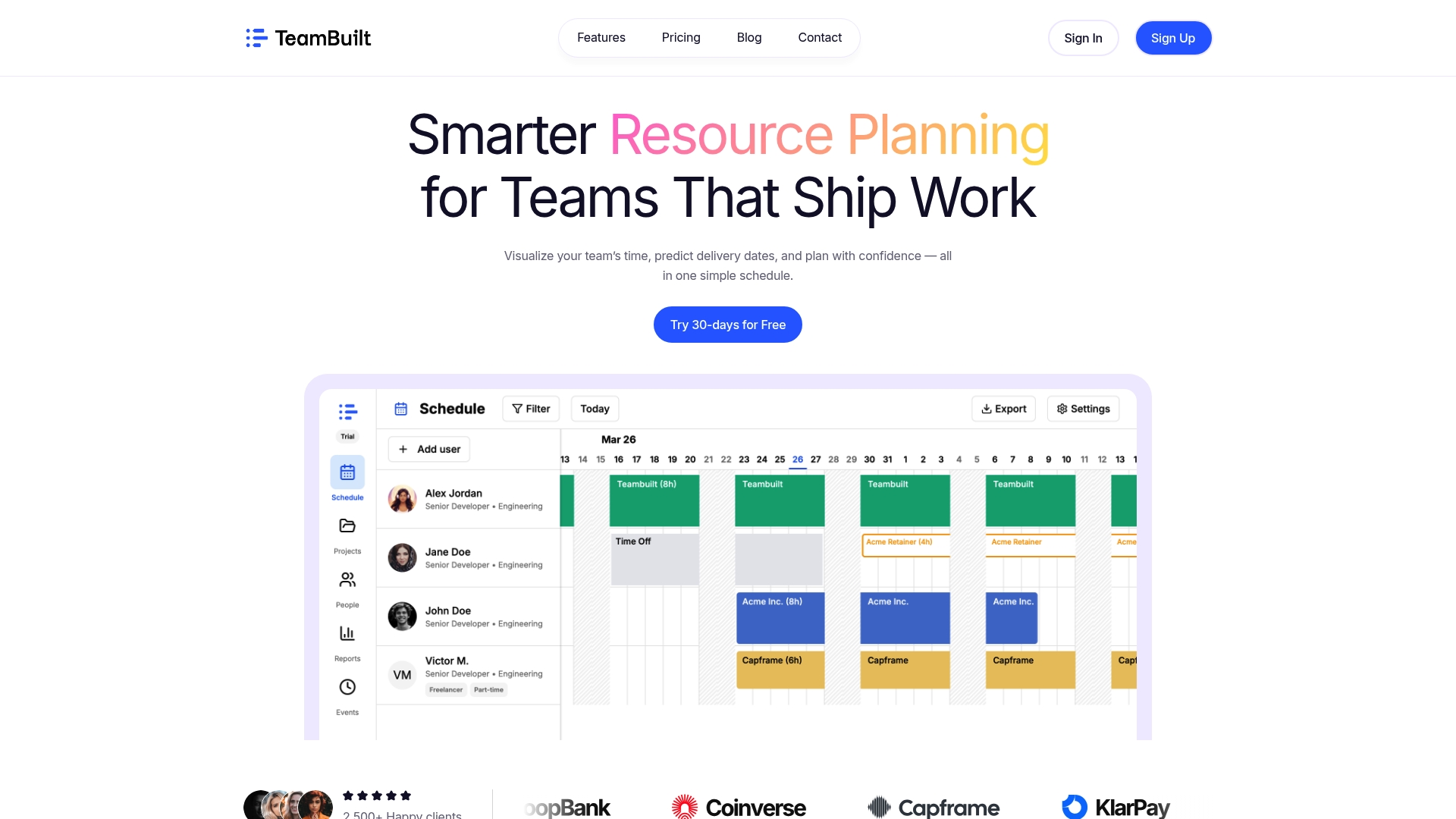
TeamBuilt brings together customizable collaborative planning templates, real-time workload visualization, and built-in commitment tracking in a single platform designed for growing teams. Instead of stitching together a Gantt tool, a Kanban app, and a spreadsheet for PPC tracking, you get a unified environment where all three planning layers stay synchronized. Explore the full resource planning features to see how TeamBuilt’s toolset maps to the template criteria and situational recommendations covered in this article. For SMBs and startups ready to move beyond spreadsheets, it’s the operational backbone your planning process actually needs.
Frequently asked questions
What makes a collaborative planning template effective?
Templates that enable explicit commitments, phased planning, and team accountability are most effective. Effective templates follow LPS principles of commitment-based planning and reliability measurement, which create feedback loops that improve execution over time.
How does commitment tracking improve project management?
Tracking commitments holds team members accountable and builds a PPC score that reveals whether your plans are realistic or consistently over-optimistic. LPS emphasizes explicit commitments and measuring PPC/RFV to drive better results, turning delivery reliability from a guess into a measurable metric.
Can I mix different planning templates for one project?
Yes, and for most complex projects you should. Combining a Gantt chart for timeline visualization with a make-ready planner for phased execution and a commitment tracker for weekly accountability gives you coverage at every planning horizon without overcomplicating any single view.
Why is measuring reliability (like PPC) important?
Reliability metrics surface process issues early, before they compound into major delivery failures. PPC/RFV measurements are a cornerstone of collaborative planning reliability, and teams that track them consistently improve their delivery predictability within just a few planning cycles.
Recommended
- Boost Team Productivity: 5 Proven Workflow Examples for SMBs | Teambuilt Blog
- Boost Team Productivity: 5 Proven Workflow Examples for SMBs | Teambuilt Blog
- Harness visualization for smarter project planning in 2026 | Teambuilt Blog
- Harness visualization for smarter project planning in 2026 | Teambuilt Blog