
How to coordinate teams effectively for SMB success



TL;DR:
- Cross-functional gridlock causes delivery delays and erodes trust in growing teams.
- Building explicit dependencies, ownership, and routines enhances coordination and productivity.
- Trust and adaptability are more crucial than any specific framework for sustained coordination success.
Cross-functional gridlock is one of the most expensive problems a growing startup or SMB can face. When engineering waits on design, sales promises what product hasn’t scoped, and no one owns the handoff, delivery dates slip and trust erodes fast. The fix isn’t hiring more people or holding more meetings. It’s building a deliberate coordination system that surfaces dependencies early, keeps ownership clear, and lets every team move with confidence. This guide walks you through the exact steps to get there.
Table of Contents
- Preparation: Assessing your team’s coordination gaps
- Frameworks and tools: Setting a strong foundation
- Execution: Best practices for seamless coordination
- Verification and continuous improvement
- The real secret: Coordination is about trust and adaptation
- Take your team coordination to the next level
- Frequently asked questions
Key Takeaways
| Point | Details |
|---|---|
| Assess coordination gaps | Start with a clear diagnosis of workflow bottlenecks and recurring delays to target improvements effectively. |
| Use proven frameworks | Apply explicit tools and matrices to clarify handoffs and responsibilities across teams. |
| Emphasize regular rituals | Establish daily and weekly coordination check-ins to catch issues early and align everyone’s efforts. |
| Measure and adapt | Continuously track and adjust coordination practices using objective metrics like cycle time and throughput. |
| Trust over tools | While frameworks are vital, successful coordination grows from trust and adapting to your team’s changing needs. |
Preparation: Assessing your team’s coordination gaps
Before you redesign any process, you need an honest picture of where your current workflows actually break down. Most teams skip this step and jump straight to installing a new framework, which is why so many coordination initiatives fail within 90 days. Start by tracing your last three to five delayed projects and asking one question at each stage: where did work stop moving, and why?
Look for patterns across your team performance metrics before drawing conclusions. You’ll typically find four culprits: unclear task ownership, unmapped dependencies between teams, duplicated work across small squads, and a backlog of blocked items nobody escalates. Research shows dependencies block 20% or more of active work in teams that lack explicit ownership matrices and async update protocols. That’s a fifth of your capacity sitting idle.
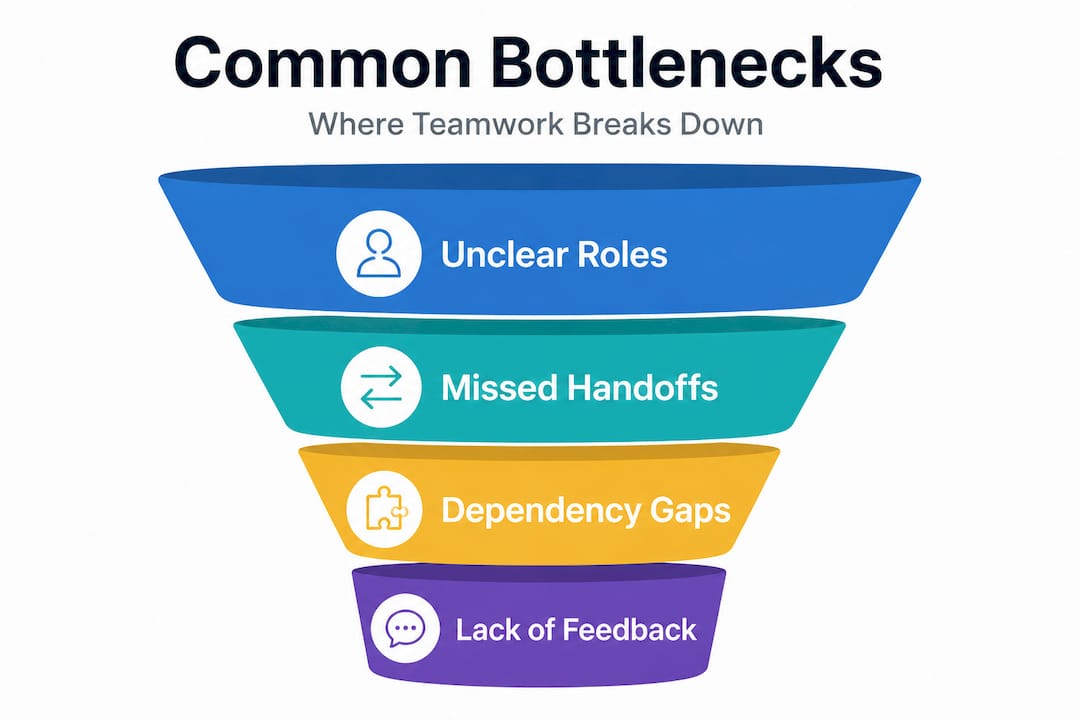
The table below maps common coordination bottlenecks to the team sizes and structures where they appear most frequently:
| Bottleneck | Most common team size | Root cause | First warning sign |
|---|---|---|---|
| Unclear task ownership | 8 to 15 people | Flat structure, no RACI | Repeated “who owns this?” questions |
| Task duplication | 4 to 6 people scaling up | Siloed communication | Two versions of the same deliverable |
| High work in progress (WIP) | Any size | Missing WIP limits | Mounting blocked items in the backlog |
| Dependency gridlock | 15 or more people | No dependency map | Frequent cross-team escalations |
| Slow handoffs | 10 to 20 people | No handoff criteria | Work stalls between sprints |
Once you’ve identified your top two bottlenecks, list every critical dependency and handoff point in your most common project type. Be specific. “Design hands off mockups to engineering” is vague. “Design delivers finalized, approved Figma frames with written acceptance criteria to the engineering lead by Thursday EOD before sprint start” is actionable. That level of precision is what prevents the 20-minute Slack thread every Monday morning.
You should also understand multi-team management methods before choosing your remediation approach, since team size and structure heavily influence which interventions stick.
Pro Tip: Monitor your WIP count weekly. When blocked items exceed 15 to 20 percent of active work across any single team, that’s an early signal of coordination stress. Address it with a short dependency review meeting before it becomes a full sprint failure.
Frameworks and tools: Setting a strong foundation
With a clear picture of your gaps, the next step is choosing the right coordination framework for your context. No framework is universally correct. A five-person startup shipping fast needs different scaffolding than a 40-person SMB running parallel workstreams across three departments.
The most practical approach, regardless of team size, is to map dependencies explicitly and build contracts between teams that include buffers and clear escalation paths. Without this, even the best framework becomes a ceremonial checklist. Dependencies should be documented visually, reviewed at sprint planning, and assigned a named owner who is accountable for unblocking them.
Here’s a comparison of the most commonly used coordination frameworks in SMB and startup environments:
| Framework | Best use case | Strengths | Limitations |
|---|---|---|---|
| Agile/Scrum | Product and engineering teams | Iterative delivery, visible velocity | Requires consistent team size |
| RACI matrix | Any cross-functional project | Clear ownership and accountability | Static; needs updates as scope changes |
| Scrum of Scrums | Multiple Agile squads | Surfaces cross-team blockers quickly | Overhead for teams under 20 people |
| Kanban | Operations and support teams | Visual WIP control, flow focus | Less useful for date-driven delivery |
| OKR alignment | Strategy to execution bridge | Connects daily work to outcomes | Doesn’t address tactical handoffs |
Key agile statistics worth noting: teams that track cycle time, WIP, velocity, throughput, and team satisfaction consistently outperform those tracking deadlines alone. These metrics give you retrospective fuel and planning precision in a single dashboard.
For tooling, the coordination framework means nothing if the systems your teams use every day don’t reinforce it. Consider these categories when building your coordination stack:
- Dependency tracking: Visual tools that show which tasks are blocked by upstream work, with named owners and due dates
- Async updates: Structured stand-up formats that work in writing, not just live video calls
- Shared scheduling: One calendar layer where cross-team capacity is visible, not just individual team boards
- Retrospective tracking: A consistent format for capturing what broke down and what the fix is
- Escalation channels: A defined path for flagging blockers within 24 hours without defaulting to a manager for every issue
If your team manages agency project workflows or juggles multiple client workstreams, the tooling selection becomes even more important because context-switching overhead compounds quickly.
Strong team scheduling strategies also play a central role here. When scheduling is transparent and centralized, teams can make realistic commitments instead of optimistic guesses that blow up at delivery.
Execution: Best practices for seamless coordination
Frameworks and tools set the stage. Execution is where coordination actually lives or dies. The most common mistake at this stage is treating coordination as a set of meetings rather than a set of habits. Meetings support coordination; they don’t replace it.
Here’s a step-by-step process for running a cross-functional project from kickoff to delivery:
- Kickoff alignment: Bring all team leads together before work begins. Confirm scope, delivery date, and success criteria. Map every dependency and assign owners on the spot.
- Ownership matrix setup: Publish a RACI or equivalent document within 24 hours of kickoff. Every task must have exactly one accountable owner.
- WIP limits and sprint scope: Agree on how much work each team will carry in the upcoming sprint. Overcommitting here is the single most predictable source of coordination failure.
- Daily async standups: Use a structured written format: what did I complete, what am I working on, and what’s blocking me. This keeps blockers visible without requiring a live meeting.
- Weekly cross-team sync: A 30-minute session where team leads share blockers, review dependency status, and flag any risks to delivery. No status updates that could be async.
- Handoff verification: Before work moves between teams, confirm that acceptance criteria are met in writing. No verbal handoffs.
- Retrospective after delivery: Within 48 hours of project close, run a structured review. What slowed us down? What broke the coordination contract? What one thing will we do differently next sprint?
Warning: For growing teams, coordination overhead above 20% of team effort is a sign that something structural needs to change. At that level, teams are spending more energy managing work than doing it. Intervene with coordination rituals before the situation reaches a breaking point.
The business case for getting this right is strong. Agile teams consistently report 60% revenue gains and 25% productivity improvements, but only when the focus stays on outcomes rather than ritual compliance. Running daily standups because the framework says so, without acting on blockers surfaced in those standups, delivers none of the benefit.
Pro Tip: Define your handoff criteria in writing before the sprint starts, not during it. A single shared document that lists “done means…” for each type of work eliminates the most common source of handoff friction in cross-functional projects.
Investing in real-time coordination infrastructure pays dividends beyond any single project. When your team can see capacity, blockers, and timelines in one place, decision-making accelerates and escalations become the exception instead of the norm. You’ll also find that collaborative resource optimization becomes far easier when execution rituals are already humming.

Verification and continuous improvement
Implementing coordination practices is not a one-time event. Teams drift. Scope changes. New people join and the implicit knowledge that made the coordination work gets diluted. Sustainable coordination requires a monitoring layer that tells you when things are slipping before a delivery crisis makes it obvious.
Start with a core metrics set. Tracking cycle time, WIP, velocity, throughput, and team satisfaction gives you a leading indicator dashboard rather than a lagging one. Cycle time tells you how long work actually takes versus how long it’s supposed to take. A sudden increase in cycle time is almost always a dependency or handoff problem in disguise.
Here are the key signals that your coordination health is deteriorating and improvement is needed:
- Blocked item count rising sprint over sprint without resolution
- Repeated topics in retrospectives that never produce action items
- Increasing frequency of “just checking in” Slack messages between teams
- Missed handoff deadlines two or more sprints in a row
- Team satisfaction scores dropping among people who sit at coordination touchpoints
- WIP climbing above agreed limits without formal exception approval
- Dependency owners not updated more than two business days after a status change
When you see three or more of these signals at the same time, it’s not a people problem. It’s a system problem. The right response is a focused coordination retrospective, not a performance conversation.
Statistic callout: Teams that adopt structured coordination practices and track the metrics above have reported revenue increases of 60% and productivity gains of 25%. For an SMB running lean, those numbers represent the difference between scaling successfully and burning out your best people on preventable rework.
Review your coordination health every quarter, not just when a project fails. Use the workflow examples for SMBs that match your industry and team structure to benchmark where you stand and identify the next lever to pull.
The real secret: Coordination is about trust and adaptation
Here’s the uncomfortable truth most coordination guides won’t tell you: the framework is almost irrelevant. Scrum, Kanban, RACI, OKRs — any of them can work, and any of them can fail spectacularly. What actually determines whether teams coordinate well is trust and the willingness to adapt when the current approach stops working.
We’ve seen teams with beautifully documented RACI matrices collapse into chaos because nobody trusted that escalating a blocker was safe. The RACI said to escalate; the culture said escalating made you look weak. The culture won every time.
Rigid adherence to a coordination framework without questioning whether it still fits your team’s current reality is one of the most common pitfalls we observe. A framework that worked when your team was eight people will likely create friction at 25. The Scrum of Scrums that solved your cross-team visibility problem at 20 people may become pure overhead at 12. Growing teams need to recalibrate their rituals every time the team structure meaningfully changes, a major new workstream begins, or velocity consistently undershoots for two or more sprints.
Trust, specifically psychological safety around surfacing problems early, is the invisible infrastructure underneath every effective coordination system. When people feel safe saying “this handoff criteria isn’t clear” or “I’m blocked and I don’t know who to ask,” blockers resolve in hours instead of days. When they don’t, everything silently piles up until the delivery crisis makes it impossible to ignore.
The teams that sustain great coordination over time aren’t the ones that chose the best framework at the start. They’re the ones that stayed curious, ran honest retrospectives, and changed what wasn’t working. Avoiding multi-team pitfalls requires this mindset more than any specific tool or process. Trust the process enough to question it when it stops serving you.
Take your team coordination to the next level
The strategies in this guide give you a clear roadmap for assessing gaps, choosing the right frameworks, executing with precision, and measuring ongoing improvement. But implementing all of this manually, across multiple teams, with spreadsheets and scattered tools, is where even the best plans lose momentum.
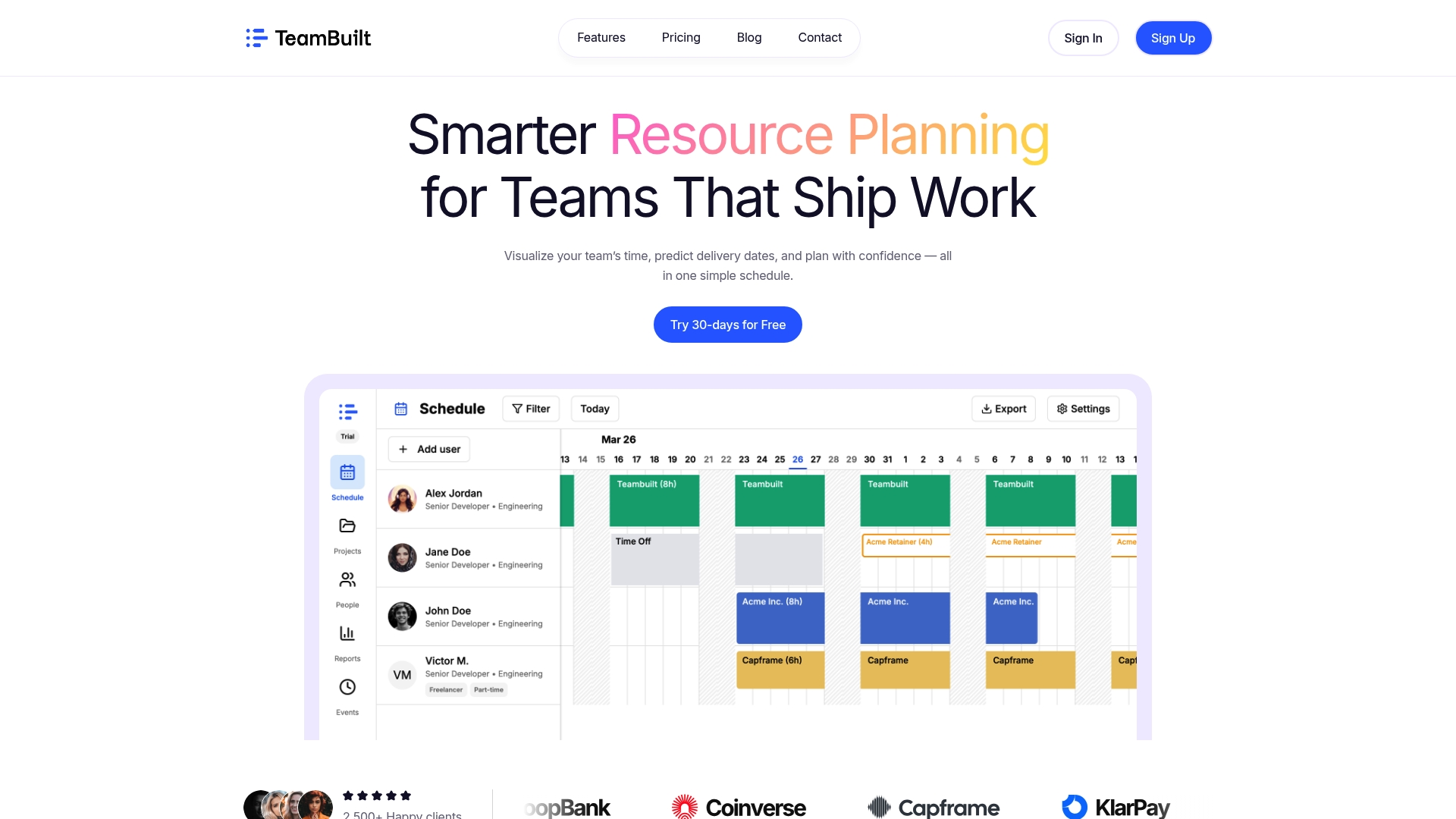
TeamBuilt is built specifically for the challenges covered here. The TeamBuilt platform gives project managers and operations leads real-time visibility into team capacity, workload distribution, and project timelines in a single centralized workspace. From dependency tracking to cross-team scheduling, the team coordination features replace the spreadsheets and disconnected tools that slow growing teams down. If you’re ready to put these coordination principles into practice with infrastructure that keeps pace with your team, TeamBuilt is the logical next step.
Frequently asked questions
What’s the most common cause of blocked work between teams?
Unmapped dependencies and unclear ownership are the top reasons work stalls during handoffs. Research confirms that unmanaged dependencies block 20% or more of active work in teams without explicit ownership matrices.
How do you measure effective team coordination beyond deadlines?
Track cycle time, team satisfaction, work in progress, velocity, and throughput for a full coordination health picture. These five metrics together give you both leading and lagging indicators of coordination quality.
When should a startup formalize its coordination processes?
Introduce clear rituals when coordination overhead nears 20% of total team effort, because beyond that point the cost of informal coordination exceeds the cost of building proper structure.
Can Agile coordination methods boost business performance?
Yes, organizations applying Agile coordination practices have seen revenue gains of 60% and productivity improvements of 25% compared to teams without structured coordination methods.
Recommended