
Centralized team management: streamline resources, boost predictability


TL;DR:
- Centralized team management consolidates decision-making and resource allocation for better oversight and predictability.
- It offers efficiency and scalability but may cause bottlenecks if overused or poorly balanced with local input.
- Successful implementation relies on standard processes, automation tools, and deliberate balancing of central control and team autonomy.
Centralized team management gets a bad reputation. Many project managers assume it means slow approvals, rigid hierarchies, and frustrated teams waiting on a single decision-maker. That assumption misses the real opportunity. When applied thoughtfully, centralized management gives SMBs something genuinely rare: consistent resource allocation, predictable delivery timelines, and a clear chain of accountability. This guide covers what centralized team management actually means, how it works operationally, where it shines and where it struggles, and the practical steps to make it work for your organization without sacrificing the agility your team depends on.
Table of Contents
- Defining centralized team management: What it really means
- How centralized team management works in practice
- Benefits and challenges of centralized team management
- Best practices and common pitfalls: Making centralized management work
- Real-world application: Examples and success factors for SMBs
- A realistic perspective: Balancing centralization and agility in SMBs
- Enable smarter centralized management with TeamBuilt
- Frequently asked questions
Key Takeaways
| Point | Details |
|---|---|
| Centralized management defined | It concentrates authority, resource allocation, and oversight at a central level for efficiency and predictability. |
| Pros and cons | Centralization boosts consistency and resource use but can cause bottlenecks if not balanced. |
| Hybrid solutions work | Combine central planning with local empowerment to reduce drawbacks as your business grows. |
| Practical rollout | Start simple, set clear roles, and employ smart tools to prevent centralization from slowing progress. |
| Adapt for scale | When complexity or geography increases, adapt your structure with hybrid or decentralized practices. |
Defining centralized team management: What it really means
Centralization in team management is not about micromanagement. It is a structural model where authority, resource decisions, and oversight flow through a single coordinating function rather than being scattered across individual teams or departments.
Centralized team management concentrates decision-making, resource allocation, and oversight at a central level instead of distributing across multiple teams.
This model has roots in classical organizational theory, but it remains highly relevant for modern SMBs. When your company is growing fast and resources are limited, having one team or leader own the planning process eliminates duplication, reduces conflicting priorities, and creates a single source of truth for workload and capacity.
Here is what distinguishes centralized management from other models:
- Decision-making authority sits with a central function, not individual team leads
- Resource allocation is coordinated across all projects from one vantage point
- Oversight means one team can see the full picture of capacity, risk, and delivery status
- Standardization applies consistent processes across teams and projects
For SMBs and startups, this matters because fragmented planning creates invisible bottlenecks. When each team manages its own resources independently, you end up with one team overloaded while another sits idle. Centralized oversight solves that. It also supports real-time collaboration by giving everyone a shared view of who is working on what.
The model also supports scalable project workflows as your organization grows. You can add teams and projects without losing visibility, because the central function scales with you rather than fragmenting into silos.
How centralized team management works in practice
Knowing the definition is one thing. Seeing how it actually runs day-to-day is where the model becomes tangible.
A single central team typically sets strategy, owns budgets and platforms, and executes activities based on standardized policies and a clear chain of command. In practice, this means one operations lead or project management office (PMO) owns the master schedule, approves resource assignments, and monitors delivery across all active projects.
| Role | Responsibility |
|---|---|
| Operations lead / PMO | Owns master resource plan and delivery calendar |
| Project manager | Executes within assigned resources and timelines |
| Team lead | Coordinates task-level work within the project scope |
| Individual contributor | Delivers assigned tasks, flags blockers to team lead |
Here is how a typical project flows through a centralized model:
- Request intake: A new project request enters through a standardized intake process
- Capacity check: The central team reviews current workload and available capacity
- Resource assignment: Team members are allocated based on skills, availability, and priority
- Kickoff and execution: The project manager runs the project within the assigned resources
- Progress tracking: The central team monitors milestones and flags risks in real time
- Delivery and review: Outcomes are reviewed centrally to inform future planning
Pro Tip: Automate your intake and status reporting steps using centralized planning tools. When recurring workflows run automatically, your operations team spends less time chasing updates and more time solving real problems. Pair this with solid resource planning features to keep capacity data accurate without manual effort.
Benefits and challenges of centralized team management
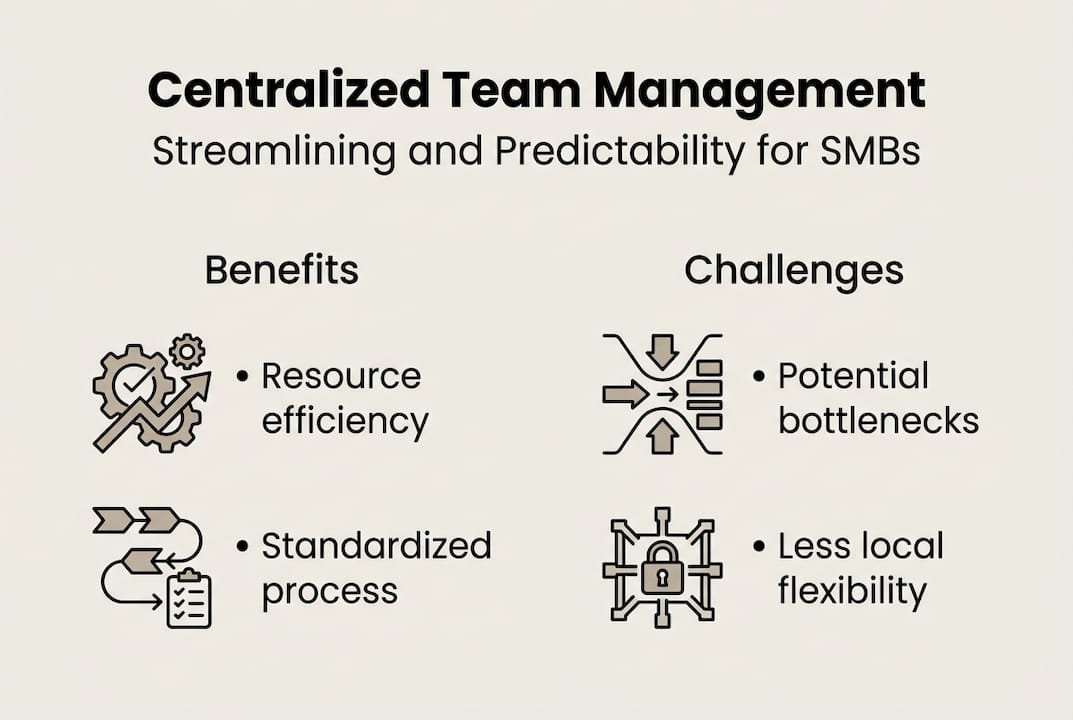
Centralized management creates real advantages for SMBs, but it also introduces risks if you apply it without care.
The core benefits:
- Efficiency: One team owns resource decisions, so there is no duplication of planning effort
- Consistent processes: Every project follows the same intake, tracking, and review steps
- Easier oversight: Leadership has a single dashboard view of all projects and capacity
- Scalable resource pool: Adding new projects does not require rebuilding planning processes from scratch
- Delivery predictability: Centralized forecasting reduces surprise delays and resource conflicts
These advantages directly support SMB team growth because you can take on more work without proportionally increasing coordination overhead.
The real challenges:
Centralized management creates efficiency and predictability, but can cause bottlenecks if not carefully balanced with local input. The central team becomes a single point of failure if it is understaffed or slow to respond. Local teams may feel disempowered if they have no voice in decisions that affect their daily work.

| Model | Control | Flexibility | Best for |
|---|---|---|---|
| Centralized | High | Low | Early-stage SMBs, resource-constrained teams |
| Decentralized | Low | High | Large orgs with distinct regional needs |
| Hybrid | Medium | Medium | Growing SMBs balancing scale and agility |
Centralized management shines when you need project timeline management precision and your teams are small enough that one central function can realistically oversee everything. Once your team grows past roughly 50 people or spans multiple time zones, pure centralization starts to strain. That is when hybrid models become worth exploring.
Best practices and common pitfalls: Making centralized management work
Having the right model is only half the equation. Execution determines whether centralized management becomes a competitive advantage or a source of frustration.
Here is a practical rollout sequence:
- Audit your current state: Map where resource decisions are made today and identify gaps or conflicts
- Define the central function: Assign clear ownership to one person or team for resource planning and oversight
- Standardize intake and reporting: Create consistent templates for project requests, status updates, and capacity reviews
- Invest in the right tools: Use SaaS for team workflows that give your central team real-time visibility without requiring manual data entry
- Build feedback loops: Give local teams a structured way to flag issues and share context with the central function
- Review and adjust regularly: Treat your centralized model as a living system, not a fixed structure
The most common mistakes are over-centralizing (routing every minor decision through the central team), ignoring local context (applying uniform rules to teams with genuinely different needs), and unclear communication lines (teams unsure who to escalate to when problems arise).
Expert guidance is to start centralized for simplicity, then distribute decision-making only as local scale or geographic spread demands. This is sound advice. Build your central function first, then deliberately push autonomy outward as your organization earns the complexity.
Pro Tip: Use team capacity planning data to identify which decisions genuinely need central oversight and which can safely move to team leads. Combine this with workflow automation examples to reduce manual coordination load on your central team.
Real-world application: Examples and success factors for SMBs
Theory is useful. Concrete scenarios are better. Here is where centralized management consistently delivers strong results for SMBs:
- A 20-person product agency uses a central PMO to assign developers and designers across six concurrent client projects. Without centralized visibility, two developers were double-booked every sprint. Centralized scheduling eliminated the conflict.
- A SaaS startup scaling from 15 to 40 people centralizes resource allocation during its growth phase to prevent ad-hoc hiring decisions from creating capacity gaps on critical product launches.
- A professional services firm with three service lines uses a central operations lead to balance utilization across teams, ensuring no single line is consistently over capacity while another runs light.
Centralized management works best when an organization needs simple, efficient coordination and only becomes unwieldy with high local complexity. Watch for these warning signs that pure centralization is becoming a constraint:
- Decision queues are backing up and project starts are delayed
- Local teams are building shadow processes to work around central bottlenecks
- Customer-facing teams cannot respond quickly to unique client needs
- Your central team is spending more time on administration than strategy
Pro Tip: Use analytics from your centralized management tools to track decision cycle times and resource utilization variance. When these metrics start deteriorating, that is your signal to consider pushing some decisions closer to the teams doing the work.
A realistic perspective: Balancing centralization and agility in SMBs
Here is something most management frameworks will not tell you directly: the debate between centralized and decentralized management is mostly a false choice for SMBs.
The organizations we see thrive are not the ones that pick a model and commit to it permanently. They are the ones that treat structure as a dial, not a switch. You start centralized because it is simpler, faster to implement, and gives you the visibility you need when resources are tight. Then you deliberately and gradually push autonomy outward as your teams prove they can handle it.
The real failure mode is not choosing the wrong model. It is treating your current model as permanent. Over-centralization kills speed and morale. But premature decentralization creates chaos in organizations that do not yet have the systems to support it.
Transparency is what keeps centralized models from becoming rigid. When your teams can see the same capacity data and project priorities that your central function uses, they stop feeling controlled and start feeling aligned. That shift from compliance to alignment is what separates functional centralization from dysfunctional bureaucracy. Tools that support collaborative team structures make this transparency practical rather than aspirational.
Enable smarter centralized management with TeamBuilt
If you are ready to move beyond spreadsheets and scattered planning tools, the right platform makes centralized management genuinely sustainable.
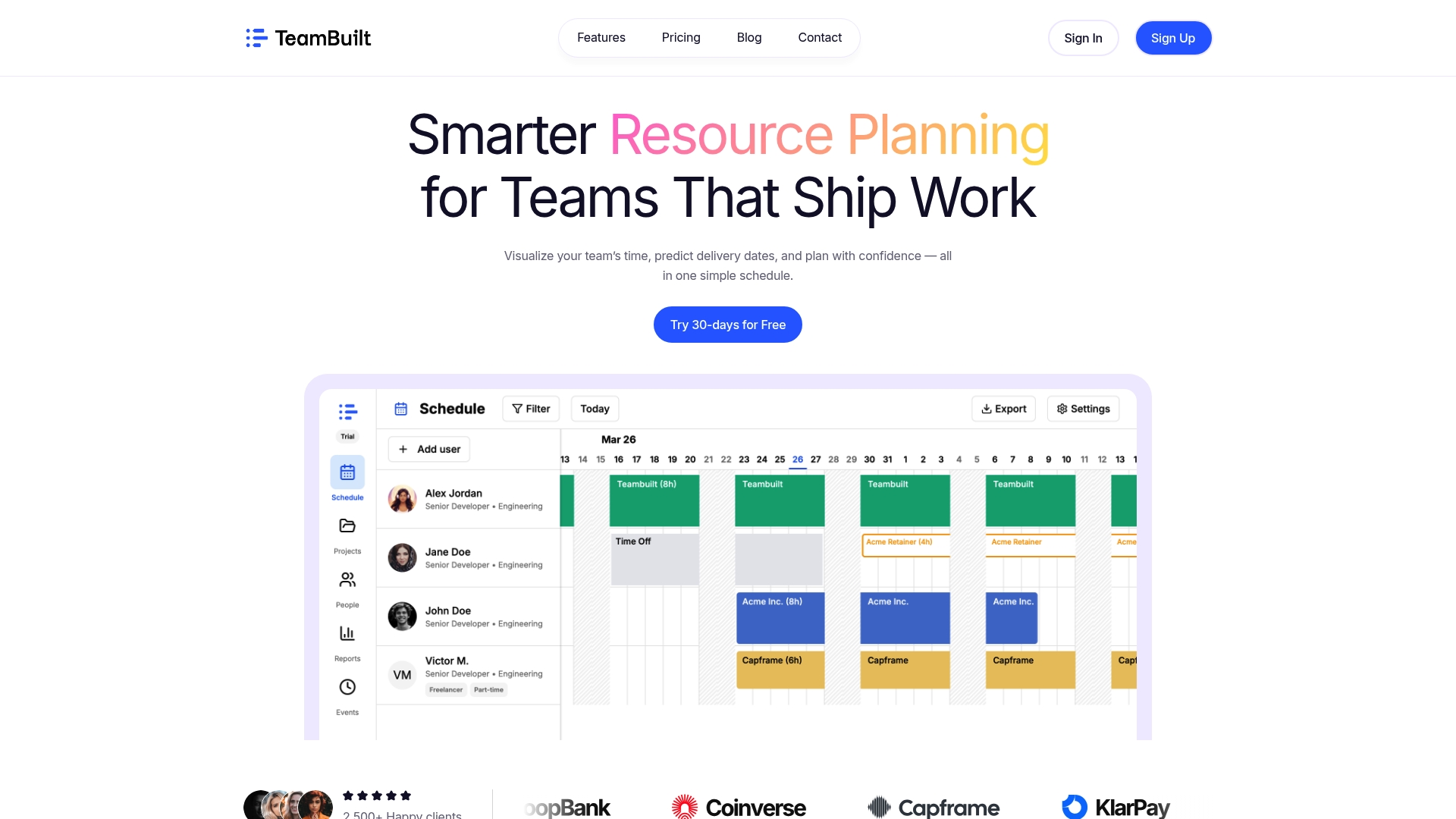
TeamBuilt is built for exactly this challenge. The platform gives your operations team real-time visibility into team capacity, workload distribution, and project delivery forecasts, all from a single centralized view. You can manage resource assignments, track utilization, and coordinate across multiple teams without losing the flexibility your projects demand. Whether you are running a pure centralized model or transitioning toward a hybrid approach, TeamBuilt’s centralized management features adapt to your structure. Explore the full platform at teambuilt.app and see how smarter resource planning translates directly into better delivery outcomes.
Frequently asked questions
When is centralized team management most effective for startups or SMBs?
It is most effective when you need resource efficiency, clear oversight, and standardized processes, especially in early growth stages or when managing distributed teams. Centralized management is ideal for resource-sensitive organizations needing oversight and consistency.
What are the biggest drawbacks of centralizing team management?
Potential drawbacks include bottlenecks, slower local response, and risk of stifling innovation if local autonomy is ignored. Over-centralization risks creating bottlenecks and reducing flexibility across the organization.
How does centralized management compare to hybrid models for growing SMBs?
Hybrid models blend the control of centralization with local empowerment to prevent bottlenecks as organizations scale and diversify. Centrally coordinated hybrids can avoid the pitfalls of pure centralization while preserving strategic oversight.
What tools help streamline centralized management for project teams?
Modern resource planning platforms and workflow automation tools simplify centralized oversight and communication, replacing manual tracking with real-time dashboards your entire team can access.
How can I tell if our SMB should decentralize part of our team management?
If decision-making slows, local teams lack responsiveness, or unique customer needs emerge, it may be time to decentralize some functions. Distribute decision-making only as local scale or complexity genuinely demands it.
Recommended