
Dynamic Team Environments: Optimize Collaboration & Resources

TL;DR:
- Dynamic teams are fluid, forming, evolving, and dissolving based on project needs.
- Successful implementation relies on psychological safety, shared documentation, and real-time visibility.
- Carefully planned splits and capacity reviews prevent burnout and improve team adaptability.
Most project managers assume that stable, fixed teams produce the most reliable results. The data says otherwise. Agile dynamic teaming can boost developer output by up to 250% in high-performing organizations, a number that should make any team leader rethink how they structure their workforce. This guide breaks down what dynamic team environments actually are, how they work in practice, and what separates teams that thrive from those that burn out. If you manage resources across multiple projects or coordinate work between departments, you’ll find specific frameworks, metrics, and tactics here that you can apply immediately.
Table of Contents
- Defining dynamic team environments
- Mechanics and frameworks: How dynamic teams operate
- Culture, leadership, and collaboration essentials
- When dynamic teams succeed—and fail
- The overlooked truths about dynamic teaming
- Unlock dynamic team potential with Teambuilt
- Frequently asked questions
Key Takeaways
| Point | Details |
|---|---|
| Fluid team structure | Dynamic team environments adapt membership and roles to project needs, boosting responsiveness. |
| Collaboration frameworks | Agile, Team Topologies, and digital tools make dynamic teams measurable and scalable. |
| Cultural essentials | Diversity, psychological safety, and inclusive leadership drive successful dynamic teaming. |
| Risk management | Leaders must guard against burnout and coordination overload using boundaries and participatory change. |
| Metrics over output | Cycle time and team health matter more than individual productivity scores in dynamic contexts. |
Defining dynamic team environments
A dynamic team environment refers to a structure where membership is fluid, roles adapt to project needs, and teams form, evolve, and dissolve based on what the work demands. This is fundamentally different from a static team, where the same people hold the same roles indefinitely, regardless of what the project actually requires.
In a static setup, you might have a backend engineer assigned to a product team for years, even when the project pivots to a mobile-first strategy and needs frontend expertise. In a dynamic environment, that engineer moves where the need is greatest, and someone with mobile skills steps in. The team reshapes itself around the work, not the org chart.
This shift matters because modern organizations rarely run one project at a time. Scaling startups and SMBs typically juggle multiple workstreams, client deliverables, and internal initiatives simultaneously. A rigid structure creates bottlenecks. A fluid one creates options.
Here are the core features that define a dynamic team environment:
- Fluid membership: People join and leave teams based on project phase and skill requirements
- Adaptive roles: Responsibilities shift as the project evolves, not when HR approves a title change
- Distributed leadership: Leadership rotates to whoever has the most relevant expertise for the current challenge
- Skill mapping: The organization maintains a clear picture of who can do what, so matching expertise to tasks is fast
- Project-based accountability: Success is measured at the project level, not just by individual performance reviews
- Cross-functional collaboration: Teams regularly include members from different departments working toward a shared outcome
The contrast with static teams becomes clearest when you look at how each handles change:
| Dimension | Static teams | Dynamic teams |
|---|---|---|
| Membership | Fixed, long-term | Fluid, project-based |
| Roles | Defined by job title | Defined by project need |
| Leadership | Hierarchical, top-down | Distributed, expertise-led |
| Response to change | Slow, requires restructuring | Fast, built into the model |
| Knowledge sharing | Siloed within team | Flows across the organization |
| Risk of bottlenecks | High | Lower with proper coordination |
“Dynamic teams are not just a structural choice. They represent a fundamentally different relationship between people, work, and organizational identity.”
For project managers, this distinction is not academic. It determines how you plan capacity, assign work, and forecast delivery. Understanding the model is step one. Knowing how to run it is what comes next.
Mechanics and frameworks: How dynamic teams operate
Knowing what a dynamic team environment is gets you started. Knowing how to run one is where most organizations struggle. The key mechanics include skill mapping, fluid leadership, project-based roles, and structured processes for matching expertise to tasks at the right moment.
Here is a practical sequence for dynamic resource allocation:
- Build a skills registry. Document every team member’s capabilities, not just their job title. Include soft skills, domain knowledge, and tool proficiency.
- Define project skill requirements early. Before kickoff, list the competencies the project needs at each phase.
- Match people to phases, not projects. Assign individuals to the phases where their skills are most needed, then release them when the phase ends.
- Establish handoff protocols. Document context and decisions so incoming team members can ramp up without losing momentum.
- Track utilization in real time. Use a platform that shows who is at capacity and who has bandwidth before you make assignment decisions.
- Run retrospectives at team transitions. Capture what worked and what did not before the team configuration changes.
On the methodology side, several frameworks support dynamic teaming well. Amy Edmondson’s dynamic teaming model focuses on psychological safety and rapid team formation. Team Topologies provides a language for defining team types and interaction modes. Hybrid Agile-Waterfall approaches work well when some parts of a project need flexibility while others require fixed milestones. Adapted Scrum and Kanban give teams visual, real-time coordination without heavy ceremony.
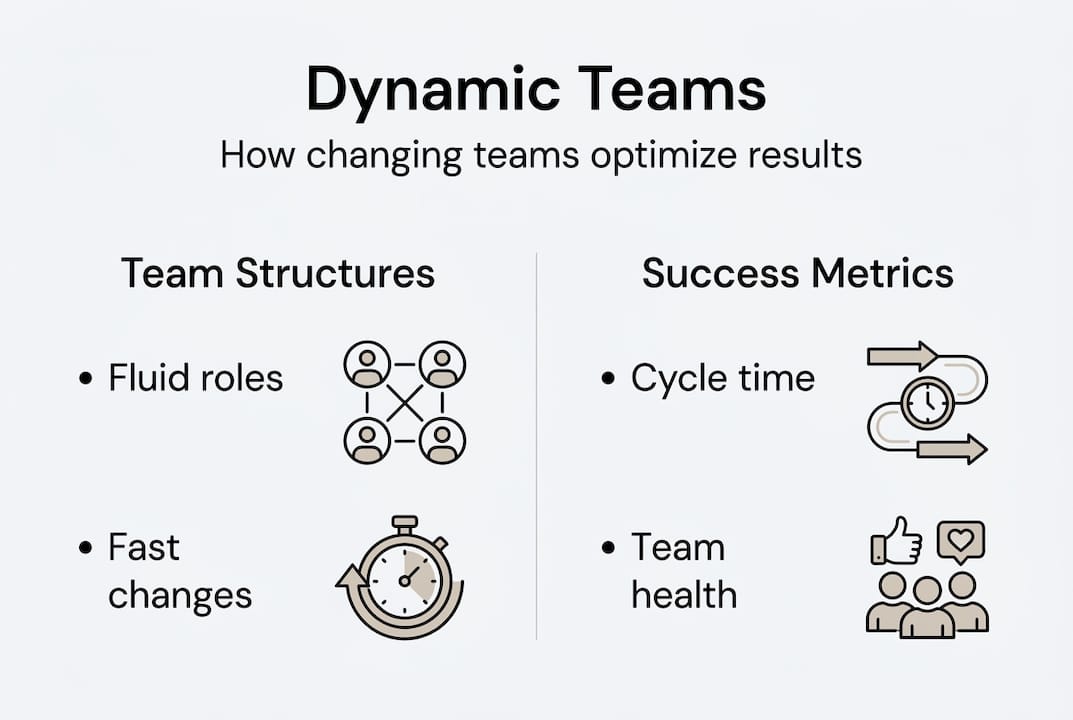
For teams using real-time collaboration tools, the transition to dynamic structures becomes significantly smoother. Pair that with workflow automation and you reduce the manual overhead that slows down team transitions.
When it comes to measuring performance, dynamic teams need different metrics than traditional ones:
| Metric | What it measures | Why it matters |
|---|---|---|
| Cycle time | Time from task start to completion | Reveals flow efficiency across team changes |
| MTTM (mean time to merge) | Speed of code review and integration | Signals collaboration health in engineering teams |
| Team health score | Morale, clarity, and psychological safety | Predicts burnout and retention risk |
| Utilization rate | Percentage of capacity actively used | Prevents both overload and underuse |
Pro Tip: Replace individual productivity KPIs with flow metrics like cycle time and MTTM. Individual output scores create competition; flow metrics create collaboration. Explore project management tools that surface these metrics automatically.
Culture, leadership, and collaboration essentials
You can have the right frameworks and still watch a dynamic team fall apart. The reason is almost always cultural. Diversity of backgrounds, psychological safety, and inclusive leadership are not soft extras. They are load-bearing pillars of any dynamic team structure.

Psychological safety, the belief that you can speak up without punishment, is especially critical in fluid teams. When team membership changes frequently, people need to trust the environment before they trust the people. Without it, team members default to silence, which kills the information flow that dynamic teams depend on.
Inclusive leadership means actively creating space for different voices, especially when the team composition shifts. A rotating cast of contributors only works if each person feels genuinely heard. Leaders who default to top-down decision-making will find that dynamic structures collapse back into informal hierarchies.
Behaviors that make dynamic teaming work in practice:
- Model vulnerability first. Leaders who admit uncertainty give others permission to do the same.
- Make decisions transparent. Document the reasoning behind key choices so new team members can get up to speed without interrogating everyone.
- Rotate facilitation. Let different team members lead stand-ups and retrospectives. It builds ownership and surfaces new perspectives.
- Celebrate transitions. Acknowledge when someone leaves a team and when someone joins. It reinforces that movement is normal, not a signal of failure.
- Invest in shared context. Use shared documentation and visual boards so no one is ever starting from zero.
Cross-functional collaboration also requires deliberate structure. Daily stand-ups keep alignment tight. Shared documentation prevents knowledge from getting trapped in individual heads. Kanban boards give everyone visibility into what is moving and what is blocked. These are not optional rituals. They are the connective tissue of a dynamic team.
“Psychological safety is not a culture initiative. It is an operational requirement for any team that changes composition regularly.”
For project managers, timeline management becomes more complex in dynamic environments. Build buffer into transition periods and treat onboarding new team members as a project task, not an afterthought.
Pro Tip: Before any major team restructure, run a participatory change session where affected team members help design the new configuration. Teams that shape their own structure adapt to it faster.
When dynamic teams succeed—and fail
Dynamic teams are not universally better. They perform best under specific conditions and struggle badly when those conditions are missing. Understanding both sides helps you decide when to use this model and when to protect your team from it.
Dynamic teams succeed when:
- Projects have clearly defined phases with distinct skill requirements
- The organization has a reliable skills registry and resource visibility
- Leadership actively maintains psychological safety through transitions
- Teams are kept small, typically under ten people per configuration
- Domain boundaries are clear enough that handoffs do not create confusion
They struggle when:
- Cognitive load from constant change accumulates faster than teams can process it, leading to burnout
- Short-lived teams skip the forming and norming stages, creating friction that never resolves
- Legacy systems create domain overlaps where no one is sure who owns what
- The pace of change outstrips the organization’s ability to maintain context
Common risks and how to address them:
- Burnout from constant flux: Set explicit rotation limits and protect recovery time between high-intensity assignments
- Coordination overhead: Use centralized planning tools to reduce the meeting load required to stay aligned
- Domain overlap: Run regular domain analysis sessions to clarify ownership before conflicts arise
- Knowledge loss at transitions: Require structured handoff documentation as a non-negotiable step
- Unclear accountability: Assign a single point of contact for each project phase, even if the team is shared
The reteaming case study from Pirate Ship illustrates how evolutionary splits, breaking one team into two as complexity grows, can prevent the burnout and coordination overhead that come from trying to scale a single team indefinitely. The key is doing it before the team hits its limit, not after.
Pro Tip: Schedule a capacity review every six weeks. If any team member is consistently above 85% utilization, that is your signal to plan a split or reduce scope. Use scheduling workflow tools and capacity planning strategies to make this a routine check, not a crisis response.
The overlooked truths about dynamic teaming
Most guides on dynamic teaming focus on the mechanics: frameworks, tools, ceremonies. What they miss is that the cultural infrastructure matters more than any methodology. You can run perfect Scrum ceremonies with a team that lacks psychological safety and still deliver late, over budget, and with high turnover.
The organizations that scale dynamic teaming successfully treat the cultural work as seriously as the technical work. They invest in inclusive leadership training before they restructure teams. They measure team health with the same rigor they apply to cycle time. They treat retrospectives as strategic tools, not compliance checkboxes.
Another underappreciated truth: hybrid project management often outperforms pure agile in dynamic environments. Some workstreams need the flexibility of Kanban. Others need the predictability of fixed milestones. Forcing everything into one methodology to keep things simple usually makes things harder.
Finally, evolutionary splits are one of the most powerful and least used tools available to team leaders. Most organizations wait until a team is overwhelmed before splitting it. The smarter move is to use scalable success workflows and domain analysis to plan splits proactively, before the cognitive load becomes a crisis.
Unlock dynamic team potential with Teambuilt
Putting dynamic teaming into practice requires more than good intentions. It requires real-time visibility into who is available, what skills they bring, and where capacity is tightest across your organization.
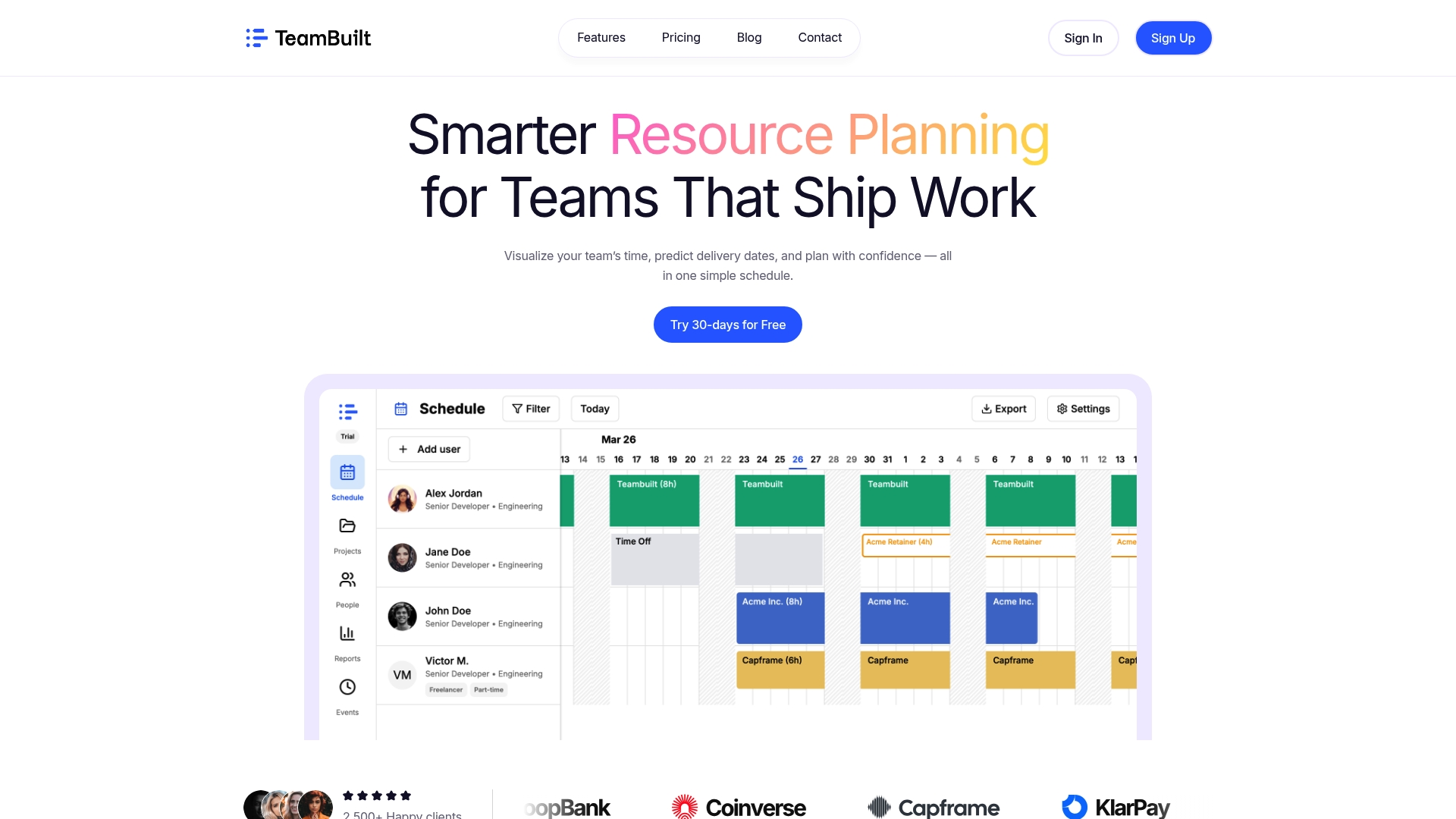
TeamBuilt’s resource planning features are built specifically for the kind of fluid, multi-team environments this article describes. You get real-time scheduling, workload visualization, and delivery forecasting that adapts as your team configurations change. No more spreadsheets, no more guessing. The TeamBuilt platform gives project managers and operations leads the centralized visibility they need to make faster, smarter resource decisions across every project and every team.
Frequently asked questions
How do dynamic team environments differ from static teams?
Dynamic teams form, adapt, and dissolve based on project demands, while static teams maintain fixed membership and responsibilities regardless of what the work requires.
What tools support dynamic team environments?
Daily stand-ups, shared documentation, and Kanban boards are foundational, and real-time resource planning platforms help teams coordinate flexible assignments at scale.
How do project managers measure dynamic team success?
Cycle time and MTTM are more reliable indicators of team health than individual output metrics, because they reflect how well the whole system is flowing.
What are common risks in dynamic teams?
High cognitive load, coordination overhead, and burnout are the most frequent failure points, and all three can be managed with clear domain boundaries, utilization tracking, and planned evolutionary splits.
Recommended