
Master multi-team management: methods, pitfalls, pro tips

TL;DR:
- Effective multi-team management relies on reducing coordination overhead and increasing visibility.
- Lean strategies like dependency mapping and shared backlogs improve coordination for SMBs.
- A focus on clarity and autonomy often outperforms complex processes in growing organizations.
Most project managers assume that adding more structure fixes coordination problems. More standups, more status reports, more process layers. But highly engaged teams with larger spans of control often outperform tightly managed ones, which means the instinct to add more oversight can actively slow you down. For startups and SMBs juggling two, five, or ten teams at once, the real challenge is not finding the perfect framework. It is knowing which coordination habits to drop. This article walks through how multi-team management actually works, which frameworks fit growing organizations, and the lean strategies that deliver results without drowning your teams in meetings.
Table of Contents
- What is multi-team management?
- Popular frameworks for multi-team coordination
- Challenges and pitfalls in multi-team management
- Lean strategies and practical tools for SMBs
- Benchmarks and success signals: How to know it’s working
- Why most SMBs overcomplicate multi-team management (and what actually works)
- Upgrade your multi-team management with TeamBuilt
- Frequently asked questions
Key Takeaways
| Point | Details |
|---|---|
| Lean beats complex process | Lightweight, async-driven coordination outperforms heavy meetings for growing teams. |
| Frameworks are tools, not crutches | Choose and blend approaches like SAFe, Scrum, or lean planning based on actual needs, not buzzwords. |
| Benchmarks guide success | Track team engagement, span of control, and delivery rates to judge management efforts. |
| Avoid common pitfalls | Watch out for meeting bloat, unclear roles, and untracked dependencies early. |
| Tools amplify results | Right resource management and scheduling tools make lean multi-team management easier. |
What is multi-team management?
Multi-team management (MTM) is the practice of coordinating two or more teams that share goals, resources, or deliverables. It is not just a bigger version of single-team leadership. It requires a fundamentally different approach to communication, prioritization, and accountability.
For most startups and SMBs, MTM kicks in at a predictable set of triggers:
- Scaling headcount beyond what one team can absorb
- Cross-functional delivery where design, engineering, and marketing must ship together
- New product launches requiring parallel workstreams
- Acquisitions or mergers that fold in entirely separate team cultures
The startup context makes this harder than it looks. Resources are constrained, roles overlap constantly, and the rate of change is high. A developer might sit on two squads. A project manager might own deliverables across three product lines. This is where multiple team membership gets complicated. Research shows MTM can both help and hinder performance depending on context, because shared members bring cross-team knowledge but also split focus and competing loyalties.
Span of control matters here too. The US average manager span is 12.1 direct reports in 2025, though the median sits closer to 5 to 6. In multi-team environments, that gap reveals something important. Managers with broader spans can succeed, but only when teams have the autonomy, clarity, and tools to self-organize effectively.
For growing organizations, the goal of MTM is not perfect control. It is structured enough to stay aligned, lean enough to move fast. Exploring team workflow examples from similar-sized companies can help you benchmark what that balance looks like in practice.
Popular frameworks for multi-team coordination
Once you understand what MTM involves, the next question is structure. Several frameworks exist to help organizations coordinate across teams, and each comes with tradeoffs.
Key methodologies include the Scaled Agile Framework (SAFe), which uses PI Planning to align multiple teams on quarterly goals, and Multi-Team Scrum, where several teams share a single Product Owner and backlog. Nexus adds a coordination layer on top of Scrum without the full SAFe overhead. Big Room Planning, a technique proven across multi-team planning contexts, brings all teams into one session to map dependencies and set priorities together.
| Framework | Meeting cadence | Team structure | Best for |
|---|---|---|---|
| SAFe | PI Planning every 8-12 weeks | Multiple ARTs with shared roadmap | Enterprises with 50+ people |
| Multi-Team Scrum | Shared sprint cadence | One PO, multiple dev teams | Product-focused SMBs |
| Nexus | Weekly integration sync | Scrum teams plus Nexus team | 3-9 teams on one product |
| Big Room Planning | Quarterly or monthly | All teams in one session | Cross-functional alignment |
Here is the honest truth most articles skip: SAFe is overkill for most SMBs. The ceremony load alone can consume more time than it saves. For organizations with fewer than 50 people across teams, leaner alternatives work better.
“The best coordination system is the one your teams will actually use consistently, not the one with the most impressive diagram.”
For project workflows for agencies and fast-moving product teams, the winning approach is usually a stripped-down blend. Think shared backlogs, lightweight dependency reviews, and async documentation over heavy ceremony. The goal is to reduce coordination drag, not formalize it into a calendar.
Teams in dynamic team environments often benefit from mixing Big Room Planning for quarterly alignment with a simple weekly async update to surface blockers between sessions.
Challenges and pitfalls in multi-team management
Knowing your frameworks is not enough. The traps in multi-team management are predictable, and most organizations fall into at least two of them.
The process monster problem. Too much coordination creates its own dysfunction. When every cross-team interaction requires a meeting, a ticket, and a status update, teams spend more time reporting on work than doing it. Async updates, shared dashboards, and clear ownership boundaries cut this overhead significantly.
Common pitfalls to watch for:
- Dependency tangles: Team A cannot ship until Team B finishes, but nobody mapped that connection upfront
- Unclear authority: Two team leads both think they own a decision, so neither makes it
- Meeting overload: Daily syncs across five teams can consume 30 to 40 percent of a manager’s week
- Engagement erosion: When people feel like coordination is their job instead of their actual work, motivation drops fast
The polycrisis effect. When overlapping crises hit, conflicting loyalties and unclear decision authority amplify every existing problem. A product delay collides with a hiring freeze collides with a client escalation. Without clear escalation paths and pre-agreed priority rules, multi-team systems lock up.
Multiple team membership adds another layer. People split across teams often feel accountable to everyone and empowered by no one. That is a recipe for burnout and slow delivery.

Pro Tip: Use a visual dependency map updated weekly. Even a simple shared spreadsheet showing which team is blocked by whom reduces surprise escalations by giving everyone the same picture at the same time. Pair this with real-time team coordination tips to keep async updates structured and actionable.
Lean strategies and practical tools for SMBs
Now for the part that actually moves the needle. For startups and SMBs, the answer to multi-team chaos is almost never more process. It is smarter, lighter coordination.
Async documentation, team APIs, and dependency reduction should come before you scale any formal process. A team API is simply a documented interface: here is what our team owns, here is how to request work from us, here is our response time. It eliminates the informal back-channels that slow everything down.
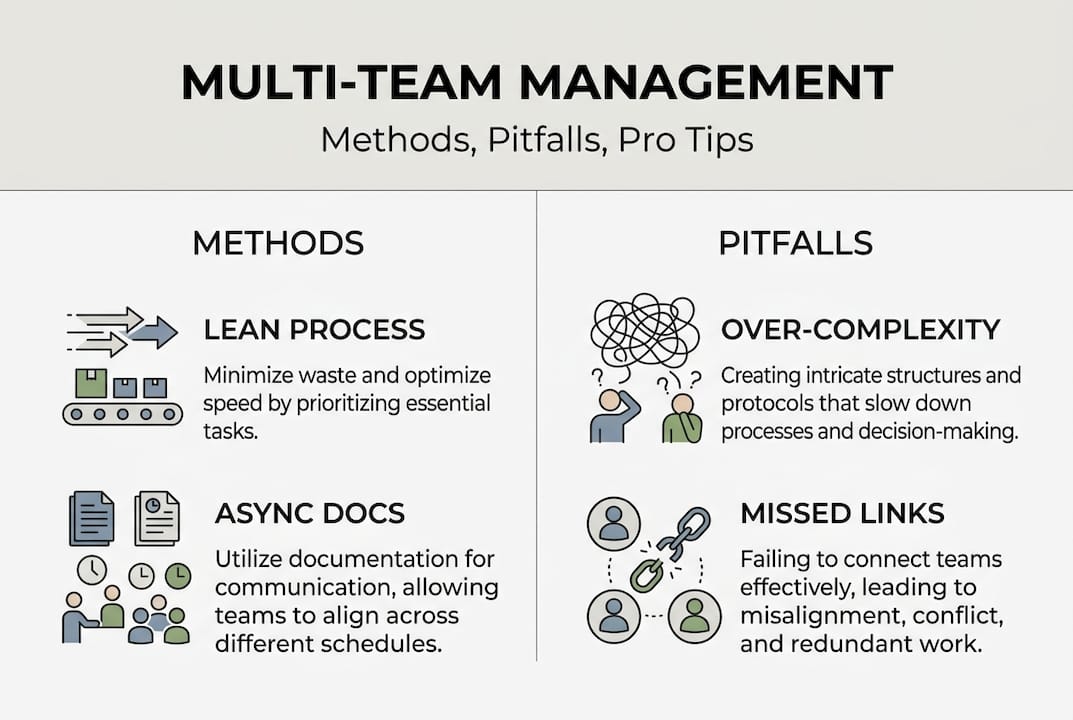
Explicit dependency visualization prevents integration debt, which is the hidden cost of teams building in parallel without knowing they will conflict at the merge point.
Here is a five-step lean rollout for SMBs:
- Map your dependencies before adding any new coordination layer
- Create team APIs so every team knows how to interact with every other
- Consolidate to a single backlog or shared priority list visible to all stakeholders
- Replace recurring status meetings with async written updates on a shared board
- Run a monthly dependency review to catch integration risks before they become blockers
| Tool type | Example use | Coordination benefit |
|---|---|---|
| Dependency map | Visual board showing team blockers | Prevents surprise delays |
| Shared backlog | Single prioritized list | Reduces conflicting priorities |
| Async update board | Weekly written status per team | Cuts meeting load by 30 to 50% |
| Resource planner | Capacity view across teams | Surfaces overallocation early |
Pro Tip: Before adopting any new tool, ask whether it reduces the number of conversations needed or just moves them to a different platform. The best tools make coordination invisible. Team scheduling steps and a solid real-time collaboration guide can help you build this foundation without overengineering it. For scaling teams, multi-team planning practices offer additional lightweight techniques worth borrowing.
Benchmarks and success signals: How to know it’s working
Implementing strategies is one thing. Knowing whether they are working is another. Empirical benchmarks give you a reality check that gut feel cannot.
Highly engaged teams consistently deliver better outcomes even at larger spans of control, which means engagement scores are a leading indicator, not just an HR metric. Track them quarterly.
| Metric | Healthy range | Warning signal |
|---|---|---|
| Manager span of control | 5 to 12 direct reports | Over 15 without strong autonomy tools |
| Team size | 5 to 9 members | Under 4 or over 12 |
| Engagement score | 70 to 85% favorable | Below 60% |
| Deployment frequency | Weekly or faster | Less than monthly |
| Meeting time per week | Under 20% of capacity | Over 35% |
Health signals to monitor beyond the table:
- Dependency resolution time: How long does it take to unblock a team once a blocker is flagged?
- Cross-team delivery predictability: Are joint deadlines hit more than 70 percent of the time?
- Escalation frequency: Are the same conflicts surfacing repeatedly?
- Voluntary attrition on shared-member roles: People split across teams who leave often signal MTM overload
When metrics reveal trouble, the fix is almost always structural, not motivational. Reduce the number of teams a person belongs to, clarify ownership, or cut a meeting. Project timeline management tools that surface capacity and delivery forecasts make it easier to spot these signals before they become crises.
Why most SMBs overcomplicate multi-team management (and what actually works)
Here is something most frameworks will not tell you: the organizations that manage multiple teams best are not the ones with the most sophisticated processes. They are the ones that have ruthlessly eliminated coordination overhead.
The conventional wisdom is that growth requires more structure. So SMBs add PI Planning, then a coordination team, then a steering committee. Before long, the coordination layer has its own coordination problem. We have seen this pattern repeat across real SMB multi-team coordination results, and it almost always traces back to the same mistake: treating coordination as a sign of maturity rather than a cost to minimize.
What actually works is autonomy backed by visibility. Teams that know their priorities, understand their dependencies, and can see each other’s capacity in real time do not need weekly syncs to stay aligned. They self-correct. The manager’s job shifts from traffic cop to obstacle remover.
The right project management tools matter here, but only if they reduce friction rather than add it. A tool that requires five minutes of data entry per update will be abandoned. A tool that surfaces the right information at the right moment becomes infrastructure.
The uncomfortable truth is that most multi-team problems are not coordination problems. They are clarity problems. Fix the clarity, and coordination often takes care of itself.
Upgrade your multi-team management with TeamBuilt
The lean strategies covered in this article only work when you have real-time visibility into who is doing what, where capacity is tight, and which dependencies are at risk. Spreadsheets and scattered tools cannot give you that picture reliably.
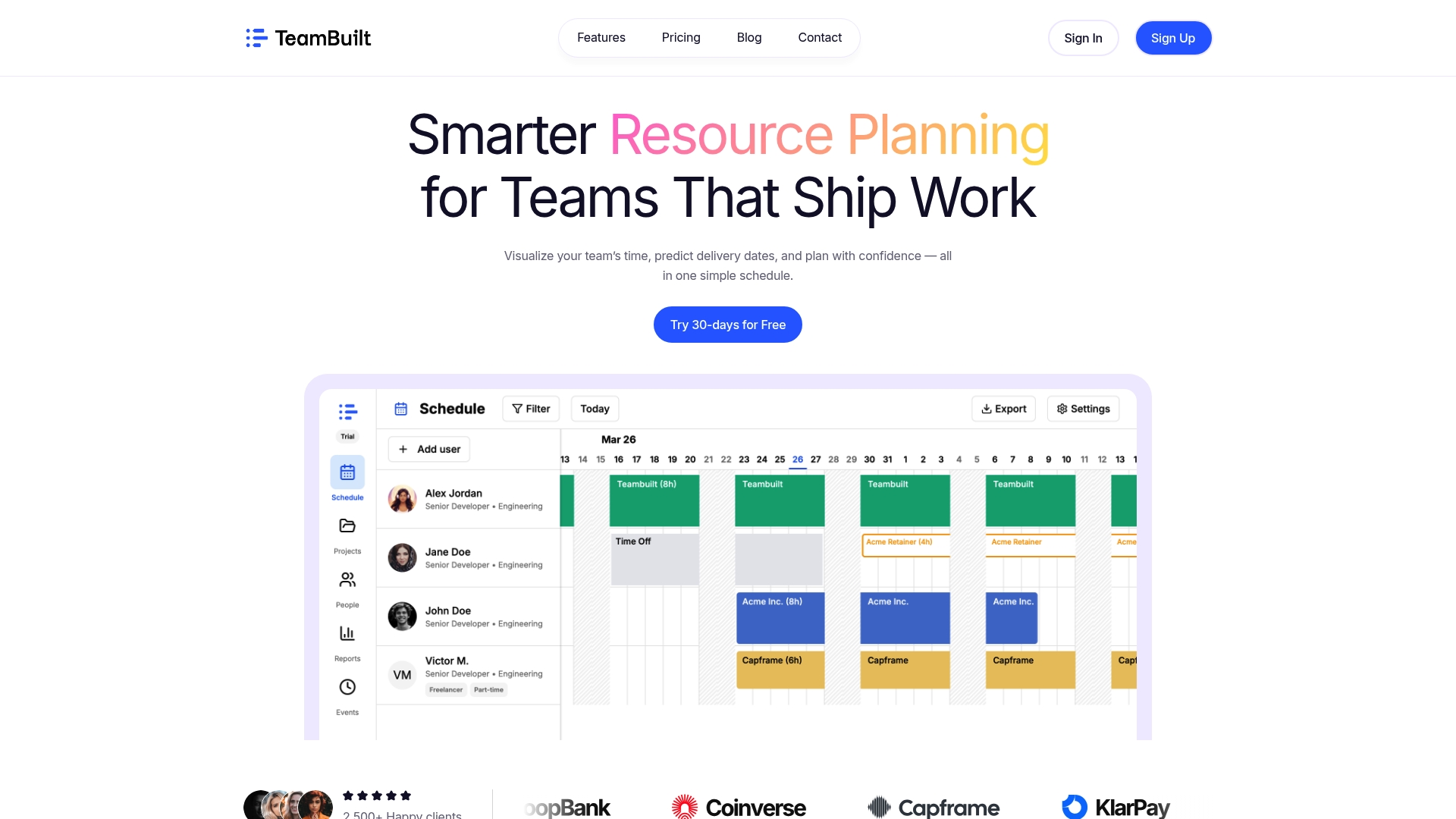
TeamBuilt is built specifically for growing startups and SMBs managing multiple teams. The resource planning features give you workload visualization, capacity tracking, and delivery forecasting in one place, so you can apply the lean coordination principles from this article without rebuilding your stack. From dependency mapping to cross-team scheduling, TeamBuilt replaces the spreadsheet chaos with a centralized, collaborative planning layer your whole organization can actually use.
Frequently asked questions
What does a multi-team manager do?
A multi-team manager coordinates several teams to align goals, resolve dependencies, and ensure effective resource use across projects. The role is less about direct supervision and more about removing blockers and maintaining shared visibility.
How is multi-team management different for startups and SMBs?
Startups and SMBs need lean, flexible coordination that avoids rigid process overhead. Async-driven coordination and adaptive tools matter more than formal frameworks at this scale.
What are the warning signs of multi-team management failure?
Key warning signs include meeting overload, missed dependencies, unclear priorities, and declining engagement scores. Process overload and integration debt are the most common root causes.
Which is the most effective framework for managing multiple teams?
No single framework wins universally. Effective SMBs combine Multi-Team Scrum with lean planning and async tools tailored to their specific team size and delivery context.
Recommended
- Centralized team management: streamline resources, boost predictability | Teambuilt Blog
- Step-by-step team scheduling: optimize projects fast | Teambuilt Blog
- Streamline your team scheduling workflow: max efficiency | Teambuilt Blog
- Dynamic Team Environments: Optimize Collaboration & Resources | Teambuilt Blog