
Project delivery best practices: 8 proven tips for SMBs


TL;DR:
- Using evidence-based practices and modular planning ensures sustainable SMB project growth.
- Hybrid methodologies balance flexibility and predictability suited for scaling SMB teams.
- Regular monitoring, workload management, and simple systems prevent delays and burnout.
Scaling a startup or SMB is exciting until your projects start missing deadlines, budgets balloon, and your team shows signs of burnout. The root cause is almost never a lack of effort. It’s a lack of the right systems. Choosing evidence-based project delivery practices is the single biggest lever you can pull to make growth sustainable. This guide walks you through the most effective strategies, from setting realistic estimates and choosing the right methodology to optimizing your team’s workload and building feedback loops that actually stick.
Table of Contents
- Establish clear project criteria and realistic estimates
- Choose the right delivery methodology for your SMB
- Optimize team resources and workload for scalable delivery
- Monitor, review, and adapt for continuous improvement
- Why most project delivery advice for SMBs misses the mark
- Streamline your project delivery with Teambuilt
- Frequently asked questions
Key Takeaways
| Point | Details |
|---|---|
| Leverage hybrid methods | Combine Agile and Waterfall approaches to balance speed and predictability in SMB project delivery. |
| Optimize team utilization | Maintain 70-85% team capacity, use buffers, and adjust workloads to avoid burnout and boost results. |
| Adopt data-driven reviews | Install regular milestone reviews, use EVM or AI tools, and track performance for continuous improvement. |
| Start with minimum viable PMO | Implement just three high-impact processes quickly to create efficient project management structure. |
Establish clear project criteria and realistic estimates
Every project that goes sideways shares one common early failure: nobody agreed on what “done” actually looks like. Before a single task gets assigned, you need to define success in concrete terms. That means locking in deadlines, budget ceilings, quality benchmarks, and target resource utilization rates. Vague goals produce vague results.
Once your criteria are set, the next challenge is estimating accurately. Most teams fall into the trap of optimism bias, assuming their next project will go smoother than the last. A more reliable approach is reference-class forecasting, which means pulling data from similar past projects to anchor your estimates in reality rather than hope. Pair that with modularizing your deliverables so you’re shipping in increments rather than waiting for one big launch.
Here’s a framework that consistently works for SMB teams:
- Define success criteria before kickoff: deadline, budget, quality, and utilization targets.
- Pull historical data from at least three comparable past projects to calibrate your timeline.
- Break deliverables into modules so each phase can be reviewed and adjusted independently.
- Plan slowly at first, running small experiments to validate assumptions before committing to a full execution sprint.
- Shift to fast execution once the plan is validated and the team is aligned.
Modularizing work also makes it easier to catch scope drift early. When deliverables are small and discrete, it’s obvious when something new gets added without a corresponding adjustment to the timeline or budget. Solid timeline management steps are the backbone of this approach.
“Incremental delivery beats big-bang launches every time. Smaller modules mean faster feedback, fewer surprises, and a team that stays motivated because they’re shipping regularly.”
Pro Tip: Build a project checklist with phase gates at each module handoff. A gate is a simple go/no-go checkpoint where the team confirms the current phase meets criteria before moving forward. This one habit prevents the most common form of scope creep.
You can find concrete workflow productivity examples that show how teams apply these principles in real SMB environments.
Choose the right delivery methodology for your SMB
Not every project needs the same playbook. Picking the wrong methodology is like wearing hiking boots to a sprint race. You’ll finish, but not well.
Agile works best when requirements are likely to change, client feedback loops are frequent, or you’re building toward an MVP. It runs in short iterative sprints of 2 to 4 weeks, which accelerates time-to-market and keeps teams adaptable. The catch is that Agile demands disciplined scope management. Without a change log and clear sprint boundaries, scope creep can quietly blow up your budget.
Waterfall is the right call for fixed-scope projects where requirements are clear from day one. Think compliance rollouts, infrastructure upgrades, or client contracts with rigid deliverable specs. It’s predictable and easy to report on, but it resists change. If the client shifts direction mid-project, you’re in trouble.
Hybrid is where most scaling SMBs land, and for good reason. It borrows Agile’s flexibility for the discovery and iteration phases while using Waterfall’s structure for final delivery and sign-off. This balance is what makes growth sustainable without sacrificing consistency.
| Attribute | Agile | Waterfall | Hybrid |
|---|---|---|---|
| Adaptability | High | Low | Medium-High |
| Learning curve | Medium | Low | Medium |
| Resource use | Flexible | Predictable | Balanced |
| Time-to-delivery | Fast (iterative) | Slower (linear) | Optimized |
Use this checklist to guide your selection:
- Project scope: Is it fixed or likely to evolve?
- Team maturity: Has your team worked in this methodology before?
- Client expectations: Do they want frequent updates or a final deliverable?
- Change tolerance: How costly is a mid-project pivot?
“Agile without scope discipline is just organized chaos. Always pair iterative sprints with a formal change log.”
For practical applications, explore team workflow examples and scalable project workflows that show how SMBs make these decisions in context. You can also compare project management tools that support each methodology.
Optimize team resources and workload for scalable delivery
Even the best methodology fails when your team is overloaded. Resource optimization is where delivery plans either hold together or fall apart.
The sweet spot for team utilization is 70 to 85%. Below 70%, you’re leaving capacity on the table. Above 85%, you’re burning people out and creating quality risk. This isn’t a soft guideline. It’s a hard operational target that directly affects turnover, delivery speed, and morale.

Beyond utilization rates, you need to build time buffers into your project phases. Complex tasks should carry a 20 to 30% buffer to absorb unexpected delays without cascading into the whole timeline. Weekly milestone reviews let you recalibrate workloads quickly before small slippage becomes a missed deadline.
| Team size | Target utilization | Recommended buffer | Review cadence |
|---|---|---|---|
| 1 to 5 people | 75-80% | 25-30% | Weekly |
| 6 to 15 people | 70-80% | 20-25% | Weekly |
| 16 to 30 people | 70-75% | 20% | Bi-weekly |
Practical steps to optimize right now:
- Audit current workloads against the 70 to 85% target.
- Identify any team members consistently above 85% and redistribute tasks.
- Add explicit buffer time to each phase in your project plan.
- Schedule weekly check-ins focused specifically on workload, not just task status.
Pro Tip: Rotate high-focus, high-intensity work weeks with lighter weeks whenever your project phases allow it. Teams that get predictable recovery time sustain high performance far longer than those grinding at full capacity every week.
Scheduling software gives you real-time visibility into where strain is building before it becomes a problem. A solid team scheduling guide can show you how to set this up. For deeper context, resource allocation workflows and dynamic collaboration strategies offer additional frameworks worth applying.
Monitor, review, and adapt for continuous improvement
Delivering one project well is a win. Delivering consistently, at scale, quarter after quarter, is a system. That system depends on structured monitoring and honest reviews.
Weekly milestone reviews are the single most underused tool in SMB project management. They create a forcing function: every week, the team has to answer whether the project is on track. If it’s not, you fix it now rather than discovering the problem at the final deadline. Empirical benchmarks show that poor monitoring practices are a primary driver of project failure across industries.
More than 50% of SMB projects miss their deadlines when regular milestone reviews aren’t in place. That’s not a statistic to file away. It’s a mandate to act.
For teams ready to go deeper, Earned Value Management (EVM) is a proven technique that tracks both cost and schedule performance in a single metric. Pair it with AI-powered risk tools that flag emerging issues before they escalate, and you have a monitoring stack that actually prevents problems rather than just documenting them.
Another high-impact move: adopt a minimum viable PMO (MVPMO) approach. Instead of building out a full project management office, identify the three highest-impact services your team needs most and roll those out in the first 8 weeks. You get real value fast without the overhead of a complex PMO structure.
Feedback and monitoring tactics to implement this quarter:
- Set weekly milestone reviews on a fixed day and make attendance non-negotiable.
- Introduce EVM tracking for any project over 8 weeks in duration.
- Pilot one AI risk monitoring tool on your most complex active project.
- Launch your MVPMO with three services: status reporting, risk tracking, and resource visibility.
- Run a retrospective after every project phase, not just at the end.
For teams building these habits, a real-time collaboration guide and workflow automation insights offer practical next steps.
Why most project delivery advice for SMBs misses the mark
Here’s the uncomfortable truth: most project management content is written for enterprises with dedicated PMOs, large budgets, and teams of specialists. When SMBs try to apply those frameworks, they don’t just fail to see results. They actively slow down.
Complex toolkits and heavyweight methodologies create overhead that small teams can’t absorb. The irony is that the more process you add, the less time your team spends actually delivering. We’ve seen this pattern repeatedly: a scaling startup adopts an enterprise framework, spends three months configuring it, and ends up slower than before.
The better path is intentional simplicity. Hybrid methods, minimum viable processes, and regular iteration beat elaborate systems every time in an SMB context. Agency workflows built for SMBs are a good reference point for what lean but effective looks like in practice.
Pro Tip: Every quarter, review your active processes and retire any that aren’t delivering clear value. Processes accumulate like debt. If you’re not actively pruning them, they’re slowing you down.
The teams that consistently deliver well aren’t the ones with the most sophisticated systems. They’re the ones with the clearest criteria, the most honest reviews, and the discipline to keep things simple.
Streamline your project delivery with Teambuilt
Applying these best practices is far easier when your tools are built for the way SMB teams actually work. TeamBuilt’s resource planning features are designed specifically for organizations managing multiple teams and complex workflows, giving you real-time visibility into capacity, utilization, and delivery timelines in one place.
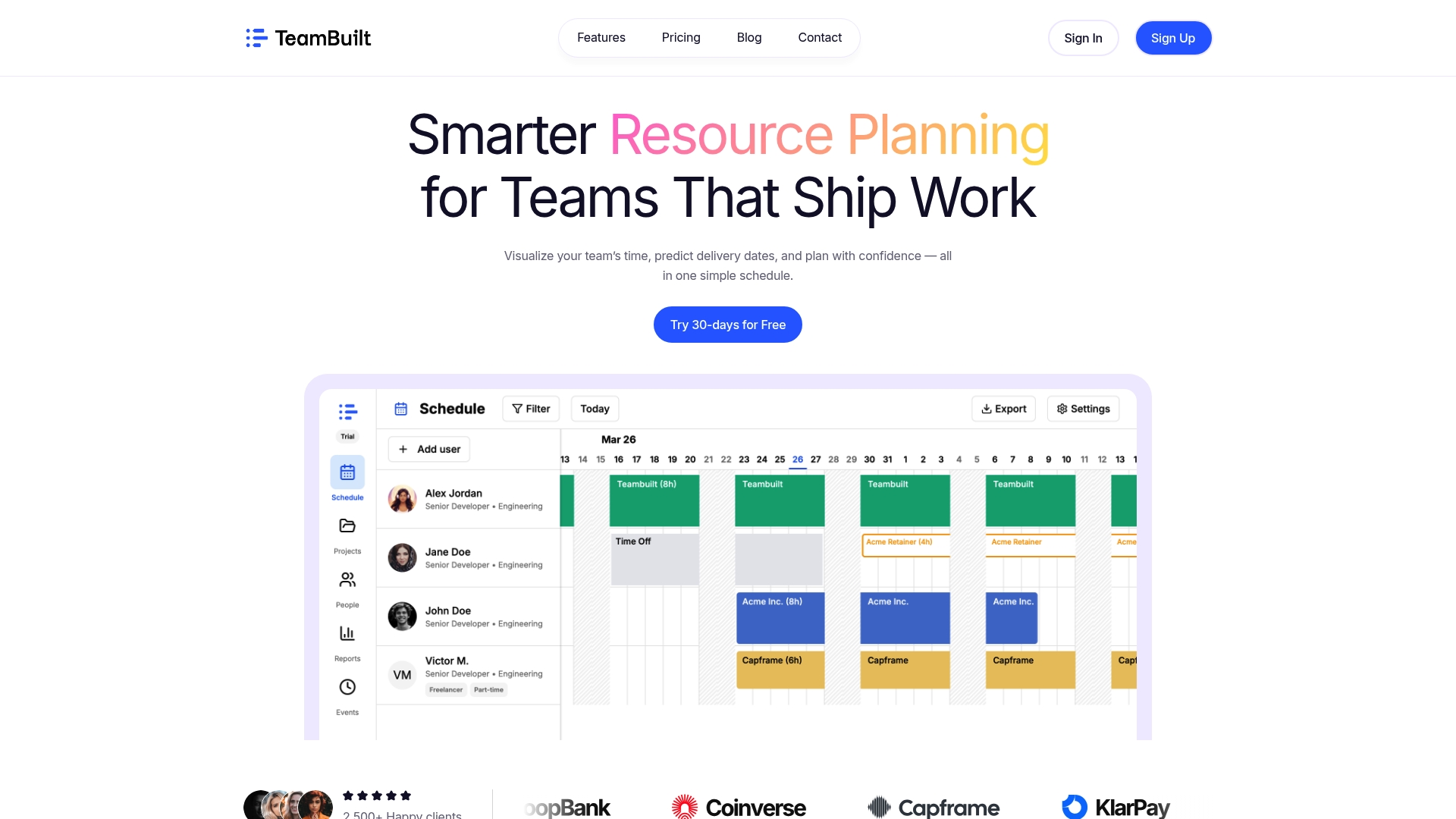
From hybrid workflow support to live scheduling and utilization tracking, TeamBuilt replaces the spreadsheets and scattered tools that hold growing teams back. If you’re ready to move from reactive firefighting to proactive, data-driven project delivery, get started with TeamBuilt and see how a centralized planning platform changes the way your team operates.
Frequently asked questions
What project delivery methodology is best for a scaling SMB?
Hybrid methods that blend Agile flexibility with Waterfall structure work best for SMBs that need fast iterations but also require predictability. They give you the speed of sprints without sacrificing delivery consistency.
How can I prevent my team from burning out on projects?
Keep team utilization rates between 70 and 85%, build buffers into your timelines, and rotate workloads to avoid repeat crunch periods. Consistent recovery time is what makes high performance sustainable.
Why do so many SMB projects miss their deadlines?
A lack of regular milestone reviews and data-driven monitoring tools leads to slippage that compounds until it becomes a missed deadline. Weekly check-ins catch problems while they’re still small.
What is the fastest way to implement PMO practices in an SMB?
Start with a minimum viable PMO and roll out 3 high-impact services in the first 8 weeks for quick, sustainable improvement. Focus on status reporting, risk tracking, and resource visibility first.
Recommended