
Real-time collaboration: Guide for efficient project teams

TL;DR:
- Real-time collaboration reduces version chaos, accelerates project completion, and improves team alignment.
- Technologies like WebSockets, OT, and CRDTs enable instant updates, conflict resolution, and offline support.
- Successful adoption depends on workflow modeling, proper tool choice, and clear process integration rather than feature sets.
Real-time collaboration is one of those terms that gets thrown around constantly, yet most teams only scratch the surface of what it actually delivers. It’s not just about seeing someone else’s cursor move across a shared doc. The real story is about eliminating version chaos, cutting coordination overhead, and giving distributed teams a single source of truth that updates instantly. When you understand how these tools work under the hood, and how to adopt them deliberately, you unlock a measurable shift in how fast your team ships work and how clearly everyone stays aligned.
Table of Contents
- What real-time collaboration actually means
- How it works: The tech behind real-time tools
- Benefits and challenges for project teams
- Choosing and implementing real-time collaboration platforms
- The real key to unlocking collaboration: Lessons for PMs and ops leads
- Drive efficiency with TeamBuilt’s real-time collaboration features
- Frequently asked questions
Key Takeaways
| Point | Details |
|---|---|
| Instant team alignment | Real-time collaboration ensures everyone sees updates immediately, reducing version chaos and miscommunication. |
| Tech choice matters | Understanding OT and CRDT technology helps match tools to your team’s workflow and offline needs. |
| Efficiency gains | Adopting real-time platforms delivers up to 23% faster project completion and cuts costly context switching. |
| Adoption over features | Focus on how well your team adopts new tools rather than just comparing long lists of features. |
What real-time collaboration actually means
At its core, real-time collaboration enables multiple users to edit shared content simultaneously, with changes propagating instantly across every connected client. That sounds simple. In practice, it’s one of the harder engineering problems in modern software, and understanding why helps you make smarter tool choices.
Think about what has to happen when two people edit the same document at the same time. Their changes need to arrive in the right order, not overwrite each other, and resolve conflicts without either person losing work. The system also needs to handle slow connections, brief network drops, and the fact that people work across different time zones. Four core challenges sit at the heart of every real-time system:
- Latency: Changes must feel instant, typically under 100 milliseconds, or the experience breaks down
- Consistency: Every user must eventually see the same state, even if they edited simultaneously
- Presence: Showing who is active, where they are in the document, and what they’re doing
- Offline support: Allowing edits when disconnected, then merging cleanly when reconnected
Before real-time tools became mainstream, teams managed shared work through email attachments, shared drives, and manual version naming. The result was “version chaos”: conflicting files, lost edits, and hours spent reconciling changes. Real-time team coordination eliminates that friction by making the document itself the single, live source of truth.
The payoff is real. Teams using structured collaboration platforms report 23% faster project completion compared to those relying on fragmented tools. That’s not a marginal gain. For a 10-person agency running 20 concurrent projects, that kind of velocity difference compounds fast.
Pro Tip: Don’t evaluate a real-time tool by its feature list alone. Test how it handles conflict resolution when two people edit the same field simultaneously. That stress test reveals more about reliability than any demo ever will.
Figma is a useful example here. How Figma powers collaboration at scale shows what’s possible when conflict resolution is built into the architecture from day one, rather than bolted on afterward.
How it works: The tech behind real-time tools
Now that we’ve established why real-time matters, here’s how the core technologies actually make it possible.
Every real-time tool relies on a persistent, low-latency connection between the client and the server. Traditional HTTP requests are one-directional: you ask, the server answers. WebSockets flip that model by keeping a two-way channel open, so the server can push updates to every connected client the moment a change occurs. This is what makes the experience feel live rather than refreshed.
But WebSockets are just the transport layer. The harder problem is what happens when two people make conflicting edits at the same millisecond. Two main algorithms handle this:
- Operational Transformation (OT): A central server receives all edits, transforms them into a consistent order, and distributes the resolved version. OT maintains consistency through a central authority, which is why Google Docs uses it for text editing where order matters precisely.
- CRDTs (Conflict-free Replicated Data Types): These are data structures that merge automatically without central authority, making them ideal for offline-first tools. Figma and Notion use CRDTs because design and structured content can tolerate a more flexible merge model.
Here’s a quick comparison to make the tradeoffs concrete:
| Feature | OT | CRDT |
|---|---|---|
| Conflict resolution | Central server | Decentralized, automatic |
| Offline support | Limited | Strong |
| Best for | Text editing | Design, docs, structured data |
| Complexity | High (server-side) | High (data structure design) |
| Examples | Google Docs | Figma, Notion |
For project timeline management, the practical implication is this: tools built on CRDTs tend to handle distributed, async teams better, while OT-based tools shine in low-latency, centralized editing scenarios.
“The choice between OT and CRDTs isn’t about which is better. It’s about which fits your team’s workflow, connectivity, and data model.”
Pro Tip: When evaluating platforms, ask vendors directly which algorithm they use and how they handle real-time data synchronization during network partitions. Vague answers are a red flag.
Benefits and challenges for project teams
Having demystified the tech, let’s look at the concrete benefits and obstacles real-time tools create for project managers and operations leads.

The benefits are well-documented. Teams using Asana and monday.com report 23% faster project completion and 84% adoption rates. Context switching, one of the most underestimated productivity drains, costs the average employee 32 days per year. Real-time tools reduce that by keeping everyone in a shared workspace rather than bouncing between email threads, spreadsheets, and chat.

Here’s how the core benefits break down by team function:
| Benefit | Impact for PMs | Impact for ops leads |
|---|---|---|
| Instant visibility | See blockers as they happen | Reallocate resources without lag |
| Fewer status meetings | Replace standups with live boards | Reduce coordination overhead |
| Single source of truth | No version conflicts | Accurate reporting at all times |
| Faster feedback loops | Clients review live, not via email | Shorter approval cycles |
But real-time tools also introduce new risks that teams often ignore:
- Rapid concurrent edits can create race conditions in tools with weak conflict resolution
- Network partitions can cause state divergence if the tool doesn’t handle offline gracefully
- Over-reliance on presence features can create a false sense of alignment without actual coordination
- Tool sprawl happens when teams adopt multiple real-time platforms without a clear workflow map
Different teams need different tool types. Visual teams doing design work thrive on CRDT-based platforms. Structured project management benefits from agency project workflows built around task-based tools with clear ownership. Mixing both without a plan creates confusion, not clarity.
Learning from collaborative writing tools research shows that adoption, not features, drives outcomes. Teams that invest in onboarding and process clarity see dramatically better results than those that simply hand out licenses.
Pro Tip: Before rolling out any real-time tool, map your existing workflow on paper first. Identify where handoffs break down and where information gets lost. Then pick a tool that fixes those specific gaps, not the most feature-rich option on the market. Workflow automation examples can help you spot those gaps faster.
Choosing and implementing real-time collaboration platforms
With benefits and challenges clear, here’s how to select and roll out real-time platforms for your team.
The selection process matters more than most teams realize. Picking the wrong tool based on a flashy demo costs months of lost productivity and trust. Here’s a structured approach:
- Map your workflow first. Write down every step from project kickoff to delivery. Note where information gets stuck, duplicated, or lost. This is your baseline.
- Identify your data model. Are you primarily editing text, managing tasks, designing visuals, or tracking resources? Your answer determines whether OT or CRDT-based tools fit better.
- Run a focused pilot. Choose one project type and one team. Test the tool for four weeks. Measure adoption, not just usage. Are people choosing to use it, or being forced to?
- Watch for technical pitfalls. Designing reliable real-time systems reveals common failure points: tombstone bloat in CRDTs (deleted data that accumulates and slows performance), timing bugs in OT implementations, and state divergence during network drops.
- Integrate, don’t replace everything at once. Connect new tools to existing systems via API before retiring old ones.
For startups and agencies specifically, prioritize CRDT-based tools like Figma or Notion for design and documentation, and structured PM tools like Asana or monday.com for task tracking. The goal is reducing coordination overhead, not maximizing feature count.
A practical checklist for tool selection:
- Does it support your team size without performance degradation?
- How does it handle offline editing and reconnection?
- What conflict resolution model does it use?
- Does it integrate with your existing stack via open API?
- What does onboarding look like for non-technical team members?
Pro Tip: Explore centralized planning tools that combine resource visibility with real-time editing. Platforms that show you who is working on what in real time, alongside capacity data, eliminate a whole category of coordination meetings. Check resource planning features to see what that looks like in practice.
The real key to unlocking collaboration: Lessons for PMs and ops leads
Here’s the take that most collaboration guides skip entirely: the technology is the easy part.
Every major real-time platform available today is technically capable. WebSockets work. CRDTs merge correctly. OT resolves conflicts. The reason teams still struggle with coordination, missed deadlines, and information silos isn’t because their tools are broken. It’s because they never modeled their workflows before adopting the tools.
Designing reliable collaboration systems makes this explicit: model workflows before building the UI, separate local optimistic state from authoritative state, and plan for CRDT pitfalls like tombstone bloat from day one. That’s engineering advice, but it applies directly to how PMs should think about rollouts.
Most teams do the opposite. They buy the tool, run a quick demo, and expect behavior change to follow. It doesn’t. The teams that see real efficiency gains from real-time collaboration are the ones who treated adoption as a project in itself, with clear success metrics, a defined pilot scope, and a guide for agency workflows that maps to how their teams actually operate. Process clarity before platform selection. Every time.
Drive efficiency with TeamBuilt’s real-time collaboration features
Putting these lessons into practice is exactly where TeamBuilt can help your team move faster without adding complexity.
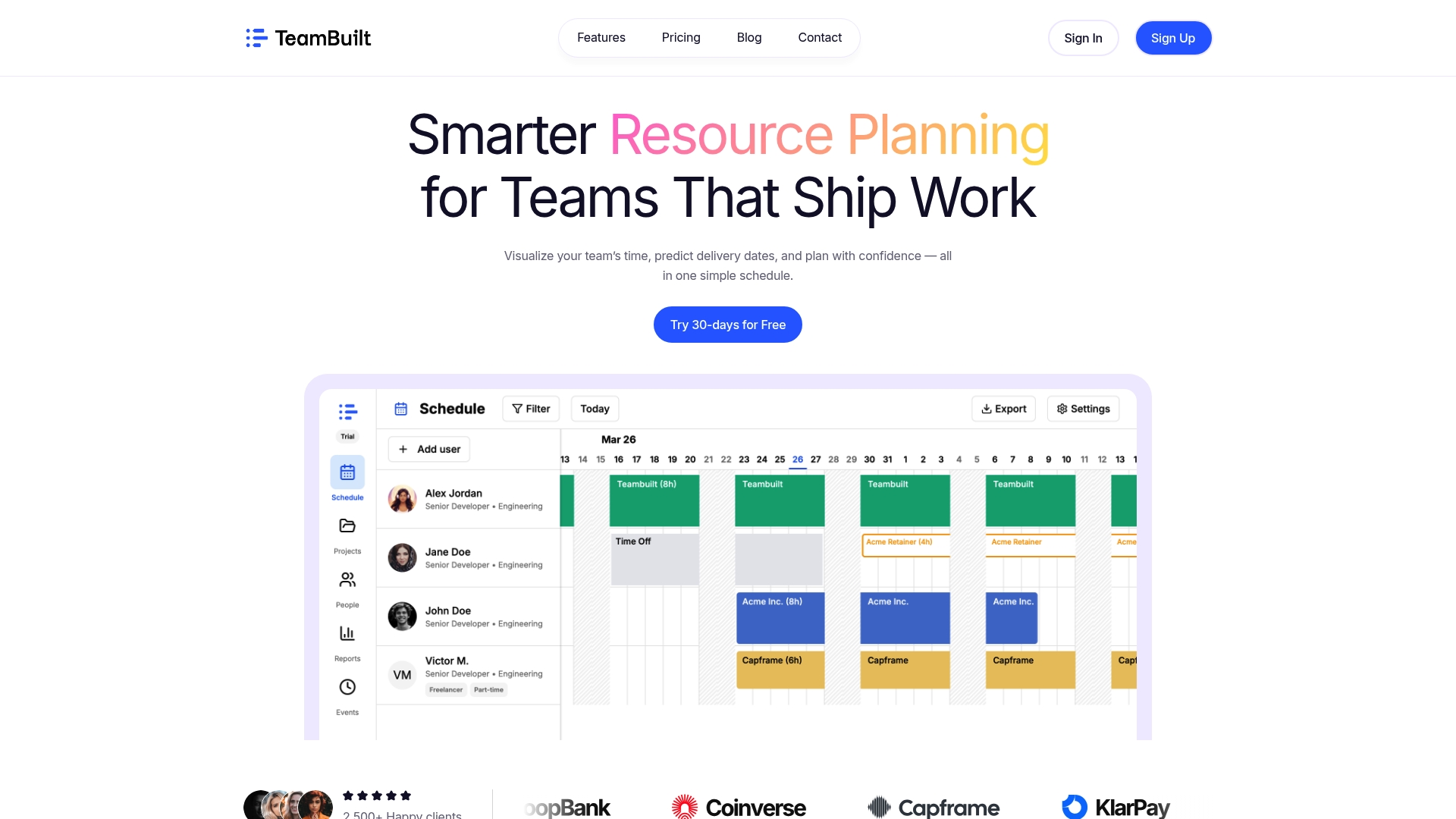
TeamBuilt combines real-time scheduling, workload visualization, and resource planning into a single platform built for agencies and growing startups. You get live visibility into who is available, what’s at risk, and where capacity is being wasted, all in one place. Instead of stitching together five tools, your team works from a shared, always-current view of every project and every person. Explore the full set of real-time features or see how the team planning platform fits your existing workflow. No spreadsheets. No coordination lag. Just clarity.
Frequently asked questions
What makes a collaboration tool ‘real-time’?
A real-time tool uses persistent low-latency connections and conflict resolution algorithms to push instant updates across clients the moment any user makes a change, without requiring a manual refresh.
Is CRDT or OT better for distributed teams?
CRDTs offer stronger offline and decentralized support, making them better for distributed or async teams, while OT is the stronger choice for centralized, low-latency text editing with a reliable connection.
How much efficiency can real-time collaboration tools deliver?
Teams consistently report 23% faster project completion and recover up to 32 days per employee annually that would otherwise be lost to context switching between disconnected tools.
Should startups build their own real-time tools or use SaaS?
Almost always use SaaS. Building from scratch requires deep expertise in OT or CRDT implementation, ongoing maintenance, and significant engineering time that most startups can’t justify when proven platforms already exist.
Recommended